...

By Ryan Chan
China News Reporter
0
Share
Newsweek is a Trust Project member
See more of our trusted coverage when you search.Prefer Newsweek on Googleto see more of our trusted coverage when you search.
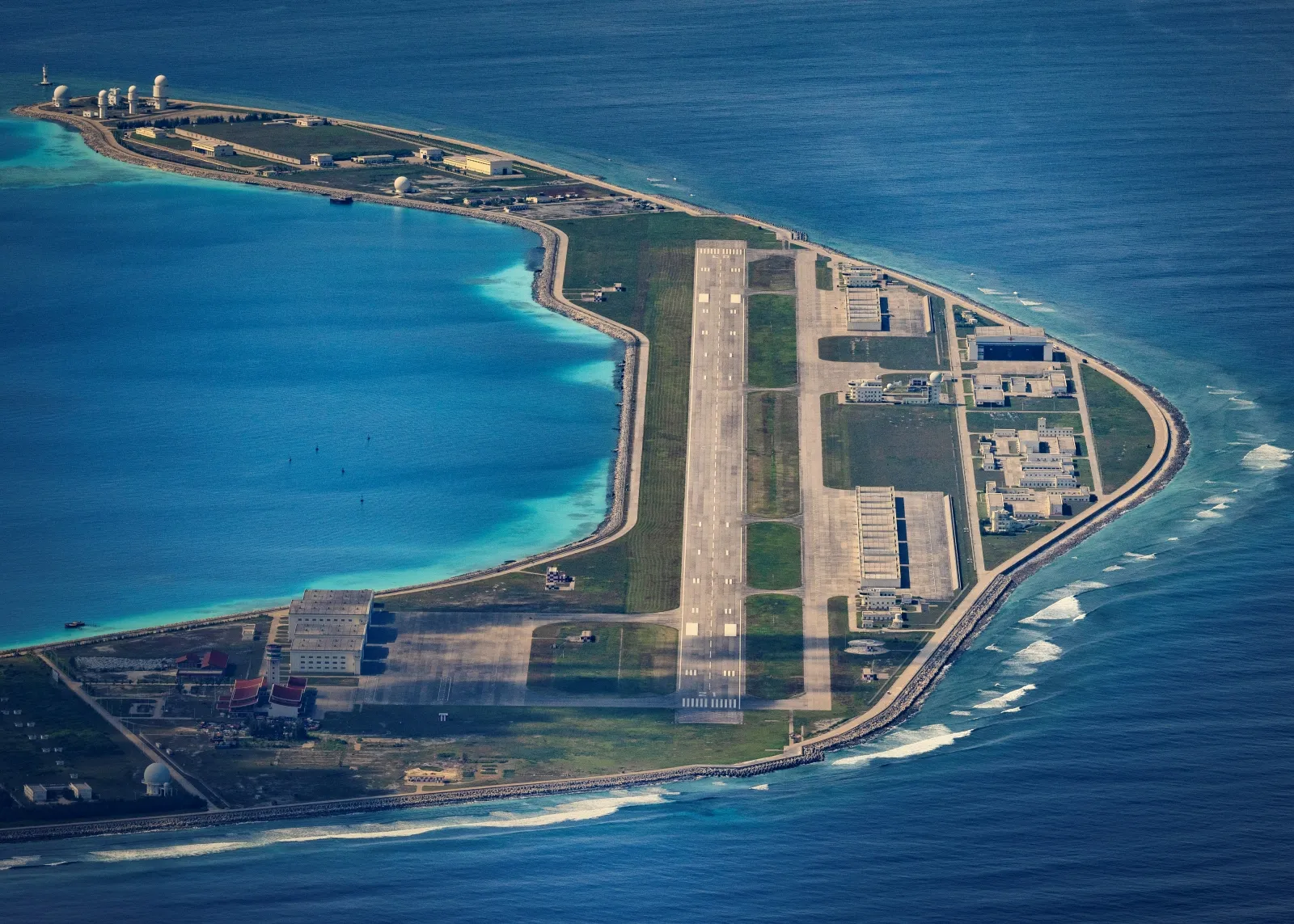
China continues to strengthen its control over the hotly contested South China Sea, as recent analysis of satellite imagery appears to show that its artificial island outposts in the region have bolstered their intelligence, electronic warfare and defensive capabilities.
The Chinese Foreign Ministry did not immediately respond to a request for comment.
Why It Matters
Citing what it describes as "historic rights"—which The Hague-based Permanent Court of Arbitration ruled in 2016 had no legal basis—China asserts sovereignty over most of the maritime features in the South China Sea, overlapping with its neighbors' claims.
Read More on World
As part of its efforts to tighten control over the waters, China maintains a persistent presence of naval and coast guard vessels, supported by reefs that have been expanded into outposts with military infrastructure, including aviation and defensive facilities.
China's assertive activities and excessive maritime claims in the South China Sea have been challenged by the United States, which has deployed warships to conduct freedom of navigation operations and patrols with allies and partners, including the Philippines.
What To Know
The Asia Maritime Transparency Initiative at the Center for Strategic and International Studies said on Tuesday that it observed new facilities on China's so-called big-three island outposts in the Spratly Islands: Fiery Cross Reef, Mischief Reef and Subi Reef.
All three reefs have undergone extensive reclamation since 2015, according to satellite images shared by the Washington, D.C.-based think tank. The reclaimed area of Fiery Cross Reef, Mischief Reef and Subi Reef is 677, 1,379 and 976 acres, respectively.
Regarding the latest facilities installed from 2023 through 2024 on the three outposts, the Asia Maritime Transparency Initiative said they were likely to support vehicle-deployed electronic warfare or intelligence, surveillance and reconnaissance (ISR) systems.
On Subi Reef, two new radomes were placed, appearing to be "nearly identical" to those that had been built on Fiery Cross Reef and Mischief Reef since 2017. The radomes are believed to provide broad, overlapping coverage in the South China Sea.
Meanwhile, the Asia Maritime Transparency Initiative found that three sets of three emplacements were built on Mischief Reef in 2023, likely to accommodate road-mobile weapons platforms, including artillery or rocket systems, to defend the outpost.
In addition to China, Vietnam has expanded reclamation efforts on maritime features in the Spratly Islands under its control. The Chinese Foreign Ministry said it opposed construction activities by other countries on islands and reefs they "illegally occupy."
...
What People Are Saying
The Asia Maritime Transparency Initiative at the Center for Strategic and International Studies said in a report published on Tuesday: "These upgrades underscore the fact that a major function of China's bases is to provide unparalleled ISR coverage of the South China Sea, supporting the operations of China's coastguard and navy in peacetime and allowing Beijing to contest the use of the electromagnetic spectrum by others in the event of a conflict."
A spokesperson for China's Foreign Ministry said in July: "China's position on the '2016 Arbitral Award on the South China Sea' is consistent and clear. The 'award' is nothing but a piece of waste paper that is illegal, null and void, and non-binding. China neither accepts nor recognizes the 'award,' and will never accept any claim or action arising from the award. China's territorial sovereignty and maritime rights and interests in the South China Sea will not be affected by the 'award' in any way."
What Happens Next
It remains to be seen whether Vietnam will follow China's footsteps in enhancing the military capabilities of its outposts.
View 0 Comments
Submit Correction
View Editorial & AI Guidelines