...

By Jenni Fink
Senior Editor
0
Share
Newsweek is a Trust Project member
See more of our trusted coverage when you search.Prefer Newsweek on Googleto see more of our trusted coverage when you search.
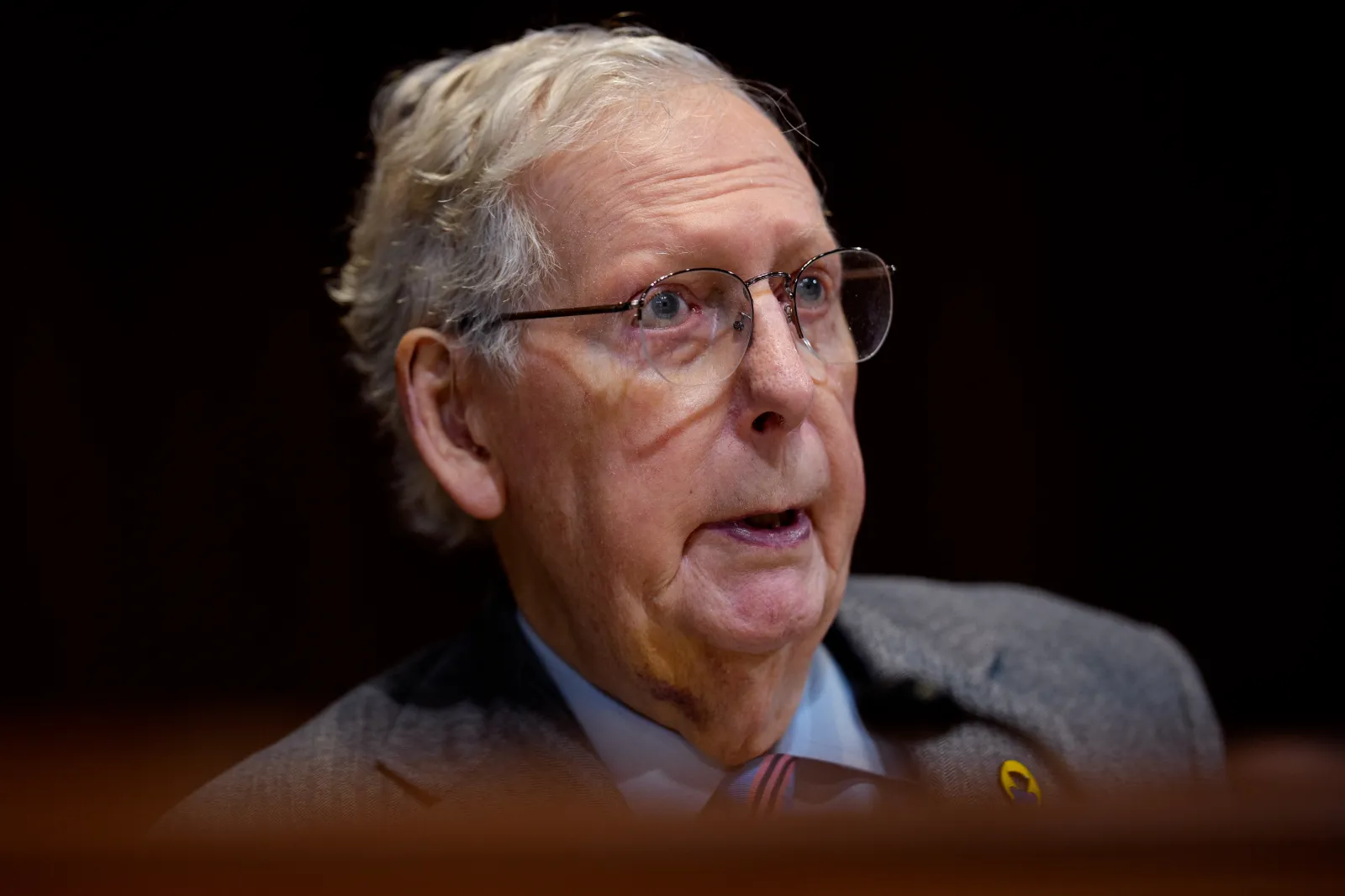
For the first time in more than four decades, Kentucky voters are choosing a new U.S. senator without longtime incumbent Mitch McConnell on the ballot, and Democrats are hoping to seize the opportunity to flip the seat.
McConnell, first elected in 1984, announced in February 2025 that he wouldn't seek reelection after becoming the longest-serving Senate party leader in American history. Once a firm ally of Donald Trump, McConnell's brand of conservatism started to clash with the president, a rift that has loomed large over the race. While a long shot, the open seat gives Democrats an opportunity they haven't had in decades at a time when Republicans can't afford to lose any seats in the Senate.
The open seat created a crowded primary for both Republicans and Democrats, with several candidates on both sides campaigning hard to become their party's nominee.
Read More on Politics
While McConnell once helped push through Trump’s legislative agenda and confirm his judicial nominees, their relationship deteriorated following the January 6, 2021, attack on the U.S. Capitol and subsequent disagreements over policy and party direction. That tension shaped the fight to replace him. Republican candidates have walked a careful line—acknowledging McConnell’s influence while distancing themselves from him—and have instead competed for Trump’s endorsement, widely seen as decisive in the state.
Trump pick Andy Barr on Tuesday was declared the winner for the Republican seat by the Associated Press, with an overwhelmingly higher margin than his opponents Daniel Cameron, George Washington, Michael James Faris and Valerie Frederick. Barr had garnered a total of 275,773 votes, accounting for 60.4 percent. His closest opponent, Cameron, won 140,915, 30.9 percent of the vote.
On the Democratic side, the contest coalesced around two familiar names: Charles Booker and Amy McGrath. Both candidates had previously run statewide and argued that McConnell’s exit offered a narrow opening to flip a reliably red seat.
Booker won the Democratic ticket, leading the pack with 47.1 percent of the vote but faces an uphill battle to win the election. Kentucky has not elected a Democratic senator since the 1990s, and nonpartisan race ratings continue to place the seat firmly in the Republican column.
Republicans are the clear favorites to win the election, regardless of who the nominee is. Kalshi has Republican chances at 93 percent, compared to Democrats' 6.6 percent chances. Polymarket showed similar odds, with Republicans at 95 percent and Democrats at 4 percent.
Polls have largely focused on the partisan primaries, and there haven't been polls conducted about the general election, yet, this year, but polls from last year from one of the campaigns shed some light on the matchups.
Kentucky Voting History
Kentucky’s modern electoral history is a study in split‑ticket instincts and shifting partisan identities.
The state has not elected a Democratic U.S. senator since 1992, when Wendell Ford won his final term, reflecting a long‑running nationalization of federal races in which Kentucky voters have increasingly favored Republicans for Congress and the presidency.
Yet those same voters have repeatedly shown a willingness to back Democrats for state leadership.
In the last five gubernatorial elections, Democrats have won four, including consecutive victories by Steve Beshear (2007, 2011) and his son Andy Beshear (2019, 2023).
Analysts often note that gubernatorial contests in Kentucky tend to revolve around local issues—public education, pensions, disaster response and the state’s economic development—rather than the national ideological battles that dominate Senate races.
The result is a political landscape where federal and state outcomes diverge sharply, underscoring Kentucky’s tradition of evaluating candidates differently depending on the office they seek.
Odds
Cook Political Report’s “Solid Republican” rating—paired with its R+7 partisan lean for the 2026 Kentucky Senate race—underscores just how structurally difficult the state has become for Democrats in federal contests.
A “solid” designation signals that, based on historical voting patterns, fundraising, candidate strength and national political environment, analysts see no clear path for a competitive race at this stage.
The R+7 figure is not a prediction of the outcome but a measure of the state’s underlying partisan tilt in federal elections, meaning Republicans typically start with a built‑in advantage of about 7 points before any campaign dynamics are factored in.
That structural edge helps explain why Kentucky has consistently elected Republicans to the Senate for more than three decades, even as voters have shown a willingness to choose Democrats for the governor's seat.
The rating also reflects a broader national trend: Federal races have become more polarized and more closely aligned with presidential voting patterns, leaving states like Kentucky far less elastic at the Senate level than in statewide executive contests.
...
Charles Booker’s Chances vs. Andy Barr
For Booker, a former Kentucky state representative, a general election against Representative Andy Barr likely presents the most uphill battle for Democrats.
Barr emerged as the early front-runner on the Republican side, bolstered by an endorsement from Trump. That backing has already reshaped the race, with Trump's endorsement convincing entrepreneur Nate Morris to drop out to help consolidate support behind Barr. An Emerson College poll from April found that 46 percent of Republicans would be more likely to vote for a candidate endorsed by Trump. However, it's not make-or-break for a candidate. Forty-one percent said Trump's endorsement would have no impact, and 13 percent said it would make them less likely to vote for a candidate.
Polling in early 2026 showed Barr leading the GOP primary field, with support levels around the high 20s, while Booker led the Democratic field with roughly one-third of likely voters, according to a poll from Emerson College. A Booker-Barr matchup is going to center on sharply contrasting political visions. Booker, a progressive, has built his campaign on expanding economic justice programs and mobilizing younger and more diverse voters.
Barr, by contrast, has aligned closely with Trump’s agenda and emphasized traditional conservative priorities, including tax cuts and national security policies.
A December poll from Booker's campaign found Barr to be his most formidable opponent. In a hypothetical matchup between Booker and Barr, Booker got 38 percent of the vote compared to Barr's 49 percent.
The challenge for Booker would be scaling his coalition beyond Democratic strongholds like Louisville and Lexington. Even in prior runs—including his 2022 Senate bid against Senator Rand Paul—he struggled to make inroads in rural areas that dominate Kentucky’s electorate.
Barr’s advantage would likely come from both party alignment and geography. Kentucky has voted decisively for Trump in recent presidential elections, giving Republicans a strong baseline advantage.
Still, Booker could attempt to reframe the race in terms of economic frustration and dissatisfaction with Washington. Polling has shown significant disapproval of McConnell among voters, suggesting potential openness to change. Frustrated Republican voters may end up staying home or not voting, which would give Democrats a better chance to win, particularly if Democratic voters in Kentucky feel there's an opportunity to flip the seat.
View 0 Comments
Submit Correction
View Editorial & AI Guidelines