...

By Jordan King
Reporter
0
Share
Newsweek is a Trust Project member
See more of our trusted coverage when you search.Prefer Newsweek on Googleto see more of our trusted coverage when you search.
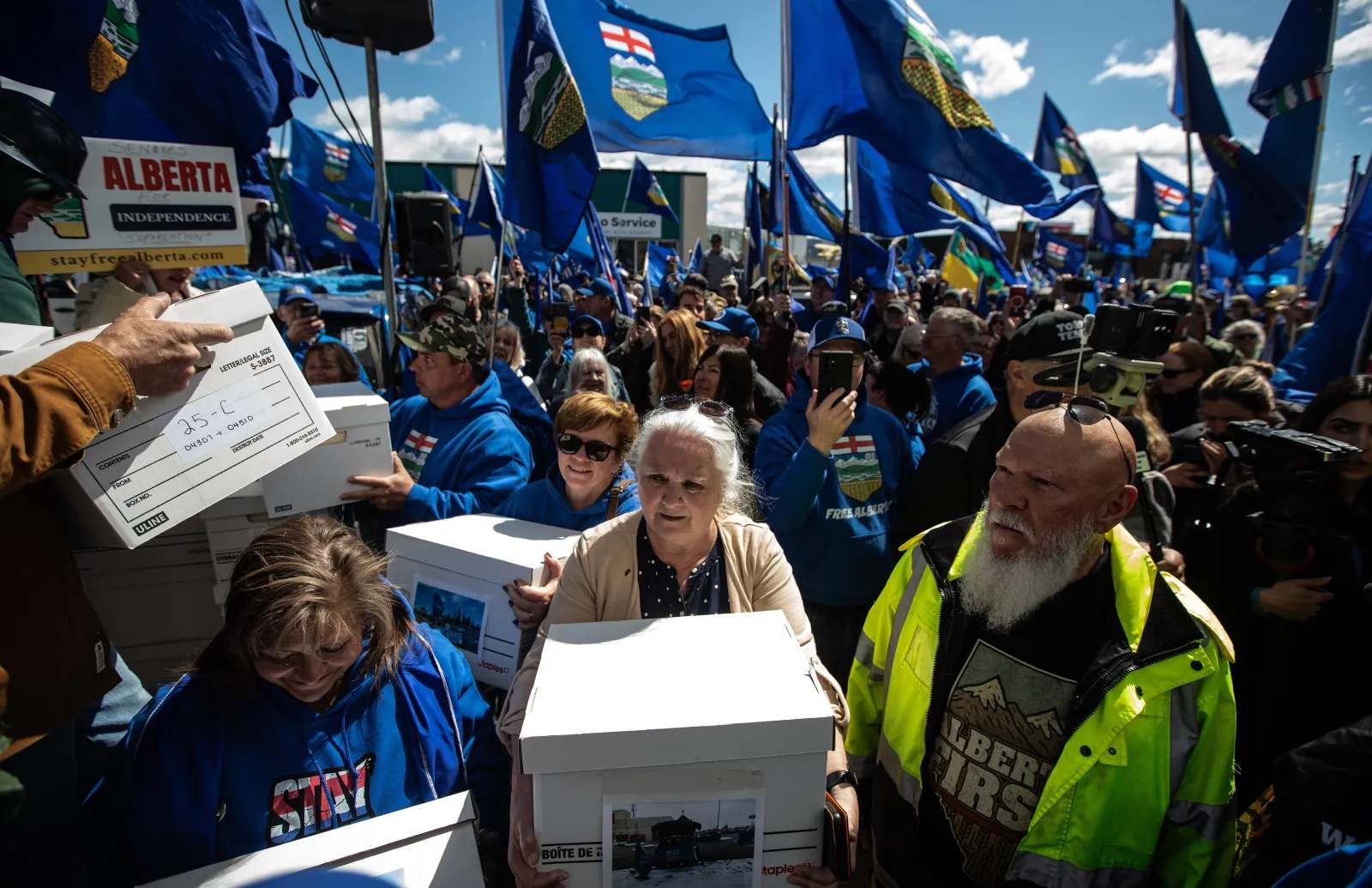
Alberta separatists say they have submitted enough signatures to trigger a citizen-led referendum on whether the province should leave Canada, though a court order has paused verification of the petition.
The effort matters now because it marks the most advanced procedural step yet toward a potential independence vote, even as legal challenges and administrative hurdles leave the process unresolved.
If the signatures are ultimately validated, Alberta voters could face a referendum as early as this fall, a development that would carry political, legal, and economic implications for the province and for Canada.
Read More on News
Stay Free Alberta said it submitted nearly 302,000 signatures to Elections Alberta on Monday—well above the roughly 178,000 required to advance a citizen initiative—according to the Associated Press. However, a judge has temporarily halted the verification process while First Nations groups challenge the legality of the referendum effort in court, and provincial officials told Newsweek that no next steps can proceed until both the legal review and an official authenticity check are completed.
What Has to Happen Next
For a referendum to move forward, the court-ordered pause would need to be lifted and Elections Alberta would need to formally verify the submitted signatures. If those steps are completed, the provincial government could then set a referendum question and establish a voting date, with a vote possible as early as October 19, the Associated Press reported.
Premier Danielle Smith has said she would move ahead with a referendum if enough valid signatures are collected, though she has stated she does not personally support independence for the oil-rich province.
“Our government has been clear: we support a strong and sovereign Alberta within a united Canada,” Sam Blackett, press secretary for Smith’s office, told Newsweek.
“This means Alberta remaining a province of Canada while advancing provincial autonomy and fighting to undo Ottawa policies that harm Albertans and intrude on our constitutional rights.”
Blackett added that Smith’s office is awaiting a court decision before Elections Alberta can begin verifying signatures and said any further action would depend on that outcome.
Legal Challenges From First Nations
Last month, Justice Shaina Leonard ruled that separatist organizers could continue collecting signatures but ordered that Elections Alberta could not verify them until a broader legal challenge is resolved.
Lawyers representing several First Nations argue that Alberta's separation from Canada would infringe on constitutionally protected treaty rights, according to Global News. Section 35 of Canada’s Constitution recognizes and affirms existing Aboriginal and treaty rights.
Alberta’s Minister of Indigenous Relations, Raja Sawhney, told Newsweek that the province’s position on treaty rights has not changed.
“Building and maintaining relationships with First Nations leadership and communities continues to be a priority for Alberta’s government,” Sawhney said. “We value these relationships and remain committed to transparency, collaboration, and mutual respect.”
She added that “the Constitution is the highest law of the land,” and said the protections for Aboriginal and treaty rights remain in force regardless of political debates over provincial autonomy.
...
Political Reactions and Separatist Claims
Separatist organizers said they delivered the signatures to Elections Alberta in Edmonton on Monday, arriving in a convoy and telling supporters they had cleared the legal threshold required to force consideration of a referendum question.
Cameron Davies, leader of the Republican Party of Alberta, told Newsweek that the petition campaign reflects growing public support for independence.
“The petition shows momentum and the will of the people is being expressed,” Davies said, adding that the governing United Conservative Party could initiate a vote if it chooses.
Davies argued that the government already has the authority to call a referendum, though provincial officials have said the citizen-led process must still comply with legal and administrative requirements.
A “yes” vote in any referendum would not automatically result in Alberta becoming an independent country. Negotiations with the federal government and additional legal steps would be required following any such outcome, the Associated Press reported.
Data Breach Raises Oversight Concerns
Separately, Elections Alberta is investigating what it described as the “unauthorized use” of voter information after a publicly accessible database containing personal details of roughly 2.9 million Albertans appeared online.
The agency said the data originated from a copy of the provincial elector list that was legally provided to the Republican Party of Alberta but later ended up with a separatist-linked group called the Centurion Project.
According to Elections Alberta, the database included names and home addresses and may have exposed individuals in “very sensitive positions,” including judges, prosecutors, and elected officials. A judge granted an injunction last month ordering the database to be taken offline while investigations by Elections Alberta and police continue.
The breach has raised broader questions about privacy and election integrity as the possibility of a referendum remains unresolved.
Davies said the Republican Party of Alberta had instructed the Centurion Project not to use any data if it originated from the party’s official copy of the voter registry and said the party would “fully comply” with the investigation.
The Centurion Project said in a statement that volunteers used its app to locate people they already knew and did not have access to phone numbers or email addresses. The group said it relied on a third party for data, had shut down the app pending a review, and would cooperate with Elections Alberta.
Market Odds Reflect Uncertainty
Despite the signature submission, prediction markets suggest a referendum remains far from certain. As of Thursday morning, Kalshi estimated the probability of a vote taking place at 19.3 percent, while Polymarket put the odds at 14 percent.
Those estimates reflect ongoing legal challenges, the verification process, and uncertainty over political follow-through, even as separatists describe the petition drive as a breakthrough moment.
View 0 Comments
Submit Correction
View Editorial & AI Guidelines