10
Loading video...


By Brendan Cole and Gabe Whisnant
0
Share
Newsweek is a Trust Project member
See more of our trusted coverage when you search.Prefer Newsweek on Googleto see more of our trusted coverage when you search.
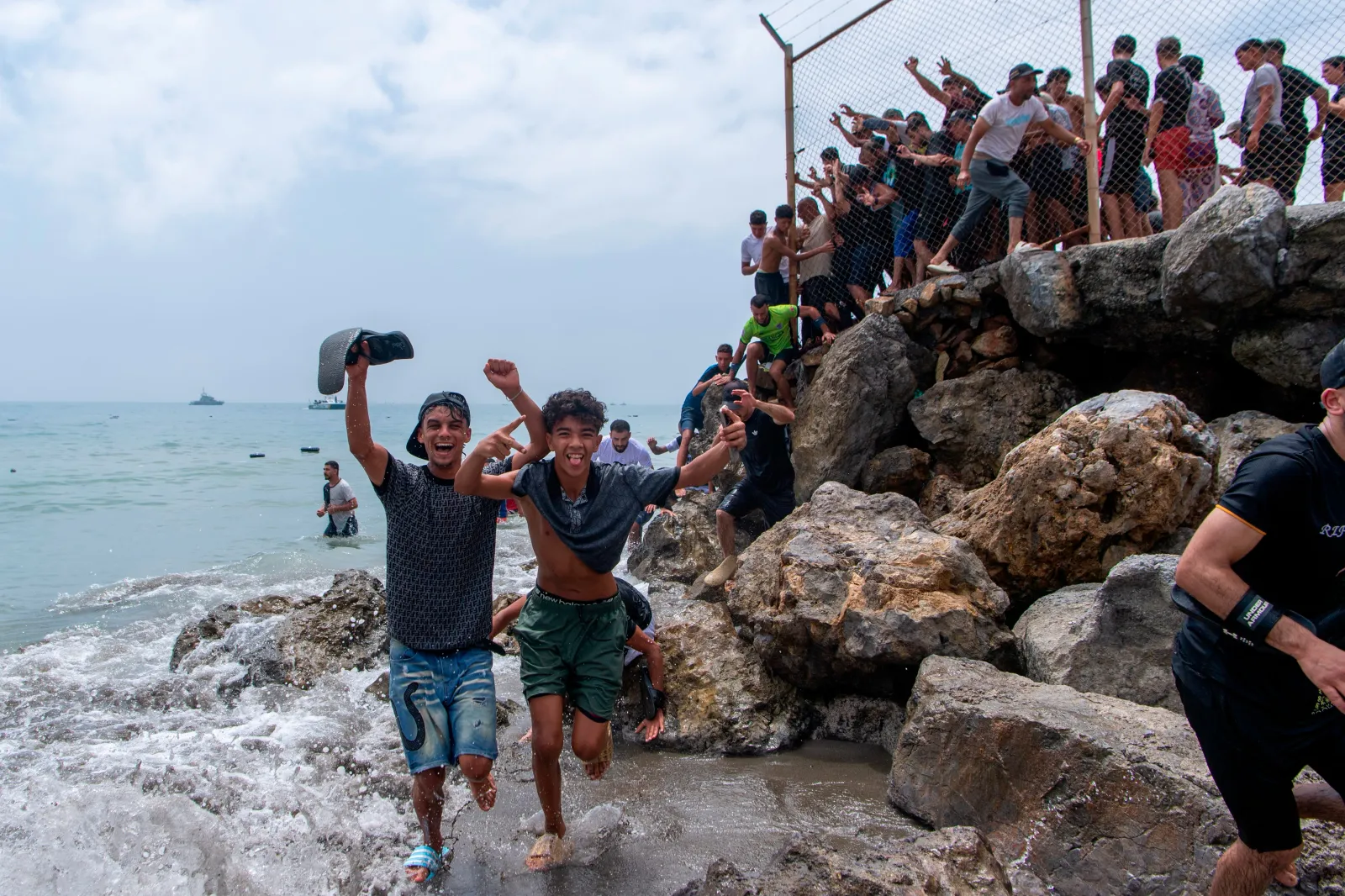
Spain deployed its armed forces to bolster security in Ceuta after tens of thousands of migrants entered the Spanish enclave, many by swimming or crossing through the land border.
At least 18 people died during the crossings, according to authorities, amid reports of drownings and a crowd crush near the border.
Ceuta borders Morocco and is a migration flashpoint for those seeking entry into Europe. Ceuta and Melilla, another Spanish enclave in North Africa, are the European Union's only land borders with Africa.
Read More on World
Juan Jesús Vivas, the leader of Ceuta's government, said on Thursday reception centers were "collapsed and saturated," and described the situation as an "absolute humanitarian and social emergency."
Vivas also called for the Spanish government to declare a national emergency.
"The Armed Forces will reinforce the Civil Guard in the exercise of its powers and any other duties that may be necessary to maintain security in the city of Ceuta," Spain's government said in a statement. "The mobilized personnel will be coordinated by the operations command and will provide support to the Civil Guard."
The Spanish Interior Ministry told Newsweek on Thursday all the government departments involved in migration management were working together, "to respond as quickly and effectively as possible to the situation in Ceuta."
It said that interior minister Fernando Grande-Marlaska was traveling to Ceuta on Friday to meet with the city’s authorities, the National Police and Civil Guard.
"The government is working with more resources, means and troops, which have been reinforced in the last week, to guarantee both security and migration control and the necessary humanitarian attention, with the aim of ensuring that no human life is endangered at sea," the Spanish ministry statement said, according to a translation.
Newsweek also reached out to Ceuta's government for comment.
In Europe, controversy around illegal immigration often centers around boat crossings across the Mediterranean Sea into countries like Greece, Italy and across the English Channel into the United Kingdom.
Most of the individuals arriving in Ceuta are Moroccans, along with a small number of Algerians who had been living in Morocco while trying to migrate to Europe.
The Spanish Interior Ministry statement said that Moroccan security forces were stopping the arrival of many people trying to access Ceuta from Moroccan territory.
Spain's Armed Forces are reinforcing the Civil Guard. It said an additional two platoons, a total of 40 troops, were joining the 80 already in place, and there would also be reinforcements of civil guards deployed from Andalusia. It said no declaration of national emergency was required because migratory flows are not considered a risk to the country’s National Civil Protection System.
Spain has pursued a comparatively pro-migration policy compared with several other European countries. Earlier this year, the government launched a program designed to provide legal status to about 500,000 undocumented migrants, prompting a surge in applications that reportedly exceeded expectations.
Right-wing parties have seized on the surge in arrivals to criticize Prime Minister Pedro Sánchez's immigration policies, arguing that the government's migrant-friendly approach has encouraged more people to attempt the crossing into Spain. Opposition leaders accused Sánchez of allowing the situation in Ceuta to spiral into a security crisis.
...
Alberto Núñez Feijóo, leader of the conservative People's Party, blamed the government for failing to get the situation under control. In a post on X, he said: "The situation in Ceuta is desperate. The government cannot look the other way... because we are facing a national security crisis."
Vivas has also criticized a Spanish Supreme Court ruling that states that migrants who arrive by sea cannot be immediately taken back across the border without due process, unlike those who arrive by land.
Vivas added that 60 bodies had been recovered at sea in recent months, and that deaths could be prevented with stronger migration controls.
Footage posted on social media shows people swimming into Ceuta around fences and border infrastructure. Other images show the new arrivals running along the streets and cheering. Many are camping outside a reception center.

...
While there are usually migrant crossings by sea during the summer months, Ceuta's authorities have said the current numbers are unusual. Interior minister Grande-Marlaska told the Spanish channel LaSexta that it was "an extraordinary, exceptional situation."
Sánchez said on Thursday that the government was "fully committed to providing an immediate response to the situation in Ceuta."
"We are mobilizing all necessary resources, working with Moroccan and international authorities, and preparing the necessary measures to restore normalcy as soon as possible," he wrote on X.

...
Italy's Meloni Threatens Extraordinary Border Measures
Italian Prime Minister Giorgia Meloni said the scenes unfolding in Ceuta show that "uncontrolled illegal immigration poses a concrete threat to the security of Europe's borders," and warned her government was prepared to take "extraordinary measures" to protect Italy's borders and citizens.
In a post on X, Meloni said she had spoken with Interior Minister Matteo Piantedosi and raised the possibility of suspending Spain's participation in the Schengen Area.
She added that her government would not "yield an inch" on illegal immigration, vowing to crack down on human traffickers and increase deportations.
Update, 7/31/26, 06:05 a.m. ET: This article was updated with the latest number of arrivals and reported deaths, and to clarify how migrants entered Ceuta.
Contact Newsweek editors on this story: Ben Kelly, Matthew Robinson, Sam Wilson, John Feng and Mike Hirst.
View 0 Comments
Submit Correction
View Editorial & AI Guidelines