10
Loading video...

By Soo Kim
Reporter
0
Share
Newsweek is a Trust Project member
See more of our trusted coverage when you search.Prefer Newsweek on Googleto see more of our trusted coverage when you search.
All kittens will reach a point when they're ready to graduate from consuming their mother's milk and move onto solid kitten food. But it's important to carefully wean them off the milk before this diet change.
Dr. Carling Matejka, a veterinarian who is a spokesperson for pet food company Solid Gold, told Newsweek: "For the first few weeks of a kitten's life, they need to rely on their mother's milk to provide all the nutrients they need."
Transitioning a kitten onto solid food is a slow, gradual process that usually takes between four to six weeks to complete, she said.
Read More
What Kitten You Should Get According to Your Personality7 min read

Should You Pet Your Cat With a Toothbrush? Experts Debunk Viral Posts5 min read

What To Do With a Stray Cat: Feeding, Adoption and All You Need To Know6 min read

Here, cat experts explain when and how to wean kittens.
When Should Kittens Be Weaned?
Kittens can start to be weaned from around four weeks of age, said Matejka.
Vicki Jo Harrison, the president of The International Cat Association, told Newsweek: "When kittens are ready to wean, you may notice that they've become more mobile and can stand on their feet while holding up their tail. They also will start to go for their mother's food."

...
What Should I Feed Kittens?
Harrison said it's important to feed kittens food that's formulated specifically for kittens when they're being weaned.
"These formulas have the higher levels of calories, protein and calcium that growing kittens need," she said.
Kittens require a precise ratio of nutrients to develop into a healthy adult cat. Matejka said: "Nutritional deficiencies can have lifelong, and sometimes deathly effects."
Below are the three key nutrients a kitten needs for growth, as outlined at the website of VCA, one of North America's largest animal hospital chains that operates over 1,000 animal hospitals across the U.S. and Canada.
- Protein: The recommended protein range for healthy kitten growth is 35 to 50 percent on a dry matter basis, with at least nine percent of the dry matter being from an animal source. The amount of protein required for kittens is high during the weaning stage, but steadily decreases afterwards.
- Fat: The fat content range for kittens should be from 18 to 35 percent on a dry matter basis.
- Calcium: A kitten's diet should contain 0.8 to 1.6 percent of calcium on a dry matter basis.
The VCA website says: "You should also avoid foods that produce a urinary pH of less than 6.2." Your veterinarian can help determine the pH levels of foods you're looking to feed your kitten.
Matejka said that while kittens are developing their teeth, they can't always eat enough hard food to get the nutrients and calories needed for growth. So young kittens should be given a mix of dry and wet food in their diet.
"Cats are also particular about food texture. It is recommended that kittens be provided with various food textures early in life to not become opposed to certain types of food later," she said.

...
How To Wean Kittens
Matejka said you can begin the weaning process by first separating the kittens from their mother for an hour or two, remembering to ensure they have their own litter box, food and water.
"Be cautious as removing a kitten from its mom too quickly can cause them to develop behavioral disorders like aggression and anxiety," she warned.
Over subsequent weeks you can slowly increase the time apart as the kittens get used to being separated from their mom.
At around four to five weeks of age, you can start giving kittens a bit of kitten formula in a shallow bowl. Do not use cow's milk as this can cause an upset stomach in some kittens.
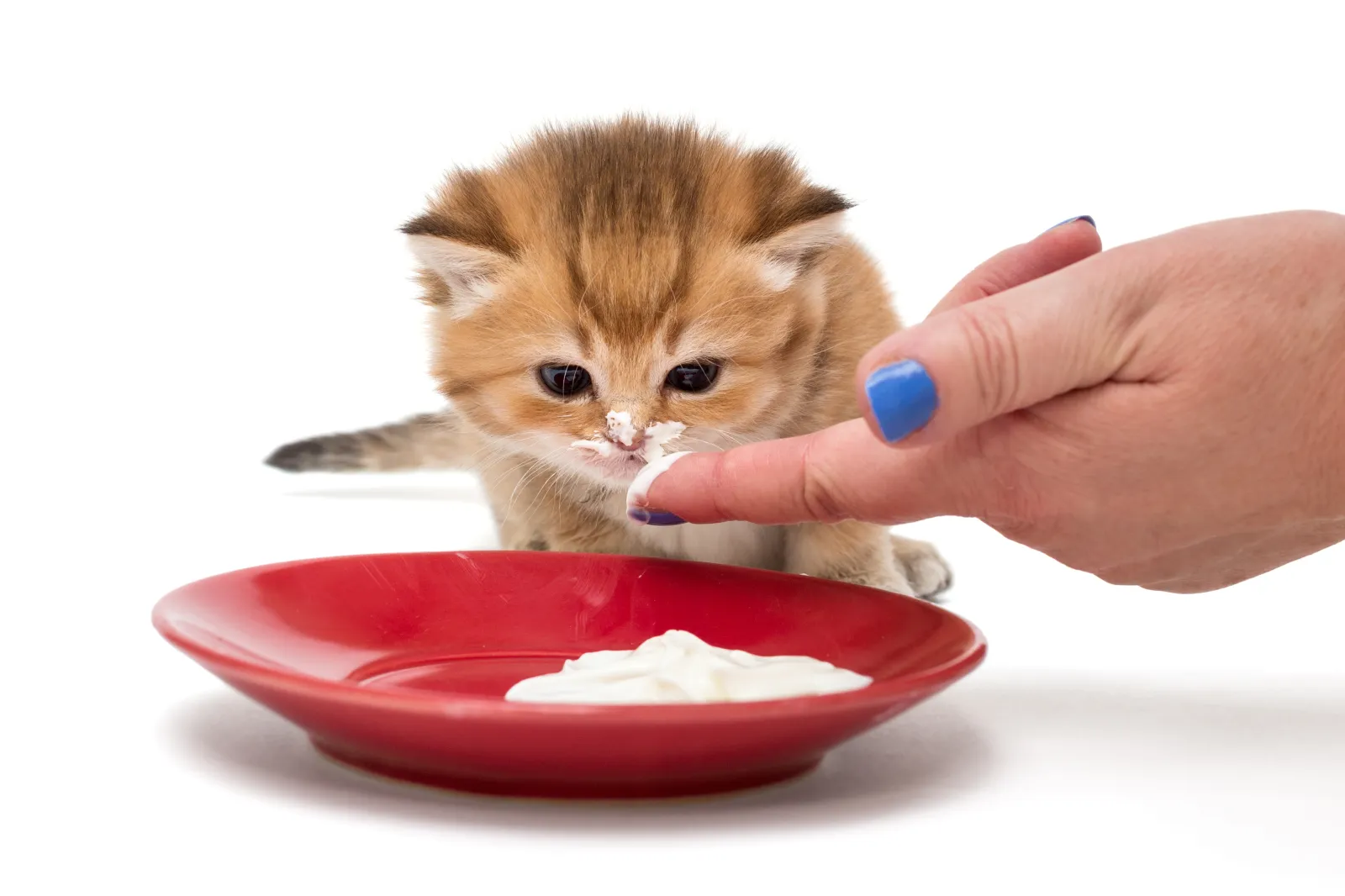
Matejka said. "You may need to encourage the kittens to drink by dipping your finger in the bowl and offering it to them to lick off."
Harrison suggested feeding kittens canned/wet food mixed with formula to help them recognize the taste.
"Smear the mixture around their mouth with your finger and let them lick it off. Supplement with formula if the kitten is not taking to the new food, to make sure it gets enough calories," she said.
Matejka said over time, you can slowly increase the amount of wet food versus formula.
Harrison said at around five to six weeks of age, kittens should start to nibble on kibble that's been slightly moistened with formula. As they get used to taking in more solid food, you can gradually decrease the amount of formula and increase the amount of food each day.
"After a week or two of softened food, your kitten should be eating only lightly moistened food. At this point, you can leave out small amounts of dry kitten food and formula," Harrison said.
...
When Is a Kitten Ready To Eat Only Solid Food?
Matejka said kittens should not be eating only solid kitten food until they are around eight to 10 weeks old.
Once kittens are eight weeks old, they're able to digest and absorb the nutrients they need from a kitten diet alone and no longer require their mother's milk. They should be fed primarily a kitten-specific diet (over 90 percent of their calories per day) until they're done growing.
Most cats are fully grown between the age of 10 and 12 months and it's safe to transition to an adult diet once they are this age, the veterinarian said.
Harrison said: "It is important to keep up the feeding protocol during the first 12 months since kittens continue to develop throughout their first year."

...
Other Key Elements and Precautions for Feeding Kittens
Below are some other things to bear in mind when feeding kittens, as outlined by Matejka:
- Make sure the food is verified by the AAFCO, which is a group that regulates pet food to ensure that it is balanced. Look for a product label that says the food "meets the nutritional requirements of kittens or all life stages established by the American Association of Feed Control Officials."
- Be mindful of portions and calories. Check the package of the product for the suggested amount based on a kitten's weight and age. The amount of food kittens require changes as they get older.
- Stick to regular meals and avoid "free feeding." Kittens can be fed twice a day when they are over four to six months old. When kittens are young (four to 16 weeks), they often can be allowed to "free-feed" as they will consume as much as their body needs. But once they're older, stick with regular meals and measure out the exact amount of food they need per day, per meal.
- Do not overfeed them. Kittens may "always act like they are starving," but it's vital not to overfeed them, as this can predispose the kittens to obesity later in life. Those concerned about their kitten's weight should consult a veterinarian to discuss what you're feeding and how much you're feeding your kitten.

...
View 0 Comments
Submit Correction
View Editorial & AI Guidelines