...

By Giulia Carbonaro
Senior Reporter
0
Share
Newsweek is a Trust Project member
See more of our trusted coverage when you search.Prefer Newsweek on Googleto see more of our trusted coverage when you search.
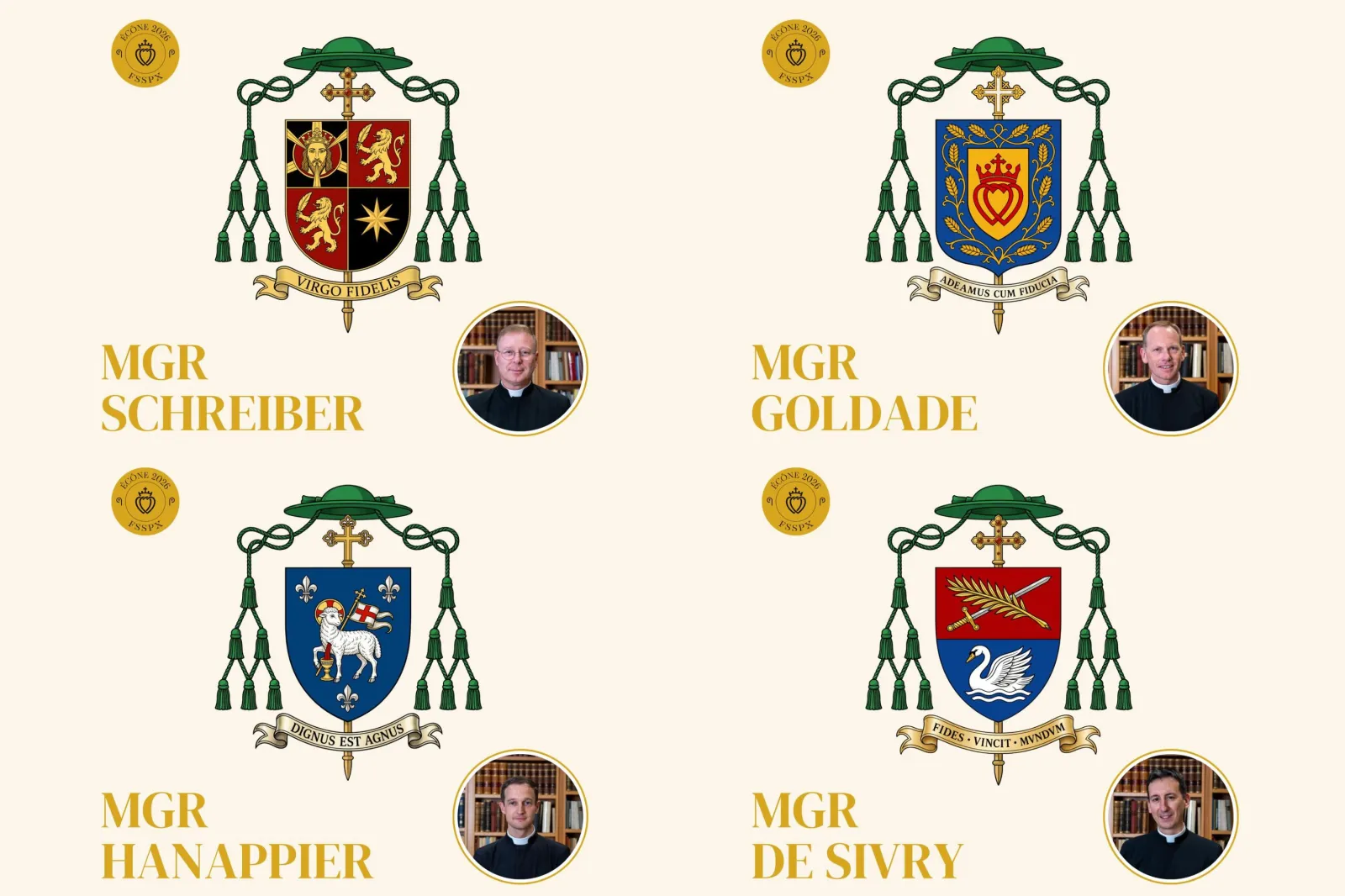
A traditionalist Catholic group on the brink of a fresh rupture with the Vatican has unveiled the coats of arms of the four priests it intends to consecrate as bishops without Pope Leo XIV's approval—an increasingly symbolic step that underscores its determination to proceed despite warnings the move would trigger automatic excommunication.
The Society of St. Pius X (SSPX), which has remained in an irregular relationship with Rome for decades, published the heraldic designs ahead of the planned July 1 consecrations, referring to the men as its "future bishops."
The announcement of the symbols is another sign the group is intent on consecrating the bishops, something that the Vatican has warned would represent a "schismatic act" and a "grave offense to God," triggering automatic excommunication.
Read More on News
...
Although coats of arms are often viewed as decorative, in Catholic tradition they function as a bishop's theological calling card, expressing his spirituality, pastoral priorities and understanding of episcopal ministry through biblical imagery, heraldic symbols and a personal motto.
The Vatican's warning came not through an anonymous spokesman but in a formal May 13 statement issued by Cardinal Víctor Manuel Fernández, prefect of the Dicastery for the Doctrine of the Faith, through the Holy See Press Office after consultation with Pope Leo XIV.
Why These Consecrations Matter
The planned consecrations represent the most serious confrontation between the Society of St. Pius X and the Vatican in decades, reviving a dispute that has shaped relations between the two sides since the late 20th century.
The SSPX was founded in 1970 by French Archbishop Marcel Lefebvre, who rejected many of the liturgical and theological reforms introduced after the Second Vatican Council, particularly the expanded use of vernacular languages in the Mass, ecumenical initiatives and aspects of the Church's engagement with the modern world.
Tensions reached a breaking point in 1988, when Lefebvre consecrated four bishops without the approval of Pope John Paul II.
Under canon law, both Lefebvre and the newly consecrated bishops incurred automatic (latae sententiae) excommunication for carrying out what the Vatican regarded as a schismatic act.
Pope Benedict XVI lifted those personal excommunications in 2009 as part of an effort to encourage reconciliation, but the SSPX never returned to full canonical Communion with Rome.
Although Pope Francis later granted SSPX priests faculties to validly hear confessions and, under certain conditions, witness marriages, the society's bishops and clergy continue to exercise ministry without regular canonical status in the Catholic Church.
Newsweek contacted SSPX for comment by email on Friday early morning.
Who Are the SSPX’s Four Soon-To-Be ‘Bishops’
The men selected by the SSPX represent a younger generation of leadership that would help secure the society's episcopal succession for decades should the consecrations proceed.
They are American Father Michael Goldade, Swiss Father Pascal Schreiber and French priests Michel Poinsinet de Sivry and Marc Hanappier.

...
Father Michael Goldade
Father Michael Goldade, 45, was born in a large Catholic family in North Dakota and raised in St. Marys, Kansas. He currently directs St. Ignatius Retreat House in Ridgefield, Connecticut.
His coat of arms features 12 ears of wheat in gold surrounding two intertwined hearts surmounted by a crown and a cross over a blue background.
According to SSPX, the ears of wheat recall both North Dakota and Kansas, the two largest wheat-producing states in the U.S., while their number (12) represents the members of Goldade’s family. The two hearts are also a reference to his family, which is particularly devoted to the Sacred Hearts of Jesus and Mary.

...
His episcopal motto, Adeamus Cum Fiducia ("Let us therefore go with confidence"), is drawn from Hebrews 4:16, emphasizing trust in divine mercy.
Father Pascal Schreiber
Schreiber, 53, was also born in a large Catholic family, but in Switzerland. He has been Rector of the Herz Jesu Seminary in Zaitzkofen, Germany, for SSPX since August 2020.
His coat of arms is possibly the most complex of the four, as it is split into four parts: in one there is the face of Jesus Christ; in the second and third two identical rampant lions; and, in the fourth, an eight-pointed star. The images are over black and red backgrounds.

...
This division in quarters reflects a long-standing tradition in German-speaking countries, SSPX said. The lion comes from the Schreiber family’s coat of arms. The star represents "the Savior."
His motto, Virgo Fidelis ("Virgin Most Faithful"), invokes the Virgin Mary.
Father Michel Poinsinet de Sivry
Poinsinet de Sivry, 42, was born in France in a Catholic family of seven children. He is currently Superior of the Benelux District in France.
Hanappier's coat of arms depicts the Lamb of the Apocalypse beneath three fleurs-de-lis traditionally associated with both French Catholic heritage and the Virgin Mary. His motto, Dignus Est Agnus ("Worthy Is the Lamb"), comes directly from the Book of Revelation.

...
Father Marc Hanappier
Hanappier, 36, was born in France and entered seminary in Switzerland. He was 23 when he was ordained, and he now teaches Acts of the Magisterium and Metaphysics within SSPX.
Hanappier's coat of arms depicts the Lamb of the Apocalypse beneath three fleurs-de-lis traditionally associated with both French Catholic heritage and the Virgin Mary.
His motto, Dignus Est Agnus ("Worthy Is the Lamb"), comes directly from the Book of Revelation.

...
What the Experts Say
Independent experts say the symbolism of the new coats of arms underscores that the SSPX is presenting these men not merely as priests assuming new responsibilities, but as successors to the bishops consecrated in 1988—a move with profound ecclesiological significance.
Massimo Faggioli, professor of theology and religious studies at Villanova University, has argued that episcopal consecrations without papal mandate strike at one of Catholicism's defining principles: Communion with the Bishop of Rome.
He has written that such acts are understood not simply as disciplinary violations but as challenges to the Church's visible unity.
Kurt Martens, professor of canon law at The Catholic University of America, has similarly explained that bishops derive their legitimate authority not merely through episcopal ordination but through canonical mission granted by the Pope. Without that mandate, consecrations are valid sacramentally but unlawful under canon law and carry severe legal consequences.
Religious historians note that episcopal coats of arms are more than personal branding. They publicly communicate how a bishop understands his office and his relationship to the wider Church.
The prominence of biblical triumph, Marian devotion and traditional devotional imagery across all four designs reflects the SSPX's long-standing emphasis on continuity with pre-Vatican II Catholic spirituality.
Canon lawyers have also noted that unveiling episcopal heraldry before a disputed consecration carries symbolic significance because it signals that the candidates already envision themselves exercising episcopal ministry. Church historians say such imagery reinforces the SSPX's argument that it is preserving apostolic succession rather than creating a rival church, even as the Vatican rejects that interpretation.
While historians differ over the symbolism, most agree the coats of arms are intended as a public affirmation that the society expects the consecrations to proceed despite Rome's objections.
What Automatic Excommunication Would Mean
Under Canon 1382 (now reflected in the revised Book VI of the Code of Canon Law), both the bishop performing an unauthorized episcopal consecration and the man receiving it incur automatic excommunication reserved to the Apostolic See. Contrary to a common misconception, excommunication does not expel someone from the Catholic Church or invalidate their ordination.
Rather, it bars them from receiving the sacraments, exercising ecclesiastical offices, celebrating the liturgy publicly in the Church's name and participating fully in ecclesial life until the penalty is lifted.
Because episcopal ordination imprints a permanent sacramental character, the four men would still be considered validly ordained bishops if the ceremony proceeds. However, they would have no lawful authority to govern dioceses, ordain clergy for the Catholic Church or exercise episcopal ministry within the Church's canonical structure.
What Happens Next
Unless the SSPX reverses course before July 1, Vatican officials have indicated the consecrations will trigger the canonical penalties already outlined in Church law.
The Holy See's warning came in a June 2026 communiqué issued by the Holy See Press Office, which described the proposed consecrations as a "schismatic act" and "a grave offense against ecclesial Communion."
The statement warned that participants would incur the penalties established under canon law if the ceremony proceeds without papal approval.
Canon lawyers say the Vatican is unlikely to recognize the four bishops in any official capacity unless the society later reconciles with Rome. Instead, the Holy See is expected to continue distinguishing between the validity of the sacramental ordinations and their lack of canonical legitimacy.
For ordinary SSPX members, the immediate practical impact is likely to be limited.
The Vatican has generally avoided declaring lay faithful schismatic merely for attending SSPX chapels, although it has repeatedly encouraged Catholics to worship within diocesan structures whenever possible.
The longer-term implications are more institutional. Additional bishops would ensure the SSPX can continue ordaining priests and perpetuating its episcopal leadership independently of Rome for decades to come, reducing one of the Vatican's principal sources of leverage in future negotiations.
Religious historians note that the Vatican has spent nearly four decades attempting to balance doctrinal firmness with pastoral outreach toward traditionalist Catholics.
If the consecrations go ahead despite repeated warnings, they could harden relations once again and make prospects for full reconciliation significantly more remote.
Contact Newsweek editors on this story: Matt Cannon and James Debens.
View 0 Comments
Submit Correction
View Editorial & AI Guidelines