
...

By Anna Skinner
Associate News Editor
0
Share
Newsweek is a Trust Project member
See more of our trusted coverage when you search.Prefer Newsweek on Googleto see more of our trusted coverage when you search.
As dangerously hot air bakes parts of California and Arizona under National Weather Service (NWS) heat alerts, fire forecasters are also flagging elevated odds of significant wildland fire activity in the Southwest this month, an early-season overlap that can stress communities and firefighting resources.
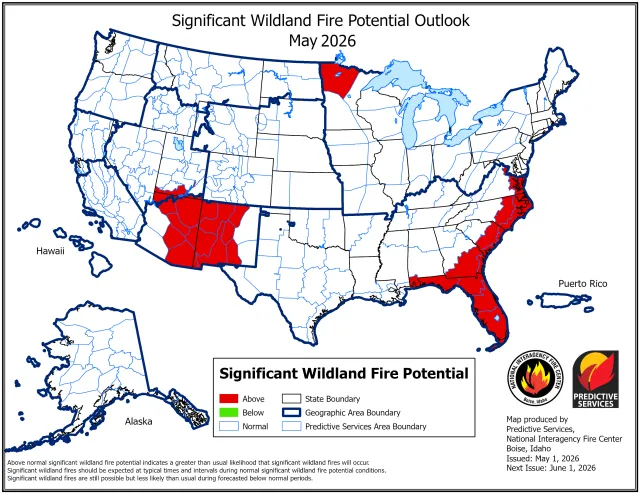
Several states across the U.S. will face "significant wildland fire potential" this month, the National Oceanic and Atmospheric Administration (NOAA) warned in its most recent national climate assessment issued last Friday. The above-average risk accompanies a mid-May heat wave walloping California and Arizona early this week, pushing temperatures well into the 100s for some of the hardest-hit areas.
"Significant wildland fire potential for May is above normal across parts of the Southwest and northern Plains as well as the southeastern coastal region, from the central Gulf to Mid-Atlantic," NOAA's report said.
Read More on Weather
The National Interagency Fire Center's (NIFC) one-month wildland fire outlook displayed the impacts. The eastern half of Arizona, southern Utah, western New Mexico, northwestern Minnesota, all of Florida, southern Alabama, southeastern Georgia, eastern South Carolina, eastern North Carolina and eastern Virginia faced an above-average chance for significant wildland fire potential in May.
The rest of the U.S. faced a normal risk level, with no states expecting below-average risk.

...
U.S. Wildfires Surge Ahead of Average
In its most recent outlook, NIFC’s predictive services noted that the country entered late April with fire activity already running well above average: 1,848,210 acres burned as of April 30, which is 194 percent of the previous 10-year average, and 24,066 wildfires were reported, 150 percent of average. The same outlook said drought coverage had increased, with nearly 62 percent of the U.S. in drought at the time of the report.
That broader signal is landing as the West confronts an episode of heat more typical of midsummer. In Southern California, an extreme heat warning was in place earlier in the week. On Tuesday, the extreme heat warning remains in place for Phoenix, Arizona, with less severe heat advisories lingering across Central California.
At the same time, red flag warnings have been issued, signifying increased fire risk. Heat on its own does not automatically translate into large fires, but when it coincides with very dry air and gusty winds, it can prime vegetation and make any ignition spread faster. Fire weather warnings in California, Arizona and Utah this week underscored those ingredients.
Red flag warnings are issued when critical conditions are occurring or expected soon, and the many of the warnings urged residents to avoid outdoor burning because any fire that starts could spread quickly. While the precise geography of red flag conditions can shift day to day, the warnings highlight how quickly spring heat and wind can push parts of the state into “critical” fire weather territory even before the traditional peak of the season.
California Wildfire Chances Throughout the Summer
As of the most recent NIFC outlook, while California is not anticipating an above-average chance at significant wildfire potential, that outlook changes as summer progresses. In June, Northern California faces an above-average risk, according to the NIFC outlook. That risk spreads slightly to encompass more of the region in July, then remains relatively stable in August.
The slideshow below shows how California's wildfire outlook changes as summer progresses.


1 of 4
Despite the concerning outlook amid summer-like weather, significant fire potential is not a guarantee of major fires. It is an assessment of where conditions and seasonal timing are more likely to produce incidents that require substantial suppression resources.
Still, the combination of early-season heat in the desert Southwest and critical fire-weather alerts in parts of California highlights why forecasters are watching May closely.

...
View 0 Comments
Submit Correction
View Editorial & AI Guidelines