
...

By Anna Skinner
Associate News Editor
0
Share
Newsweek is a Trust Project member
See more of our trusted coverage when you search.Prefer Newsweek on Googleto see more of our trusted coverage when you search.
Hundreds of thousands of people across Southern California’s desert regions were urged to limit outdoor activity and remain indoors for an extended period after the National Weather Service (NWS) issued extreme heat watches on Thursday ahead of a prolonged spell of dangerous temperatures expected to begin this weekend.
On Friday, the meteorologists upgraded the alerts to extreme heat warnings, the highest level of heat alert issued by the NWS. Extreme heat warnings were also issued in Arizona, and less severe heat advisories were issued across Central California, encompassing millions more.
NWS forecasters warned that a roughly 60-hour stretch of intense heat could push afternoon highs well above 100 degrees from Sunday through at least Monday night, and in some areas into Tuesday evening, increasing the risk of heat-related illnesses. The extreme heat warnings cover large portions of Imperial County, the Salton Sea region, the Coachella Valley, San Diego County deserts and the San Gorgonio Pass near Banning, areas home to an estimated 450,000 residents. In Arizona, the extreme heat warnings include Phoenix. The heat advisories were issued for many populous areas across Central California, including Fresno, Bakersfield, Merced, and others.
Read More on Weather
“The second surge of summerlike heat this spring is returning to the West," AccuWeather senior meteorologist Tyler Roys told Newsweek. "Temperatures will climb 20 to 30 degrees in just a few days, which can catch people off guard. Las Vegas and Fresno could see their first 100-degree day of the year, with some daily records challenged. This is unusual heat for May, but it is not as extreme as the March heat wave.”
...
California Extreme Heat: What to Know
In western Imperial County and around the Salton Sea, the NWS office in Phoenix said temperatures could climb to between 105 and 112 degrees during the afternoons from Sunday morning through Monday evening. Meteorologists classified the threat as a “Major Heat Risk,” warning that the combination of high temperatures and prolonged exposure could quickly become dangerous, even for people accustomed to desert heat.
“Heat-related illnesses increase significantly during extreme heat events,” the agency said, noting that overexposure can lead to heat cramps and heat exhaustion and, without prompt treatment, potentially fatal heat stroke.
A separate extreme heat watch issued by the NWS office in San Diego applies to the Coachella Valley, San Diego County deserts and the San Gorgonio Pass near Banning from Sunday morning through Tuesday evening. Forecast highs in those areas are expected to range from 104 to 109 degrees, with the hottest conditions most likely on Monday.
Officials urged residents to stay in air-conditioned spaces whenever possible, avoid direct sun exposure, and drink plenty of fluids. People who work outdoors were advised to reschedule strenuous activities to the early morning or evening hours and to take frequent breaks in shaded or cooled environments.
The Occupational Safety and Health Administration (OSHA) recommends regular rest periods during extreme heat and emphasizes that anyone showing signs of heat illness should be moved to a cool, shaded location immediately. Authorities stressed that heat stroke is a medical emergency and requires calling 911.
Forecasters also encouraged residents to check on vulnerable neighbors and relatives, including older adults, young children and those with health conditions, who are at higher risk during prolonged heat events.
While the alerts are currently classified as watches rather than warnings, the NWS said residents should take precautions now and prepare for potentially hazardous conditions as the heat builds early next week.
Extreme Heat: Which States Will Be Hottest?
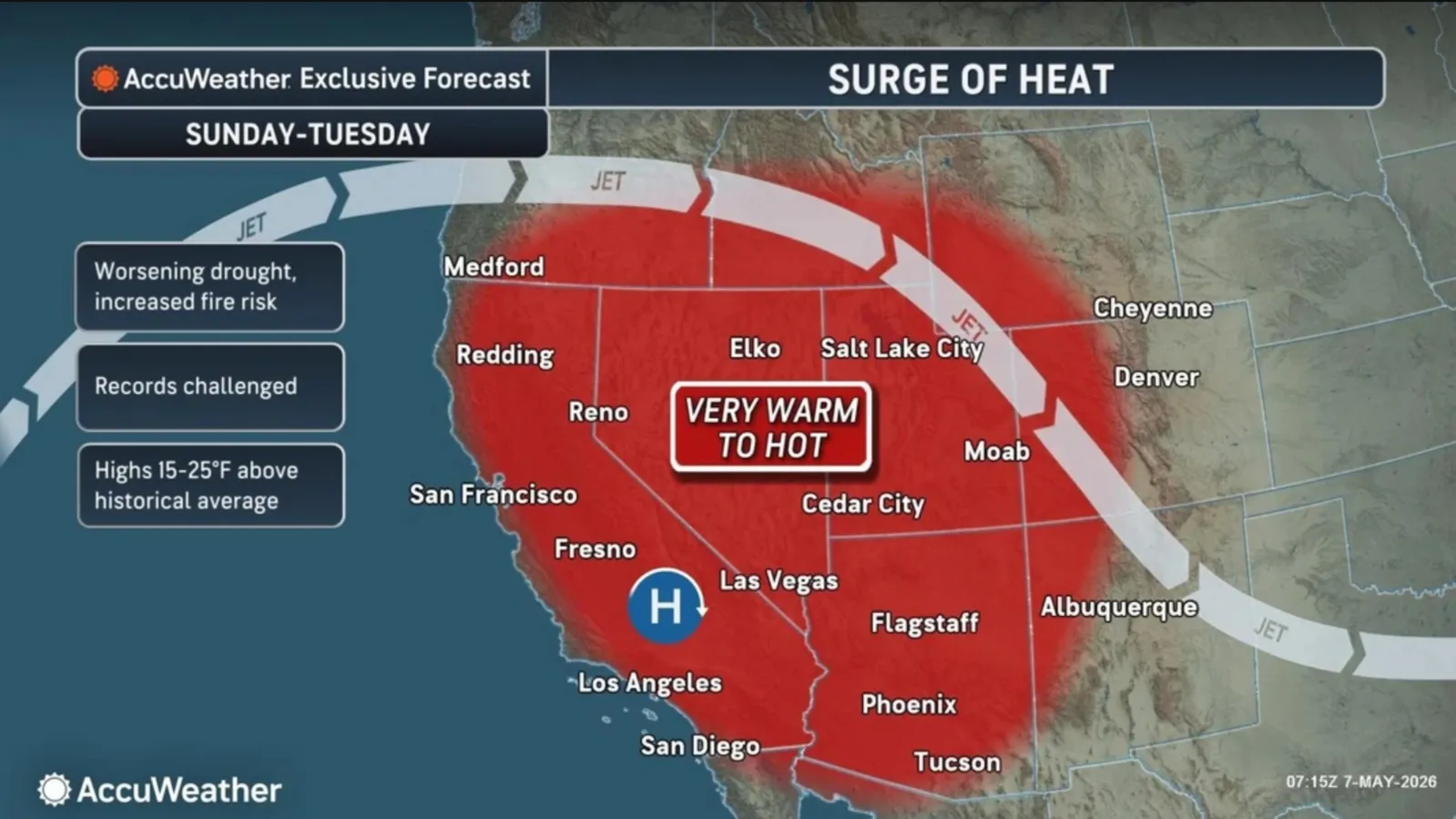
AccuWeather meteorologists warned that interior California and other Desert Southwest and Western states will feel the surge of heat, with temperatures at times reaching levels that are 25 degrees above average. Warm to hot weather will encompass southern Oregon, southern Idaho, southwestern Wyoming, western Colorado, northwestern New Mexico, Arizona, Utah, Nevada, and California.
...
Extreme Heat Watch vs. Extreme Heat Warning: What's the Difference?
An Extreme Heat Watch means conditions are favorable for a dangerous heat event, but there is still some uncertainty about the exact timing, duration or intensity. Watches are issued days in advance to signal that extreme heat is possible and that people should begin preparing, such as planning to limit outdoor activities, checking cooling options, and watching for updates.
An Extreme Heat Warning is more serious and is issued when extremely dangerous heat is expected or already occurring. This indicates a high risk of heat-related illness for the general public if precautions are not taken. During a warning, the NWS urges people to stay indoors in air-conditioned spaces as much as possible, avoid outdoor activity, hydrate frequently, and check on vulnerable individuals.
Symptoms of Heat Stroke as Forecasters Urge Caution
Heatstroke is a life-threatening condition marked by a dangerously high body temperature and severe symptoms, including hot, red, dry or clammy skin; confusion, agitation or slurred speech; throbbing headache; dizziness or loss of coordination; nausea or vomiting; rapid heartbeat; and fainting or seizures in severe cases. Unlike milder heat illnesses, heatstroke often involves mental changes and a failure of the body’s cooling system, and it requires immediate medical attention.
View 0 Comments
Submit Correction
View Editorial & AI Guidelines