...


By Alice Gibbs and Hannah Parry
0
Share
Newsweek is a Trust Project member
See more of our trusted coverage when you search.Prefer Newsweek on Googleto see more of our trusted coverage when you search.
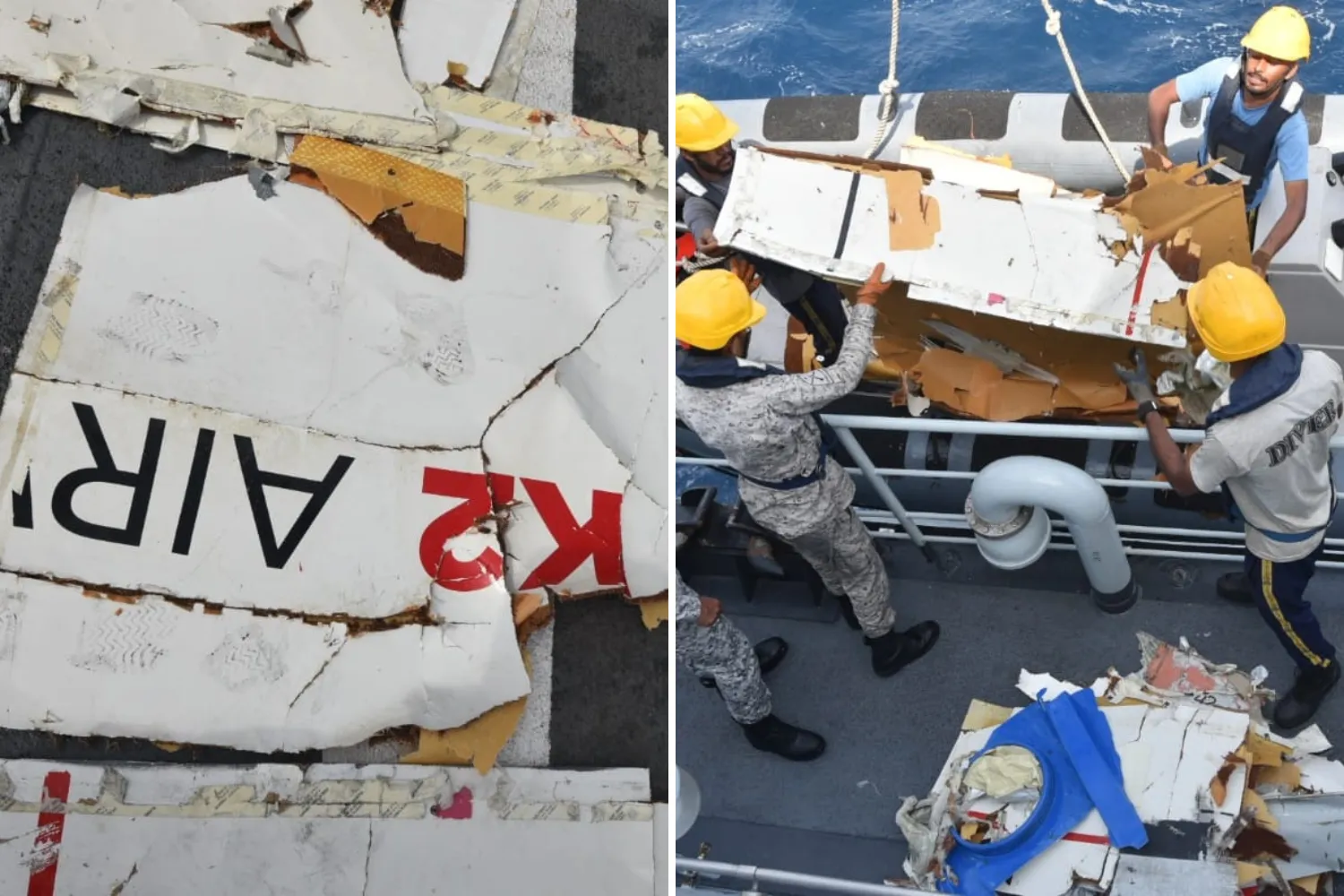
Wreckage from a K2 Cargo Airways Boeing 737-400 carrying five crew members has been recovered from the Arabian Sea after the aircraft disappeared during a flight from Sharjah, United Arab Emirates, to Karachi, Pakistan, according to Pakistani authorities.
Pakistan Airports Authority said on Wednesday that search-and-rescue teams had located and identified wreckage from Flight KTA1732 after more than 12 hours of operations at sea. The debris was recovered about 53 nautical miles south of Ormara, a coastal city in Pakistan's Balochistan province
The final transmission from the pilot stated that the plane had begun “rolling or floating”. Rolling refers to the banking motion of an aircraft around its longitudinal axis, while floating typically refers to the aircraft being unable to settle onto the runway because of excess airspeed or a cushion of air under its wings, meaning it "floats" inches off the ground unable to land.
Read More
How George W. Bush’s 80th Birthday Messages Compare to Trump4 min read

Multiple Books on Trump’s New Air Force One Titled ‘Library’6 min read

The Supersonic Era Is Back—What US Flights Might Look Like With New Jet5 min read

The aircraft, carrying five crew members, vanished from radar on Tuesday evening while en route to Karachi. Preliminary flight-tracking data indicated the Boeing 737 experienced significant altitude and heading changes shortly before contact was lost. Pakistani authorities previously said the crew had reported a navigation system issue and was being guided by air traffic controllers before communications ceased.
Aviation journalist and FlightGlobal consulting editor David Learmount told Newsweek the reported flight path appeared unusual for what should have been a routine cargo flight, saying the aircraft carried out maneuvers that "don't make sense" given the route being flown.

...
In a statement posted on X on Wednesday, Pakistan President Asif Ali Zardari expressed "profound concern and grief" over the aircraft's disappearance, voiced hope for the success of search-and-rescue operations and offered his sympathies to the crew's families.
Boeing also released a statement offering its "deepest condolences to the loved ones of the eight crew members who lost their lives," adding that it was "with great sadness that we confirm two Boeing employees were among those on board."
"We are on contact with their families and are offering support," it added.
K2 Airways released the names of the five crew members aboard Flight KTA1732 in a statement. The airline said the crew consisted of Captain Mohammad Rizwan Idrees, First Officer Faisal Mehmood, Load Master Muhammad Toufique Khan, and Engineers Arif Siddiqui and Mohammad Hamid.
In a statement, the carrier said the aircraft "lost contact with Air Traffic Control at about 21:21 hours according to Pakistan time" while en route from Sharjah to Karachi. K2 Airways said it was cooperating with aviation authorities and added: "We continue to pray, earnestly, for the safety of our colleagues."
The Pakistan Airports Authority told Newsweek: “Search and Rescue (SAR) missions by the Pakistan Navy (PN) and Pakistan Maritime Security Agency (PMSA) in the deep sea are still in progress. The search for the crew members is continuing with full vigor through the coordinated employment of aerial and sea-borne assets. Additional parts and debris of the ill-fated aircraft have been located and retrieved for subsequent analysis by the investigation team.”
Newsweek reached out to K2 Cargo via email for comment.
Where Was the Aircraft Heading?
The Boeing 737 freighter was operating a cargo flight from Sharjah International Airport in the United Arab Emirates to Jinnah International Airport in Karachi, Pakistan's largest city and busiest airport.
Flight-tracking data indicates the aircraft had crossed the Gulf of Oman and was approaching Pakistan's coastline when contact was lost. Its last known position was over the Arabian Sea, southwest of Karachi. Search efforts focused on the area where the aircraft's final signals were received.

...
What Has Happened To Flight KTA1732?
Data published by flight-tracking services appeared to show unusual movements in the aircraft's final minutes.
The last received position showed the aircraft at about 1,100 feet with a reported ground speed of 114 knots. Earlier tracking data indicated significant altitude changes and deviations from its previous flight path before transmissions stopped.
Data from Flightradar24 appeared to show the aircraft suddenly plunging at a speed of 22,400 feet per minute. Typical descent for an airliner at altitude is 3,000 feet per minute.
Aviation expert Imran Aslam said he was baffled by the aircraft's rapid descent as typically a plane suffering from engine failure would still continue gliding to an attempted landing.
"I still cannot understand how the plane went down so abruptly instead of gliding," he said.
The Pakistan Airports Authority said in a public statement on Tuesday night: "A K2 Airways B737 Pakistan Cargo flight en route from Sharjah to Karachi reported a navigational system issue at 21:18 PST and was promptly guided by Karachi Area Control Center (ACC).
"However, at 21:21 PST, the aircraft was observed on radar rapidly descending with a rapid heading change. Subsequently, radar contact and communication were lost approximately 155 NM west of Karachi."
Learmount said the reported navigation issue should be treated cautiously, noting that even if some of the early reports prove accurate, air traffic control assistance would have been available as the aircraft approached Pakistan.

...
"The reports about a navigation problem are not reliable. But if they are true or partly true, the aircraft was within radar range of the coast at all times, so air traffic control help was easily available," he said. "Even if the pilots had lost all their navigation aids because of an electrical failure, all they had to do to reach their destination was to follow the coast eastwards to Karachi."
Asked what might explain a loss of control or pilot disorientation, Learmount stressed that it was far too early to draw conclusions but said investigators would examine a range of possibilities.
"As regards loss of control or pilot disorientation, a fire on board springs to mind," he said. "Freight often includes dangerous cargo, including lithium batteries that can spontaneously combust."
Learmount added that smoke in the cockpit could potentially contribute to disorientation, while a serious fire could affect aircraft systems, but emphasized that investigators would need evidence before determining whether any such scenario played a role in the disappearance.
Former commercial pilot Captain Byron Bailey told Newsweek: "I have flown that route many times. To me it appears they had an emergency necessitating an emergency descent possible depressurization or a fire. Certainly just an engine failure does not need a rapid descent."
The Pakistan Aerospace Council, which said it is not involved in the official investigation, urged caution over early theories and told Newsweek "there is no official information regarding the cause of the incident" at this stage.

...
Aircraft Was K2 Airways' Only Freighter
The missing aircraft, registered AP-BOI, entered service in 1999 and previously flew for Aeroflot, Garuda Indonesia, TNT Airways, ASL Airlines Belgium and FedEx before joining K2 Airways in October 2024.
Its disappearance represents a major blow to the Karachi-based carrier, as AP-BOI was reportedly the airline's only operational freighter aircraft.
What Happens When a Plane Goes Missing?
When an aircraft loses contact with air traffic control or stops transmitting position data, authorities first attempt to re-establish communication through radar, controllers and nearby aircraft.
Search-and-rescue teams then use the aircraft's last known position, flight path and weather conditions to define a search area. If the aircraft is located, investigators typically seek to recover the flight data recorder and cockpit voice recorder, commonly known as the aircraft's "black boxes."
Those devices can provide crucial information about the aircraft's systems, crew actions and final moments before contact was lost.
Learmount said investigators already have an important advantage because flight-tracking data provides a relatively clear starting point for search efforts.
"Because of flight tracking, the investigators have a good idea of where to start searching," he said. "Any wreckage floating on the sea could confirm the location, but aircraft, when sinking, do not sink vertically, so the search might have to be a wide one."
He added that the goal of any aviation investigation is ultimately to determine what occurred and prevent a similar incident from happening again.
"The purpose of all investigations is to find out what happened, so that any mistakes, failures or damage can be prevented in future," Learmount said.
Other Aircraft Disappearances
Cases involving aircraft disappearing from tracking systems are rare, particularly in commercial aviation.
One of the most notable examples is Malaysia Airlines Flight MH370, which vanished during a flight from Kuala Lumpur to Beijing in March 2014. Air France Flight 447 also disappeared over the Atlantic Ocean in 2009 before wreckage and flight recorders were eventually recovered.
In most cases, authorities are ultimately able to locate aircraft using radar information, satellite data, emergency locator signals and debris searches, though investigations can take months or years to complete.
Contact Newsweek editors on this story: Rebecca Flood and Emma Lee-Sang
Update 07/08/26 06:45 a.m. ET: This story was updated with comment from President Asif Ali Zardari.
Update 07/08/26 07:05 a.m. ET: This story was updated with comment from aviation expert David Learmount.
Update 07/08/26 07:25 a.m. ET: This story was updated with comment from aviation expert Byron Bailey and the Pakistan Aerospace Council.
Update 07/08/26 11 a.m. ET: This story was updated as wreckage of the flight was found.
Update 07/08/26 1 p.m. ET: This story was updated with more information.
Update 07/10/26 07:50 a.m. ET: This story was updated with comment from the Pakistan Airports Authority.
View 0 Comments
Submit Correction
View Editorial & AI Guidelines