
10
Loading video...

By Mike Hirst
Deputy Publishing Editor, in Belfast
0
Share
Newsweek is a Trust Project member
See more of our trusted coverage when you search.Prefer Newsweek on Googleto see more of our trusted coverage when you search.
Belfast is trying to return to normal after a week in which anti-immigration unrest forced business closures, event cancellations and disruptions to Northern Ireland’s public transport network.
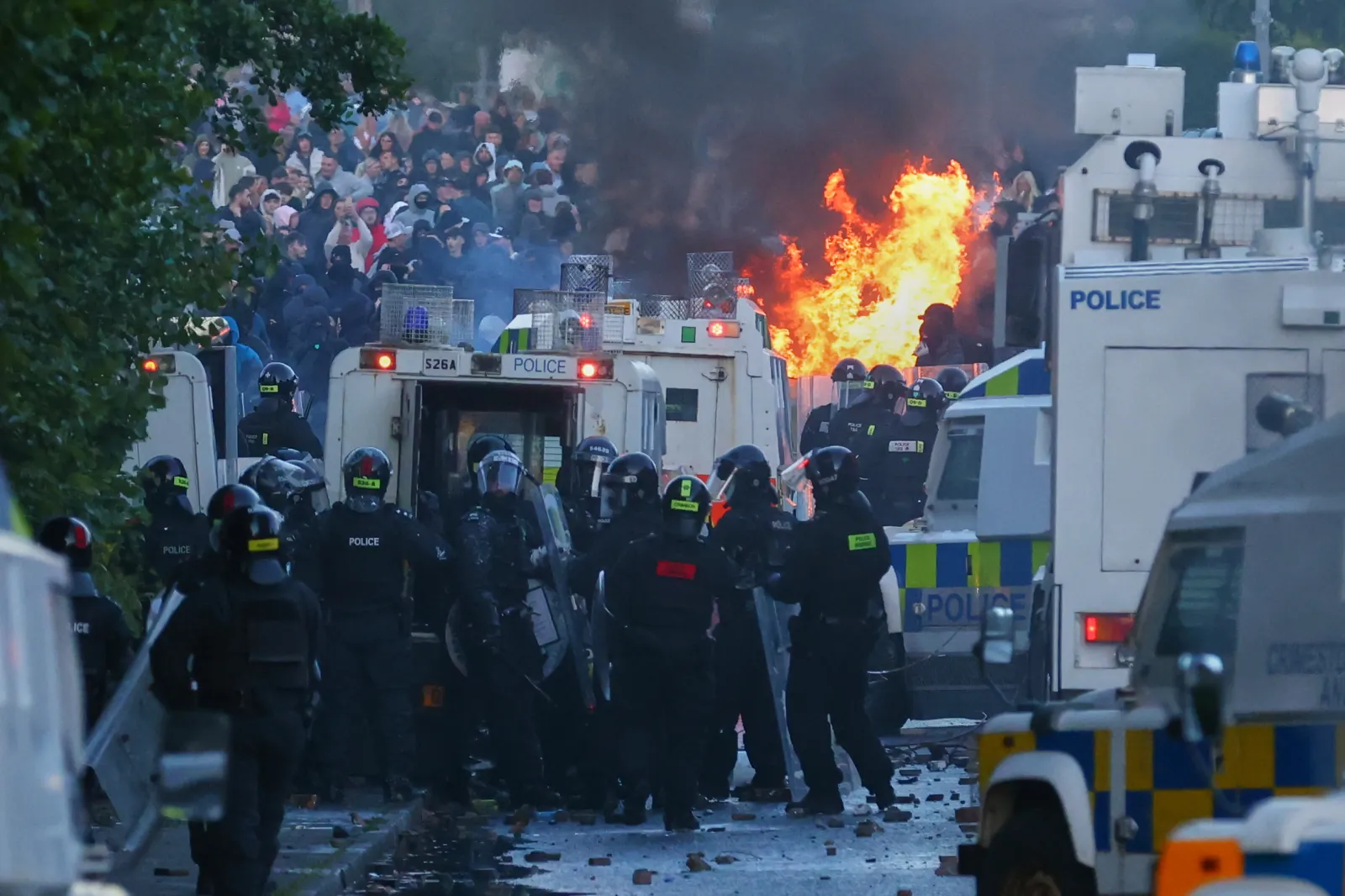
Some of the worst violence came on Tuesday, when masked men took to the streets, forcing non-white residents from their homes and hurling bricks and petrol bombs at police.
The violence, targeting ethnic minorities, has made many residents fear for their lives.
Read More on News
"Many feel they are not safe walking outside, or for their children going to school, or even in their own home," Biji Jose, a nurse from India who has worked in Northern Ireland for 24 years, told Newsweek.
The unrest followed a brutal knife attack in north Belfast, but police warnings, community accounts and hate-crime data suggest the violence did not emerge in isolation.
It has exposed a volatile mix of anti-migrant mobilization online, rising race-hate incidents, pressure on policing resources and political disputes over migration and border controls.

...
Violence Follows North Belfast Knife Attack
Graphic footage of Monday night’s attack on Stephen Ogilvie in north Belfast spread rapidly online.
Hadi Alodid, a 30-year-old Sudanese national, has been charged with attempted murder.
But even before the formal police action was taken, there were anti-immigrant protests being organized online.
By Tuesday evening, they had escalated into violence in pockets of Belfast and other towns and cities.
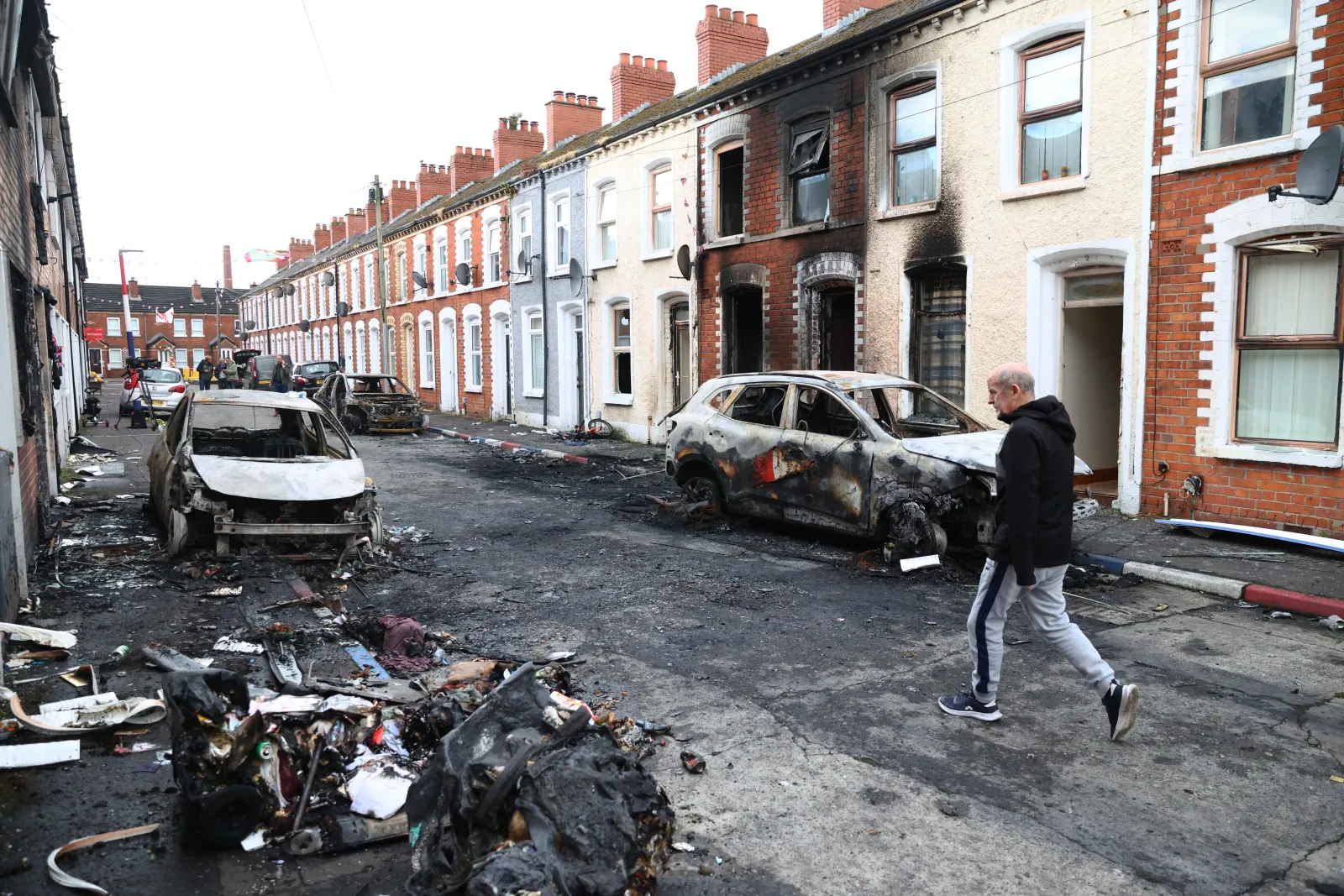
Masked groups set cars and buildings alight, and attacked properties believed to house migrants. They broke paving stones to use them as makeshift missiles. Police said at least 12 officers were injured.
For those living in the affected communities, the impact has been immediate and personal.
Jose, who leads a 600-member forum of Indian nurses, said many ethnic minority healthcare workers now fear for their safety and that of their families.
"The deliberate targeting of individuals and families is cruel, cowardly and utterly unacceptable," she told Newsweek.
"No community should live under the threat of intimidation and violence."
That sentiment was echoed by Belfast politician and Social Democratic and Labour Party leader Matthew O’Toole, who said he had helped move half a dozen South Asian families to shelter on Tuesday after their homes were targeted.
He denounced the "tidal wave of coordinated racist attacks" fueled by hard-right actors online "trying to sow discontent."
"Whatever concerns anyone may have about immigration, there can be no excuse for attacking healthcare workers, targeting families or forcing young children from their burning homes," O’Toole told Newsweek.
Previous Unrest Set Pattern
This week followed a pattern seen in previous episodes of anti-immigration unrest in Northern Ireland.
In June 2025, large-scale disorder broke out in Ballymena, a largely unionist market town about 30 miles north of Belfast, following allegations involving foreign nationals. Rioting continued for days, spreading to multiple towns, with homes and vehicles set on fire and police coming under sustained attack.
There were also riots in the summer of 2024, after anti-immigration unrest spread from England following the fatal stabbings at a children’s dance class in Southport.
Officials have been blunt in their response. Northern Ireland Secretary Hilary Benn described the latest violence as "racist thuggery," while Northern Ireland's first and deputy first ministers, Michelle O’Neill and Emma Little-Pengelly, jointly condemned the attacks, stating: "There can be no justification for attacking homes…and damaging our public transport and our roads."
...
The knife attack victim's family also denounced the unrest, saying on Wednesday they were "disgusted" that the attack on their son had been used to justify race-based violence.
"We have many migrants who make a deeply valuable contribution to our country, including in our healthcare system and hospitality sector and we depend on them to make our country work," said the family.
How Online Misinformation Fueled Anti-Migrant Unrest
While the riots appeared sudden, police and monitoring groups had warned before this week’s disorder that online anti-immigration networks were amplifying graphic material and unverified claims.
Police Service of Northern Ireland (PSNI) Chief Constable Jon Boutcher called for calm immediately after Monday’s attack, urging people not to be "fooled or duped into a trap by people online inciting awful behavior."
Days earlier, at the Northern Ireland Policing Board’s June 4 public meeting, he warned of "the malign influence of bad actors spreading extreme, anti-immigration disinformation on social media."
He said: "There are those in society who seek to use any incident in our communities to create misunderstanding, generate fear and provoke anti-migrant sentiment."
High-profile online figures also helped propel the unrest beyond Northern Ireland. Tommy Robinson, the English far-right activist, promoted posts about the attack and subsequent protests, while X owner Elon Musk in the U.S. amplified commentary around the case and criticized official responses.
Northern Ireland’s Justice Minister Naomi Long said the violence was being fueled by online commentators "who would struggle to find Belfast on a map."
Warnings Over ‘Hit List’ and Migrant Accommodation
Monitoring groups and local sources said far-right activists from England had traveled to Northern Ireland before the unrest and were later seen at several flashpoints.
Accountability Project NI, a volunteer-led monitoring group, told Newsweek it had also been tracking the circulation of addresses linked to Houses of Multiple Occupancy (HMOs) in anti-immigration online spaces since last August.
The group said it had submitted around 50 reports to police about online activity, including 10 focused on accommodation-related tensions between November and April. A January submission included addresses flagged online and recommended cross-referencing them against previous incidents.
When a document described online as a "hit list" circulated during this week’s unrest, the group said some addresses appeared consistent with material it had previously reported to police—though it could not confirm whether those addresses were later targeted.
...
"The issues that featured during this week’s disorder did not emerge in a vacuum," a spokesperson told Newsweek.
A 16-year-old boy is among the 19 people arrested in connection with the violence, as of Saturday morning.
Race Hate Incidents Reach Record High
The PSNI did not answer Newsweek's questions about Accountability Project NI's warnings, saying: "Our public order inquiry team are working tirelessly to ensure that those involved in this violence are brought before our courts to face the consequences of their actions."
Police-recorded race hate incidents in Northern Ireland have reached their highest level since records began in 2004.
Officers recorded 2,367 race-motivated incidents in the 12 months to March 31, 2026, up 561 on the previous year, alongside 1,507 race-motivated crimes, an increase of 320.
The latest PSNI hate motivations bulletin said race incidents and crimes have risen sharply since 2020/21, with spikes linked to the unrest in August 2024 and June 2025.
Those figures provide crucial context for the violence seen this week, suggesting the riots are part of a longer upward trajectory rather than a one-off eruption.
Policing Under Pressure Ahead of Marching Season
At the same time, structural pressures on policing have intensified concerns about how such unrest can be contained.
Police staffing levels fall well below long-standing targets. The chair of the Northern Ireland Policing Board said this week the PSNI has "6,300 officers, against a recognized need for 7,500, so it lacks resilience."
That shortfall leaves the force stretched, particularly during the summer months when the July 12 marching season places heavy demands on resources.

...
For many unionists and loyalists, parades and bonfires—commemorating Protestant King William of Orange's victory over Catholic King James II at the Battle of the Boyne in 1690—are a celebration of heritage. For many nationalists and Catholics, they remain symbols of historic exclusion and contested territory.
Most events pass peacefully, but in flashpoint areas the mix of identity, territory and unresolved legacy from the Troubles can still turn celebration into confrontation.
While much of this week's rioting has been focused in working-class loyalist areas, police and community sources have not suggested that loyalist paramilitary groups are directing or orchestrating it.
Migration, Border Controls and the Common Travel Area
The unrest has reignited political debate over migration and border controls, particularly the Common Travel Area (CTA), which allows British and Irish citizens to move freely between the U.K. and the Republic of Ireland.
In this case, because the Ogilvie attack suspect was reported to have entered Northern Ireland across its land border, critics say the current agreements are flawed.
Local politician and Traditional Unionist Voice leader Jim Allister told Newsweek the riots should be condemned, but said they could not be viewed separately from the attack on Ogilvie or from wider anger over borders and post-Brexit arrangements.
"The details of that horrific attack and particularly how the suspect came to be in Northern Ireland has highlighted a fundamental failure by Government to protect the people of the United Kingdom," said Allister.
Belfast parliamentarian John Finucane, from the republican Sinn Féin party that supports Irish reunification, said immigration, asylum and border arrangements were legitimate political issues.
But he told Newsweek that public representatives had a responsibility to avoid misinformation and "inflammatory rhetoric that makes an already difficult situation worse."
Why Unrest Matters Beyond Northern Ireland
The significance of this week’s riots lies in what they reveal about Northern Ireland’s social and political fault lines.
In the immediate term, the priority remains restoring order. Additional officers from across the U.K. have already been deployed to support the police as it continues arrests and seeks to deter further violence.
For now, Belfast has returned to a fragile calm. But with marching season approaching, policing resources stretched and migration tensions heightened, this week’s violence may be less an isolated eruption than an early stress test for Northern Ireland’s summer.
View 0 Comments
Submit Correction
View Editorial & AI Guidelines