...

By Soo Kim
Reporter
0
Share
Newsweek is a Trust Project member
See more of our trusted coverage when you search.Prefer Newsweek on Googleto see more of our trusted coverage when you search.
The northern lights may be seen in parts of the United States tonight, including as far south as Iowa and South Dakota.
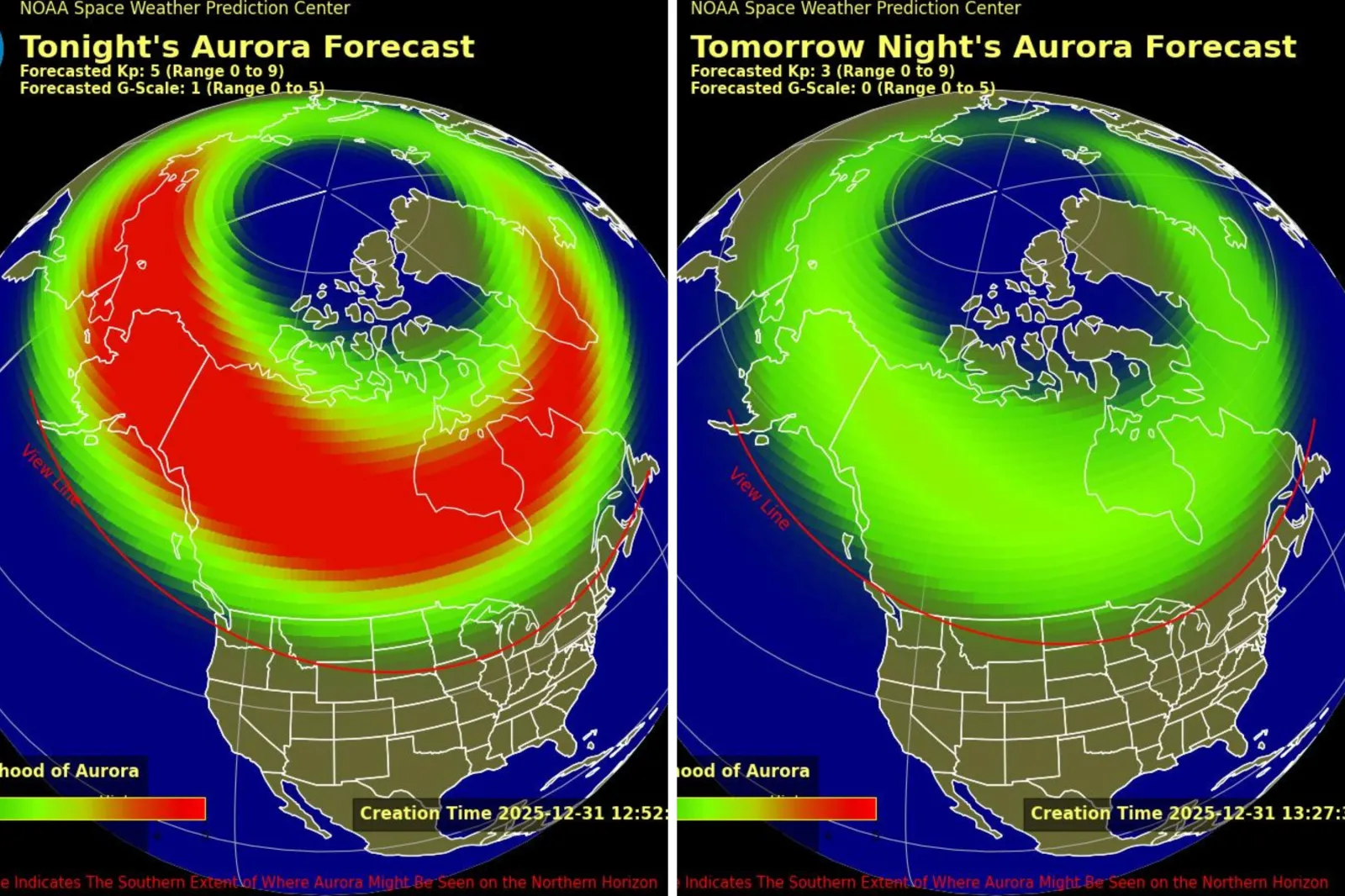
With a maximum forecast geomagnetic activity rating around four out of a possible nine at 9 p.m. UT, stargazers can expect the northern lights, also known as the aurora borealis, to be visible in some of the northernmost states near the border with Canada, according to the National Oceanic and Atmospheric Administration (NOAA)'s Space Weather Prediction Center.
A 'viewline' map shared by the Space Weather Prediction Center shows that viewers may see the aurora in parts of Alaska, Idaho, Iowa, Maine, Michigan, Montana, New Hampshire, New York, Oregon, South Dakota, Vermont, Washington, Wisconsin and Wyoming.
Read More on Science
The bright green color on the map shows all the areas where the northern lights could appear directly overhead. The red spots show the places where the aurora is projected to be more intense.
...
The northern lights are the result of electrons colliding with atoms in the upper reaches of Earth’s atmosphere.
“In these collisions, the electrons transfer their energy to the atmosphere, thus exciting the atoms and molecules to higher energy states. When they relax back down to lower energy states, they release their energy in the form of light. This is similar to how a neon light works,” explains NOAA.
The northern lights are best viewed either just after sunset or just before sunrise. They are not visible during daylight hours.
They typically form around 50 to 310 miles above the Earth’s surface and can seen from as far as 620 miles away “when the aurora is bright and if conditions are right,” says NOAA.
The agenct explains that the Earth’s magnetic field “guides the electrons such that the aurora forms two ovals approximately centered at the magnetic poles. During major geomagnetic storms these ovals expand away from the poles such that aurora can be seen over most of the United States.
“When space weather activity increases and more frequent and larger storms and substorms occur, the aurora extends equatorward. During large events, the aurora can be observed as far south as the US, Europe, and Asia.”
Do you have a science story to share with Newsweek? Do you have a question about the northern lights? Let us know via science@newsweek.com.
View 0 Comments
Submit Correction
View Editorial & AI Guidelines