...

By Ian Randall
Deputy Science Editor
0
Share
Newsweek is a Trust Project member
See more of our trusted coverage when you search.Prefer Newsweek on Googleto see more of our trusted coverage when you search.
Astronomers have solved a cosmic mystery, revealing the long-hidden object that collided with the Perseus cluster in a vast-scale hit-and-run billions of years ago.
Composed of thousands of galaxies strung together by their gravity attraction, galaxy clusters are among the most massive structures in the universe. They grow by mergers that are so energetic, they are among the most-powerful events since the Big Bang.
Located 240 million light-years from Earth, the Perseus cluster—which has the same mass as 600 trillion suns—was believed to have settled down into a stable, post-merger state. In fact, it was long cited as a textbook example of a relaxed cluster.
Read More
Hubble Space Telescope Releases New Anniversary Image of Iconic Galaxy3 min read

Half of Universe’s Normal Matter Was ‘Missing’; Astronomers Have Found It4 min read

Astronomers Discover Planet With a Tail4 min read

Developments in astronomical techniques, however, have since revealed that the cluster's internal structure exhibits subtle signs of having undergone a collision.
Until now, however, it was unclear exactly what the cluster might have collided with.
"This is the missing piece we've been looking for," said paper author and astronomer James Lee of South Korea's Yonsei University in a statement.
"All the odd shapes and swirling gas observed in the Perseus cluster now make sense within the context of a major merger," Lee added.
...
In their study, Lee and colleagues analyzed archival data collected by the Subaru Telescope, which is at the Mauna Kea Observatory on Hawaii.
The telescope can map out the location of otherwise-invisible dark matter by looking for signs of gravitational lensing—the phenomenon where the gravity from massive objects distorts the light from galaxies behind them.
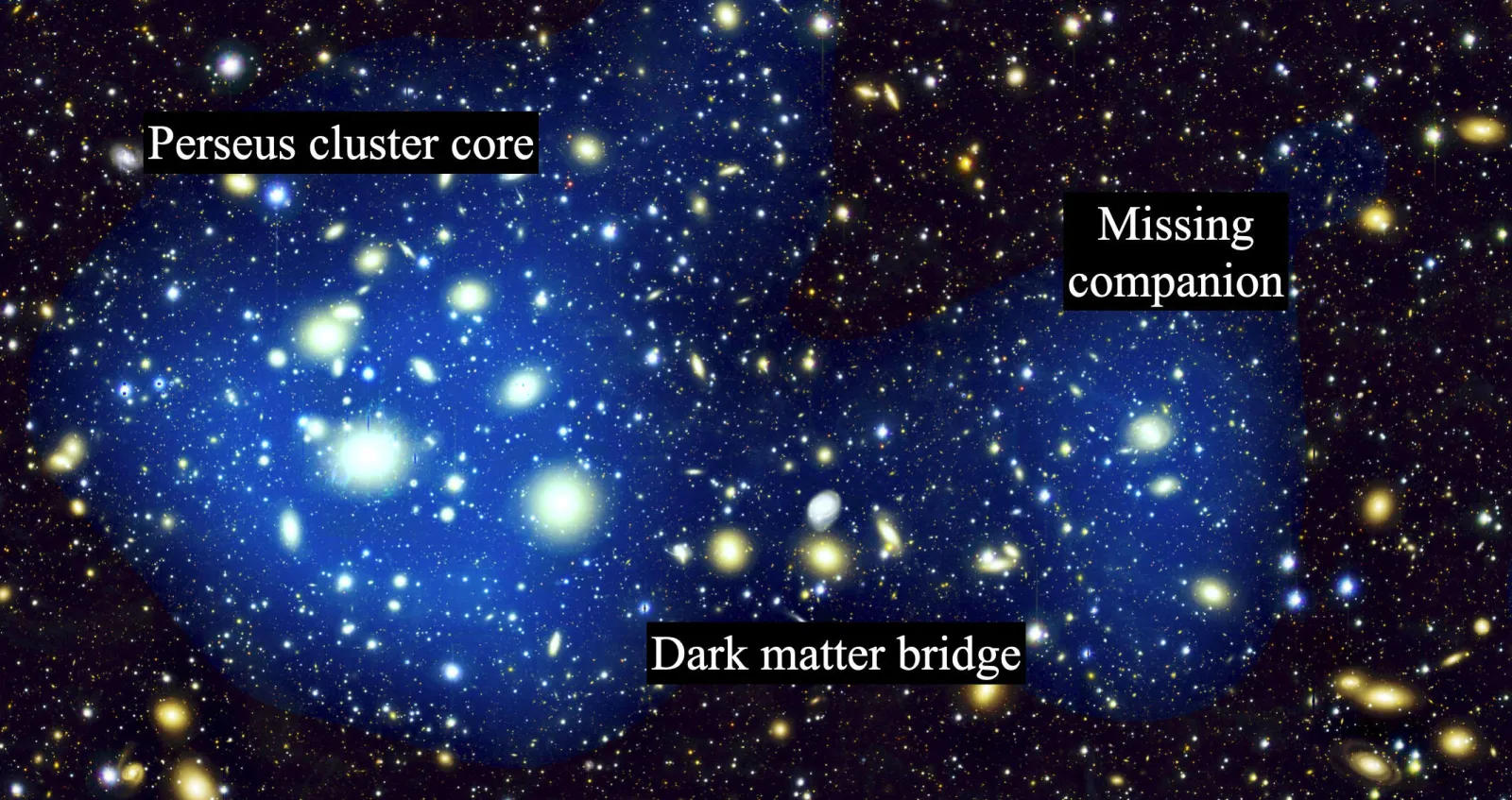
In this way, the researchers succeeded in mapping out a massive clump of dark matter, with a mass equivalent to that of some 200 trillion suns, that lies roughly 1.4 million light-years from the core of the Perseus cluster.
Moreover, the team found that this newly identified structure appears to be connected to the Perseus cluster's core by a faint "dark matter bridge"—providing direct evidence of the pair's past interaction.
"This breakthrough was made possible by combining deep imaging data from the Subaru Telescope with advanced gravitational lensing techniques we developed—demonstrating the power of lensing to unveil the hidden dynamics of the universe's most massive structures," said Lee.
The researchers' numerical simulations suggest that the newly detected dark matter substructure collided with the Perseus cluster some five billion years ago.
"It took courage to challenge the prevailing consensus, but the simulation results from our collaborators and recent observations from the Euclid and XRISM space telescopes strongly support our findings," concluded Yonsei University astronomer Kim HyeongHan in a statement.
Do you have a tip on a science story that Newsweek should be covering? Do you have a question about galaxy clusters? Let us know via science@newsweek.com.
Reference
HyeongHan, K., Jee, M. J., Lee, W., ZuHone, J., Zhuravleva, I., Kang, W., & Hwang, H. S. (2025). Direct evidence of a major merger in the Perseus cluster. Nature Astronomy. https://doi.org/10.1038/s41550-025-02530-w
View 0 Comments
Submit Correction
View Editorial & AI Guidelines