...

By Maria Azzurra Volpe
Reporter
0
Share
Newsweek is a Trust Project member
See more of our trusted coverage when you search.Prefer Newsweek on Googleto see more of our trusted coverage when you search.
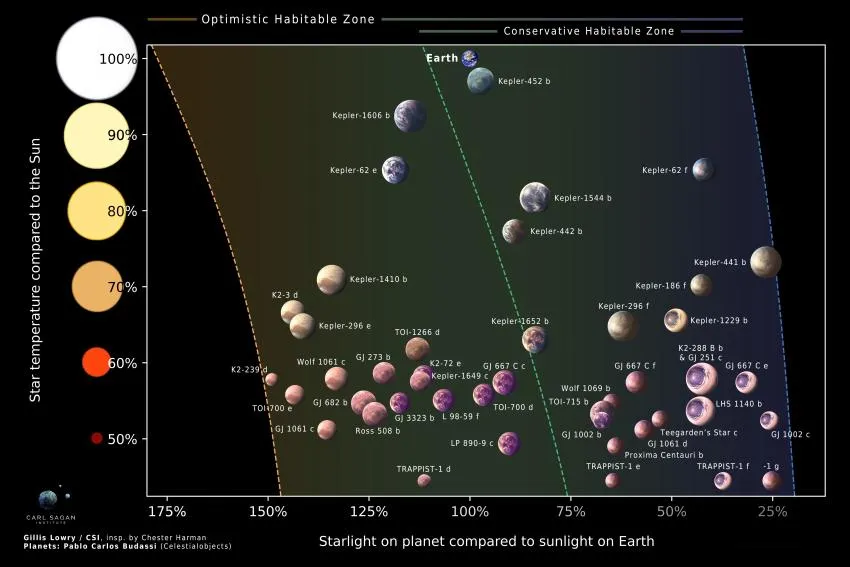
Astronomers have just revealed the most promising places in the universe to search for extraterrestrial life, identifying almost 50 rocky worlds that are most likely to be habitable.
In their study, researchers used data from the European Space Agency's Gaia mission and the NASA Exoplanet Archive to narrow down the most Earth-like worlds from more than 6,000 known exoplanets.
The research echoes the premises of Project Hail Mary, a new film in which Ryan Gosling’s character travels to an exoplanet system in search of a way to save Earth.
Read More
Pete Hegseth Gives Update On UFO File Release3 min read

Chances of Trump Releasing Alien Files4 min read

New ‘Alien: Earth’ Teaser Confirms New Alien Species3 min read

On the way he encounters an alien lifeform named Rocky and the fictional extraterrestrial micro-organisms Astrophage and Taumoeba.
...
Paper author professor Lisa Kaltenegger, director of the Carl Sagan Institute at Cornell University, said in a statement that the fictional scenario captures the spirit of the team’s work.
"As Project Hail Mary so beautifully illustrates, life might be much more versatile than we currently imagine, so figuring out which of the 6,000 known exoplanets would be most likely to host extraterrestrials such as Astrophage and Taumoeba–or Rocky–could prove critical, and not just to Ryan Gosling," Professor Kaltenegger said.
"Our paper reveals where you should travel to find life if we ever built a 'Hail Mary' spacecraft."
The team focused on planets located in the so-called 'Goldilocks' or 'Habitable' zone around their host stars—not too close that it’s too hot, and not too far away that it’s too cold—where water could exist in its liquid form on a planet's surface.
They also identified 24 additional planets within a narrower, more conservative 3D habitable zone, offering a refined list for future explorations.
Some of the worlds highlighted are already well known, including Proxima Centauri b, TRAPPIST-1f and Kepler 186f. Others are less familiar, such as TOI-715 b. Among the most compelling targets are TRAPPIST-1 d, e, f and g, located 40-light years away, and LHS 1140 b, at a distance of 48-light years.
Whether these planets can sustain liquid water depends heavily on their ability to retain an atmosphere.
The study also identified planets that receive stellar energy similar to Earth, including TRAPPIST-1 e, TOI-715 b, Kepler-1652 b, Kepler-442 b, Kepler-1544 b and the planets Proxima Centauri b, GJ 1061 d, GJ 1002 b, and Wolf 1069 b.
Researchers hope that planets near the inner and outer edges of the habitable zone will help refine long-standing theories about where habitability begins and ends.
Paper author and astronomer Gillis Lowry, now at San Francisco University, said in a statement: "While it's hard to say what makes something more likely to have life, identifying where to look is the first key step – so the goal of our project was to say 'here are the best targets for observation',"
Fellow researcher Lucas Lawrence added: "We wanted to create something that will enable other scientists to search effectively and we kept discovering new things about these worlds we wanted to investigate further."
The team also examined planets with eccentric orbits, which could reveal how changing heat levels affect long-term habitability.
Paper co-author Abigail Bohl noted that comparing exoplanets to Venus, Earth and Mars helps scientists to understand how much stellar energy a planet can receive before losing its ability to support life.
The list they've created will guide astronomers studying the night sky with JWST, the upcoming Nancy Grace Roman Space Telescope (set to launch in 2027), the Extremely Large Telescope (set to see first light in 2029), the Habitable Worlds Observatory (expected to launch in the 2040s) and the proposed Large Interferometer For Exoplanets (LIFE) project.
The TRAPPIST-1 planetary system is a main focus of observation with the JWST telescope, a programme led by Nikole Lewis, associate professor of astronomy at Cornell. Trappist-1 and TOI-715 b are both small red stars, making it easier to see the small, Earth-sized planets orbiting around them.
Do you have a science story to share with Newsweek? Do you have a question about exoplanets? Let us know via science@newsweek.com.
Reference
Bohl, A., Lawrence, L., Lowry, G., & Kaltenegger, L. (2026). Probing the limits of habitability: A catalogue of rocky exoplanets in the habitable zone. Monthly Notices of the Royal Astronomical Society, 547(3). https://doi.org/10.1093/mnras/stag028
View 0 Comments
Submit Correction
View Editorial & AI Guidelines