...

By Rachael O'Connor
Reporter
0
Share
Newsweek is a Trust Project member
See more of our trusted coverage when you search.Prefer Newsweek on Googleto see more of our trusted coverage when you search.
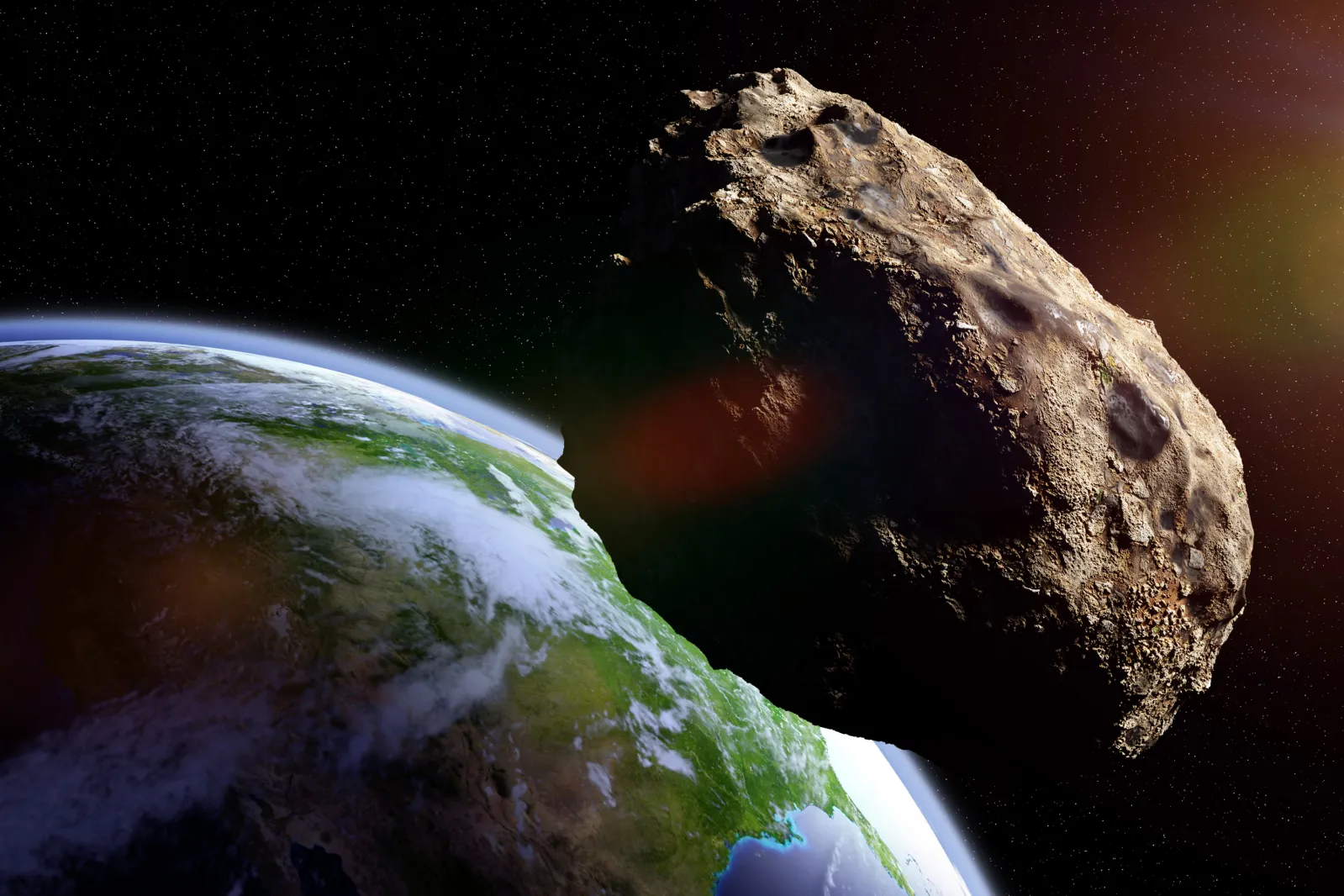
An enormous asteroid is approaching Earth at 24,136 miles per hour—and will be at its closest to us in two days' time.
The space rock—dubbed "2025 FA22"—is 520 feet across. On a cosmic scale, it will come close to Earth, getting to within just 523,000 miles of our home.
For context, the present distance between Earth and the moon is around 239,000 miles.
Read More on Science
Asteroids are rocky remnants from the early formations of the solar system 4.6 billion years ago that can be found orbiting the sun. They can vary massively in size—one of the largest, known as Vesta, is around 329 miles in diameter.
NASA's Asteroid Watch tracks asteroids projected to come within 4.6 million miles to Earth. Any object larger than 492 feet within this distance, is deemed a potentially hazardous object.
Davide Farnocchia, JPL navigation engineer with NASA's Center for Near-Earth Object Studies (CNEOS), told Newsweek that the 2025 FA22 "has an approximate size range of 400 to 900 ft (120 to 280 m) and will make a close approach to Earth at 2.2 times the distance between the Earth and the Moon."
"Objects of this size are not as numerous as smaller ones, and statistically, only one of them approaches this close to Earth every few years," Farnocchia said, but added in reassurance: "The close approach is too distant to pose any concern. And no Earth impact is possible for this object for at least 100 years."
While the 2025 FA22 is the biggest visitor to our backyard this week at up to 951 feet across, it is far from the only thing coming relatively close to Earth in the coming days.
...
On September 16 alone, an asteroid measuring 77 feet will come within 126,000 miles of our planet, and a 45-foot asteroid will pass within 698,000 miles.
On the same date, an asteroid around 160 feet wide is also due to come within 990,000 miles of Earth.
September 18, the same date as the building-sized asteroid will pass close to Earth, will also see a 41-foot asteroid coming within 634,000 feet of the planet.
Farnocchia told Newsweek: "2025 FA22 was discovered last March by the NASA-funded Pan-STARRS survey and has been tracked ever since. In particular, observations are being collected right now and will be collected during and after the encounter. Archival data have been found all the way back to 2012.
"There is an ongoing campaign of the International Asteroid Warning Network to study this object in detail. In fact, the upcoming close approach also enables observations to measure the asteroid's size, rotation period, and composition."
There are currently 1,362,002 known asteroids in the solar system, according to NASA.
Outer space is filled with asteroids, and any that appear to be in danger of approaching Earth is tracked by NASA, with the CNEOS computing their odds of impact.
One famous asteroid, named Apophis, is due to pass close by in April 2029—but upon its discovery in 2004, initial calculations indicated a possibility it would hit our planet.
The asteroid Apophis is now predicted to safely pass around 23,189 miles from the planet's surface on April 13, 2029.
Update, 09/23/2025, 11:40 a.m. ET: This article has been updated to include comment from Davide Farnocchia.
Do you have a tip on a science story that Newsweek should be covering? Do you have a question about space? Let us know via science@newsweek.com.
View 0 Comments
Submit Correction
View Editorial & AI Guidelines