...

By Jess Thomson
Science Reporter
0
Share
Newsweek is a Trust Project member
See more of our trusted coverage when you search.Prefer Newsweek on Googleto see more of our trusted coverage when you search.
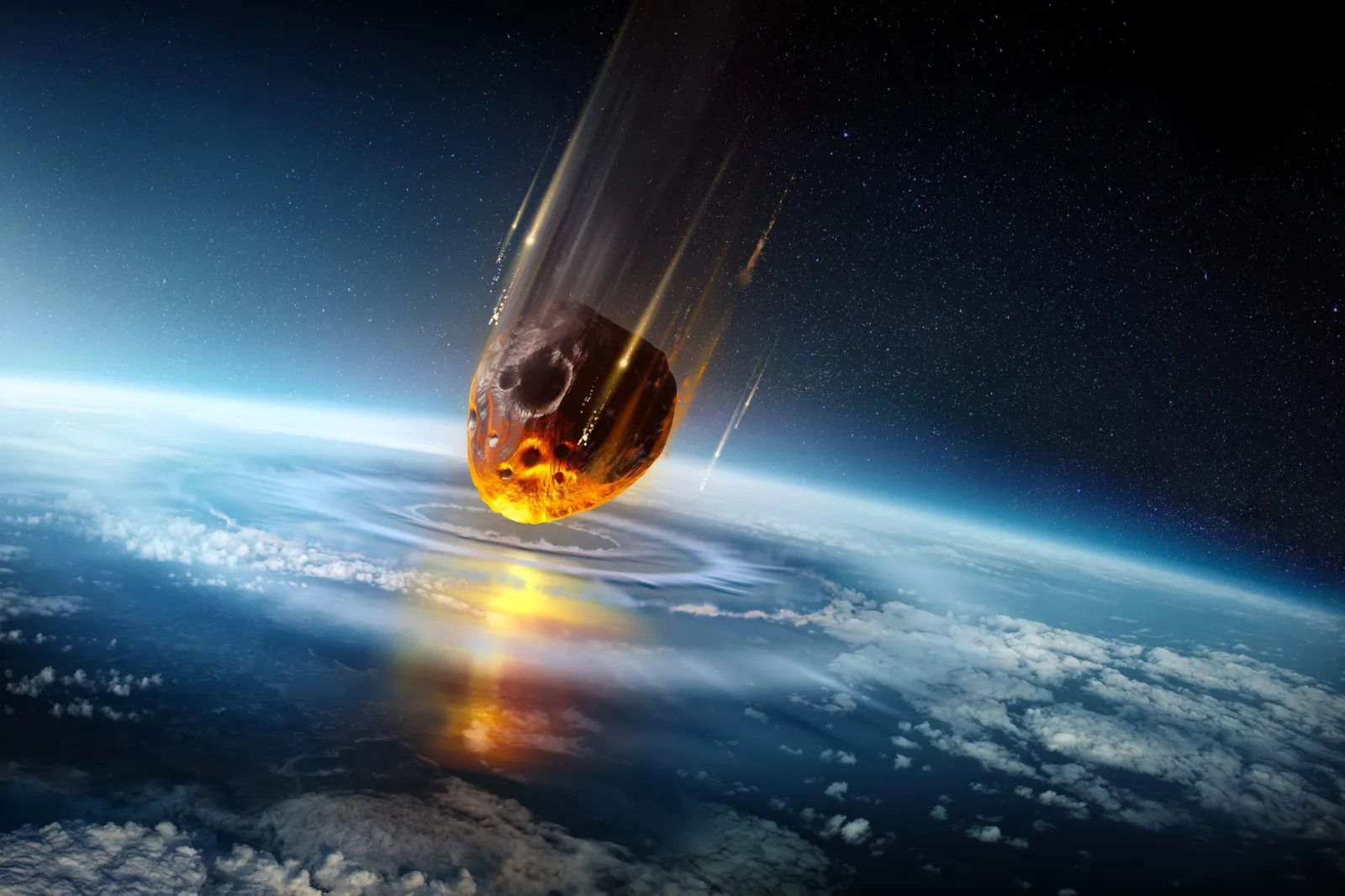
We might be able to defend Earth from a future asteroid impact using something straight out of a sci-fi movie: a blast of X-rays.
This pulse of X-ray radiation, produced by a nuclear explosion, could be used to vaporize the surface of an asteroid, changing its trajectory just enough that it misses our planet, according to a new paper in the journal Nature Physics.
In the wake of NASA's Double Asteroid Redirection Test (DART), which showed that asteroids could be shifted by slamming a spacecraft into them, this X-ray technique could further prop up our planetary defense arsenal.
Read More on Science
...
"For decades, it has been theorized that an intense X-ray burst could be our only option for deflecting asteroids large enough to disrupt life on Earth, or even to deal with smaller asteroids that surprise us. Theory is great, but at some point, you have to prove it," study co-author Nathan W. Moore, a researcher at the Sandia National Laboratories in Albuquerque, told Newsweek.
"Our miniaturized asteroid experiment not only showed that this concept is viable; it allows us to practice and prepare for deflecting different types of asteroids here on Earth so we're ready should the need arise."
If an asteroid hit our planet, it could be catastrophic to human society and millions of other species.
"Asteroid impacts are among the many natural hazards facing civilization. Although most asteroids bypass the Earth or cause little damage, the largest collisions have led to regional devastation and even the elimination of habitable climates," the researchers wrote in the paper.
"The Chicxulub asteroid impact triggered mass extinction, mega-tsunamis and a spell of global warming that lasted for around 100,000 years."
The researchers described in the paper how their laboratory experiments are proof-of-concept that this X-ray technique could work on real asteroids.
The researchers used X-rays—generated by argon plasma—on two 12-millimeter-wide mock-up asteroids in a vacuum, one of which was made of fused silica and the other from quartz. They found that the X-rays heated up the miniature asteroids enough to produce a plume of vapor on one side, which propelled them in the opposite direction.
"The primary mechanism involves using X-rays to rapidly heat the target surface, causing it to vaporize and expand into the adjacent vacuum. The expanding gas pushes against the asteroid, transferring momentum in the direction of the intercept," the researchers wrote.
Scaling these velocities up to the equivalent of a real asteroid heading toward Earth, they found that this could indeed help to deflect an asteroid's path.
"Our calculations predict that asteroids as large as 4 km [2.5 miles] could be easily deflected using this method, assuming a similar composition as in our study. That's certainly in the "devastating" category. Deflecting larger asteroids is certainly possible with longer warning times. Details matter," Moore said. "Asteroids can be made of different minerals. What they're made of affects their mass, their properties, and how easily they're pushed off-course."
While the DART mission showed that sending a fast-moving spacecraft zooming into the side of an asteroid could indeed deflect it, this kind of tactic would take years of preparation and planning. Additionally, it would only work against smaller asteroids, and may have minimal effects on larger space rocks heading our way.
"Kinetic impact will be a great option for many situations, but not for the largest asteroids, or when warning time is extremely short [e.g., one year or less]," Moore said. "At present, an X-ray burst is the only known way to give an asteroid the herculean push needed for those scenarios. A small spacecraft impacting a miles-wide asteroid simply wouldn't pack enough punch."
By exploding a nuclear bomb high above the surface of the asteroid, the burst of X-rays could be enough to vaporize the surface to the point that the escaping vapors shift the rock out of our path, the researchers explain.
"To generate a strong enough X-ray burst, one would just need to detonate a nuclear device within a few miles of the asteroid," Moore said. "The advantage of this approach is that it would give the asteroid a strong push, but not as strong as an explosion directly on the surface. That's key to reducing the risk of fracturing."
Update 9/25/24, 2:45 p.m. ET: This story was updated with comments from Nathan W. Moore.
Do you have a tip on a science story that Newsweek should be covering? Do you have a question about asteroids? Let us know via science@newsweek.com.
References
Moore, N. W., Mesh, M., Sanchez, J. J., Schaeuble, M., McCoy, C. A., Aragon, C. R., Cochrane, K. R., Powell, M. J., & Root, S. (2024). Simulation of asteroid deflection with a megajoule-class X-ray pulse. Nature. https://doi.org/10.1038/s41567-024-02633-7
View 0 Comments
Submit Correction
View Editorial & AI Guidelines