...

By Aristos Georgiou
Science and Health Reporter
0
Share
Newsweek is a Trust Project member
See more of our trusted coverage when you search.Prefer Newsweek on Googleto see more of our trusted coverage when you search.
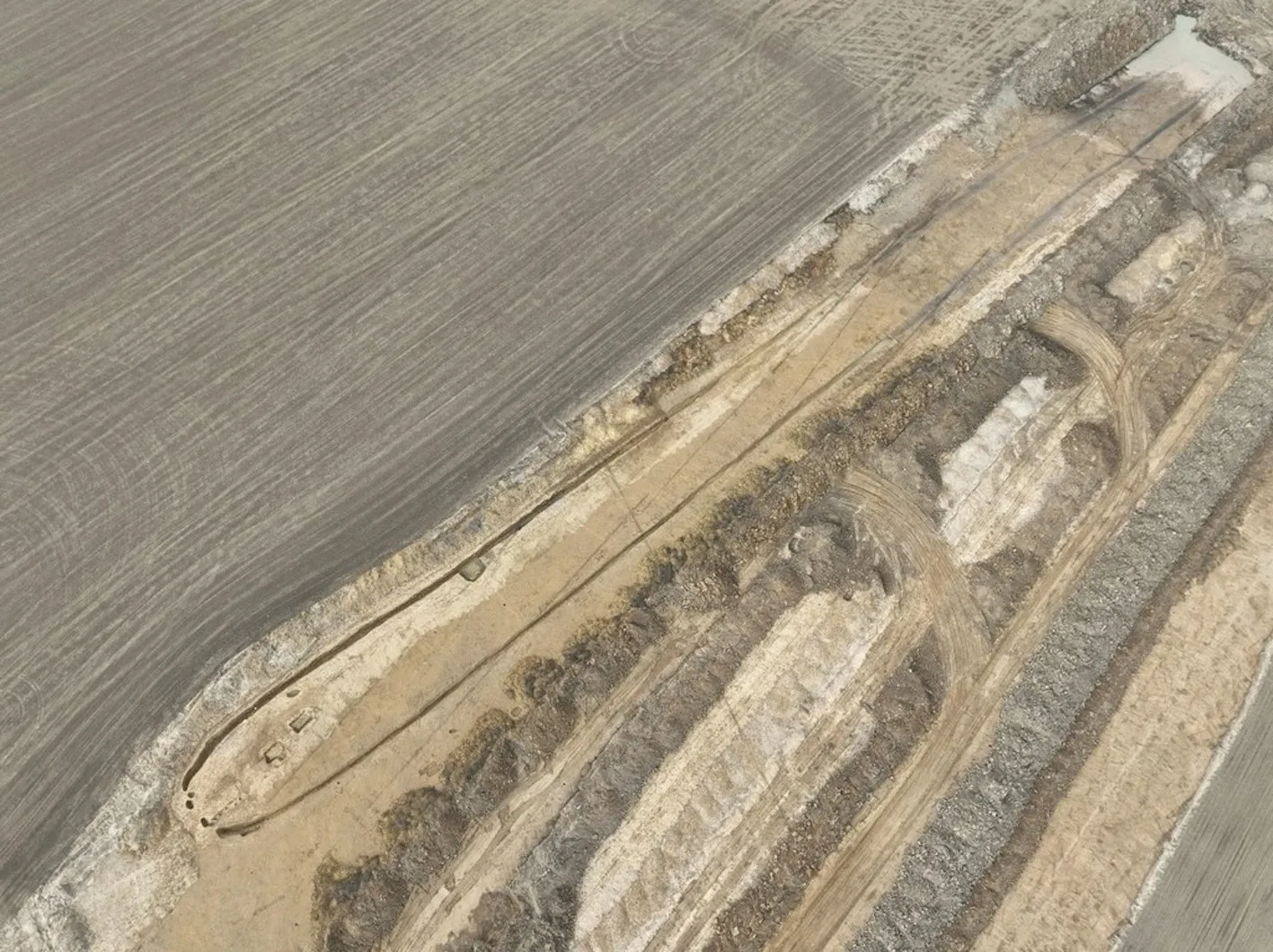
Archaeologists have unearthed a huge prehistoric monument during excavations along a highway route in the Czech Republic.
The monument is a large burial mound measuring around 620 feet in length and roughly 50 feet across at its widest point, a team from the University of Hradec Králové (UHK) announced.
The structure—located at the border of the villages of Dlouhé Dvory and Lípa in the eastern part of the country's Bohemia region—is thought to date back to the 4th millennium B.C., placing it among the earliest funerary monuments in Europe, according to the archaeologists.
Read More
Americans Should Cut Back on Bacon, Say Scientists3 min read

Quick Questions Reveal Your Risk of Heart Attack3 min read

Bee Stinger Lodges in Man’s Eye After Attack4 min read

Its significant length means that the burial mound may be one of the longest of its kind in Europe, the researchers suggest.
...
"Mounds of this type are found mainly in northwestern Bohemia. They have not yet been reliably documented in Eastern Bohemia. In addition, the examined specimen represents the longest prehistoric mound not only in our region, but probably in the whole of Europe," Petr Krištuf from UHK's Department of Archeology at the Faculty of Arts said in a press release.
The burial mound was uncovered during rescue archaeological excavations taking place ahead of the construction of the newly built D35 highway between Plotiště and Sadová.
The team has managed to excavate the entrance to the long barrow—the name for this type of funerary monumental structure—which is preserved in the form of a posthole and a gutter.
"The long barrows are among the oldest and largest funerary monuments of European prehistory. And the barrow we've discovered is the longest long barrow yet excavated in Europe," Ladislav Rytíř with the UHK Department of Archeology, who is responsible for the excavation, told Newsweek.
Burial mounds like these were built as monumental funerary objects and as such they contain graves, the UHK Department of Archaeology said in a Facebook post.
The burials of the individuals for whom the mound was built—who were likely of high status—are known as "central" burials.
In this case, the team recorded two central burials within the long barrow. The first central burial features a human skeleton on its left side facing north, with an accompanying ceramic vessel as a grave offering.
ENG belowPři záchranném archeologickém výzkumu v trase dálnice D35 Plotiště-Sadová jsme nalezli na pracovním úseku 6 na přelomu katastrů Dlouhých Dvorů a Lípy tzv. dlouhou mohylu. Dlouhá mohyla je...
The second central burial features another body on its left side while facing north, but contains an offering of five chipped stone artifacts made of flint.
This grave was disturbed by a younger pit that the archaeologists believe also represents a burial pit—but it did not contain any human remains. Whether this was a grave or not will be revealed by further analysis.
Archaeologists also identified another grave beside the two central burials and the mysterious pit, although the human remains it contained consisted of only very poorly preserved skull fragments.
Researchers are now studying samples from the graves to try and understand as much as possible about the deceased.
"Similar burial mounds in Central Europe usually consist of only one, maximum two, burials. From this point of view, it will be interesting to see how the discovered graves are related to each other and whether they represent the burials of relatives," Krištuf said.
Researchers also documented almost 30 additional graves in the vicinity of the burial mound that appear to be dated to the same period—although this has yet to be confirmed. The working assumption is that a burial ground expanded around the long barrow over time.
"The significance of the discovery of the long mound... is not only in its size. The first results show that the monumental burial mound stood here for many centuries, and funeral and ritual activities of the local people took place in its vicinity. It was thus an important ritual place and landmark in the landscape at that time," Krištuf said.
"Since the barrow is surrounded with a number of other contemporary graves and there is also an equally old settlement nearby, we have the unique opportunity to explore the site in a comprehensive way," Rytíř said. "Thus, we can study how the landscape was structured at that time, how the settlement and burial components relate to each other. On the basis of anthropological and DNA analyses, it will also be possible to trace social and kinship relationships at the burial site."
Do you have a tip on a science story that Newsweek should be covering? Do you have a question about archaeology? Let us know via science@newsweek.com.
Update 07/05/24, 7:11 a.m. ET: This article was updated with additional comment from Ladislav Rytíř.
View 0 Comments
Submit Correction
View Editorial & AI Guidelines