
10
Loading video...

By Amanda Castro
Associate News Editor
0
Share
Newsweek is a Trust Project member
See more of our trusted coverage when you search.Prefer Newsweek on Googleto see more of our trusted coverage when you search.
Apple on Wednesday introduced its first foldable iPhone, the iPhone Duo, a book‑style device that opens into a wide 7.6‑inch display and marks the company’s most dramatic hardware shift since the original iPhone debuted in 2007.
The launch signals a high‑stakes attempt to reignite slowing smartphone sales and establish new CEO John Ternus as the architect of Apple’s next era.
Analysts say Apple’s move could accelerate global adoption of foldables, reshape the premium market, and challenge rivals that have dominated the category for years.
Read More on Tech
...
What To Know About Apple's Foldable Phone
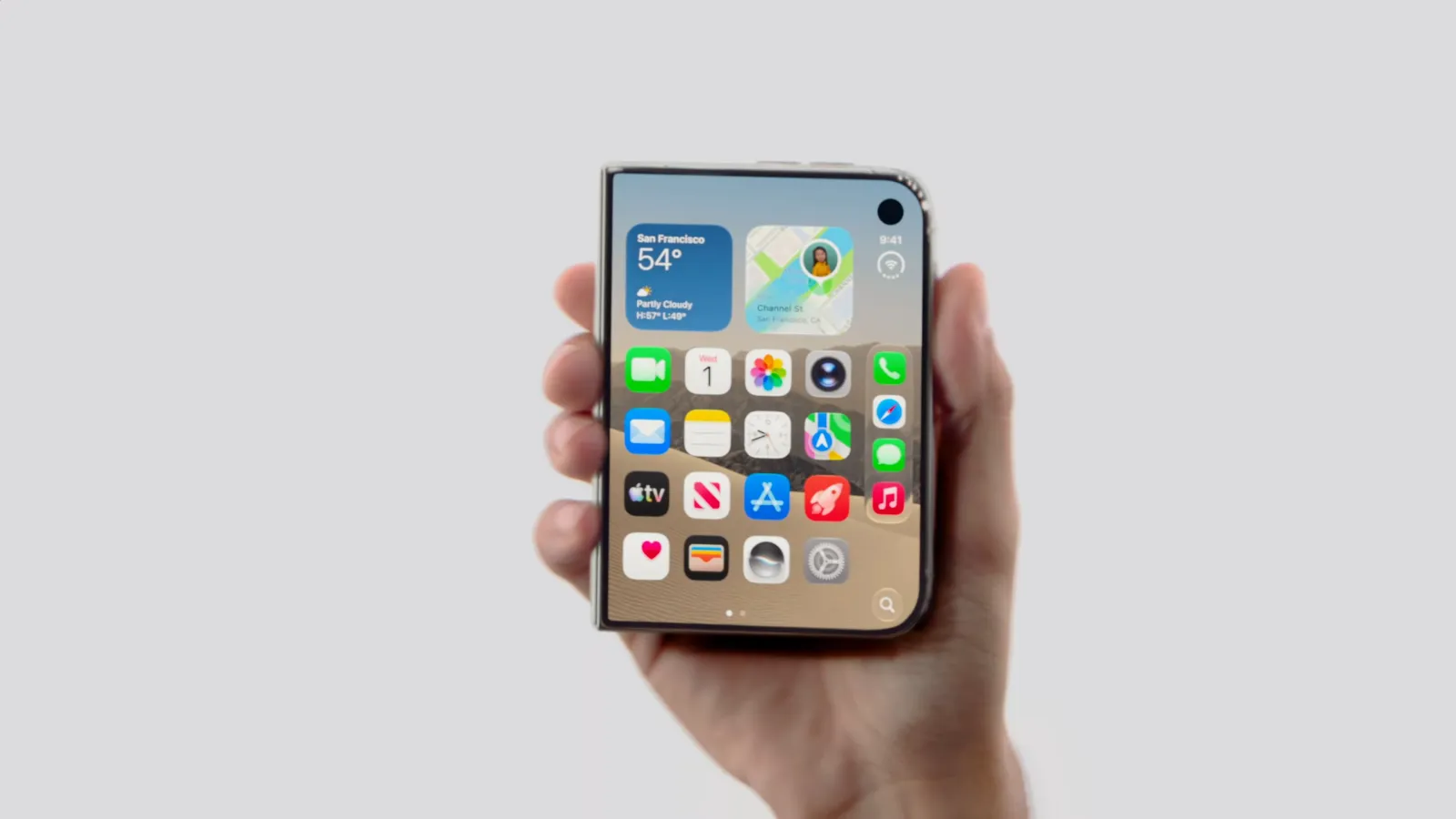
Apple’s first foldable iPhone arrives as a two‑screen device: an external display for standard phone use and a larger internal screen that unfolds like a book. The Duo’s doublewide interior panel measures 7.6 inches, roughly 50 percent larger than the iPhone Pro Max, and is designed to function more like a compact iPad than a stretched smartphone.
Apple executives emphasized that the Duo’s hinge and display architecture were engineered to avoid the “two phones stuck together” feel that has plagued early foldables.
The Duo features a titanium frame and speakers on both the top and bottom edges. Apple is launching the device in two finishes—Star White and Night Sky—with the external screen usable even when the phone is only partially opened. The company says the Duo delivers the largest display ever on an iPhone while still fitting into a pocket, a pitch aimed at users who want tablet‑like space without carrying a second device.
Apple’s entry comes after years of durability concerns that slowed mainstream adoption of foldables. Early models from Samsung and Motorola struggled with hinge failures, screen creasing and fragile protective layers.
Apple’s decision to wait, Ternus said, was deliberate as the company wanted a design that felt seamless, intuitive and structurally sound. The Duo’s hinge mechanism and internal display stack are Apple’s answer to those long‑standing complaints.
Related Story

New iPhone 18 May Signal Higher Prices Ahead
Samsung Fold Vs. Apple iPhone Duo: Price Differences
Apple’s first foldable phone enters the market with a premium price tag that puts it directly against Samsung’s flagship foldable — and slightly above it. The Duo starts at $1,999, coming in $100 higher than the base Samsung Galaxy Z Fold 8, which begins at $1,899 for the same 256GB configuration.
Apple’s pricing climbs quickly across storage tiers. The 512GB Duo is listed at $2,199, while the 1TB model reaches $2,599. A top‑end 2TB version pushes the device to $3,199, making it one of the most expensive foldables ever sold.
Samsung’s Fold 8 scales more modestly, topping out around $2,500 for its 1TB/16GB RAM variant.
The two devices also differ in timing. Samsung’s Galaxy Z Fold 8 is already on shelves following its mid‑July release, giving it a head start in the “passport‑style” foldable category both companies now occupy.
Apple will open iPhone Duo preorders on October 16, with units arriving in stores on October 23, positioning the device for the holiday cycle.
Can iPhone Duo Overcome Durability Doubts and Shift Foldable Adoption?
Foldables have struggled to reach mass adoption, in part because consumers question durability and long‑term reliability. Enthusiasts have tried to counter those concerns with stress‑test videos showing devices folding hundreds of thousands of times. Apple’s reputation for hardware polish and its ability to mainstream niche formats could shift that narrative, especially if the Duo proves sturdier than early competitors.
The idea of a flexible display has been around for decades. In 2007, the same year Apple introduced the first iPhone, Polymer Vision showed off a foldable e‑reader prototype called Readius, which never made it to market before the company shut down in 2009. Apple’s Duo is the company’s first attempt to bring that long‑imagined concept into the mainstream.
"Apple’s message was clear that the next generation of computing should be personal, private, and intelligent," EMARKETER analyst Jacob Bourne told Newsweek. "And Apple is no longer shying away from calling that intelligence AI. From deeper third-party integration with Siri and Apple Intelligence to camera features designed to verify authenticity, Apple is trying to apply AI to real-world problems while reinforcing the iPhone’s continued relevance as a device hub.
"The foldable iPhone Duo is a compelling addition, and Apple continues to differentiate through an ecosystem consumers already know and trust, but as always, price is the catch. The test is whether the trust Apple has cultivated, and the enormous installed base behind it, is enough to convince consumers to choose Apple’s AI devices over increasingly capable alternatives."
Analysts say Apple’s arrival could do more than ease durability concerns — it could reshape how the entire foldable category evolves. Carolina Milanesi, principal analyst at Creative Strategies, told Newsweek that Apple’s ecosystem strength alone could shift global adoption trends.
“Apple always adds credibility to a segment because it goes at it with the full ecosystem driving software and apps development,” Milanesi said. “This is going to help drive more engagement and ultimately create more stickiness to the devices. Android, if interested in this segment, will have to follow suit.”
She added that Apple’s timing may also reshape the competitive landscape. While companies like Samsung, Oppo and Xiaomi have made meaningful hardware progress, Milanesi said the software side has lagged because developers haven’t had a consistent form factor to build for.
“Vendors like Samsung, Oppo, Xiaomi have done a good job on the hardware side, but because of the fragmentation on form factor and the low volume, they have not seen much interest from the developers,” she said. Apple’s unified approach, she argued, could finally give developers a stable target — and show what foldables can do when software is designed around them rather than adapted to them.
As for what the Duo signals about Apple’s direction under CEO John Ternus, Milanesi said the device itself reflects decisions made before his tenure.
“I am not sure we can read much into the directions because the iPhone Duo is very much a Tim Cook product,” she said. “We can read into what John said this morning, though, which is that the iPhone is your intelligent personal hub and will remain that as more devices are brought to market and will orchestrate around it.”
Timeline: Apple’s Greatest Innovations Leading to the Foldable iPhone

...
1973-1992: Foundations of Mobile Technology
The smartphone era began decades before Apple entered the scene. In 1973, Motorola’s Martin Cooper made the first mobile phone call, paving the way for portable communications. By 1984, Motorola’s DynaTAC 8000X became the first commercial mobile phone—nicknamed “The Brick” for its 2‑pound weight and 30‑minute battery life.
In 1992, IBM unveiled the Simon Personal Communicator, widely recognized as the first true smartphone. It combined a touchscreen, stylus, email, faxing and apps like a calendar and notepad—features that foreshadowed the modern iPhone. The Simon’s bulky form and one‑hour battery life limited adoption, but it marked the beginning of smartphones as multifunctional devices.
1997-2007: Smartphones Emerge, Apple Prepares Its Move
By 1997, Ericsson coined the term “smartphone” for its GS88 prototype, and Nokia introduced Snake, launching the mobile gaming industry. Camera phones arrived in 1999 with Kyocera’s VP‑210, followed by Sharp’s J‑SH04 in 2000—the first mass‑market camera phone.
In 2001, 3G networks allowed phones to access the internet, setting the stage for Apple’s entry. But early smartphones were clunky hybrids—PDA‑phone mashups with styluses, physical keyboards and resistive touchscreens.
Everything changed in 2007.
2007: Apple Reinvents the Smartphone
Steve Jobs unveiled the first iPhone, calling it a “revolutionary and magical product.” It introduced a capacitive touchscreen, full web browsing, a wide LCD display and a software ecosystem that would soon support millions of apps. Apple sold 1.4 million iPhones in its first year, and by 2008, that number hit 11.6 million.
The iPhone mainstreamed touchscreens years after they were invented—and Apple is now betting it can do the same for foldables.
2008-2020: Rise of Android and the Modern Smartphone
In 2008, HTC and Google launched the first Android phone, the HTC Dream, with a slide‑out keyboard and the first Android Market. By 2009, 4G networks arrived, followed by 5G in 2019.
Smartphones became faster, thinner and more powerful. Cameras rivaled professional equipment, apps transformed daily life, and global smartphone users surged to 6.9 billion by 2023.
2018-2026: Foldable Era
Foldables began with Royole’s FlexPai in 2018—widely criticized for clunky software and fragile hinges. Samsung’s 2019 Galaxy Fold suffered “foldgate,” with reviewers peeling off a protective layer that wasn’t meant to be removed.
Huawei, Motorola and Microsoft experimented with outward folds, clamshells and dual‑screen hinges.
Contact Newsweek editors on this story: Gabe Whisnant, Dave Siminoff, Sam Wilson.
View 0 Comments
Submit Correction
View Editorial & AI Guidelines