10
Loading video...

By Pandora Dewan
Senior Science Reporter
0
Share
Newsweek is a Trust Project member
See more of our trusted coverage when you search.Prefer Newsweek on Googleto see more of our trusted coverage when you search.
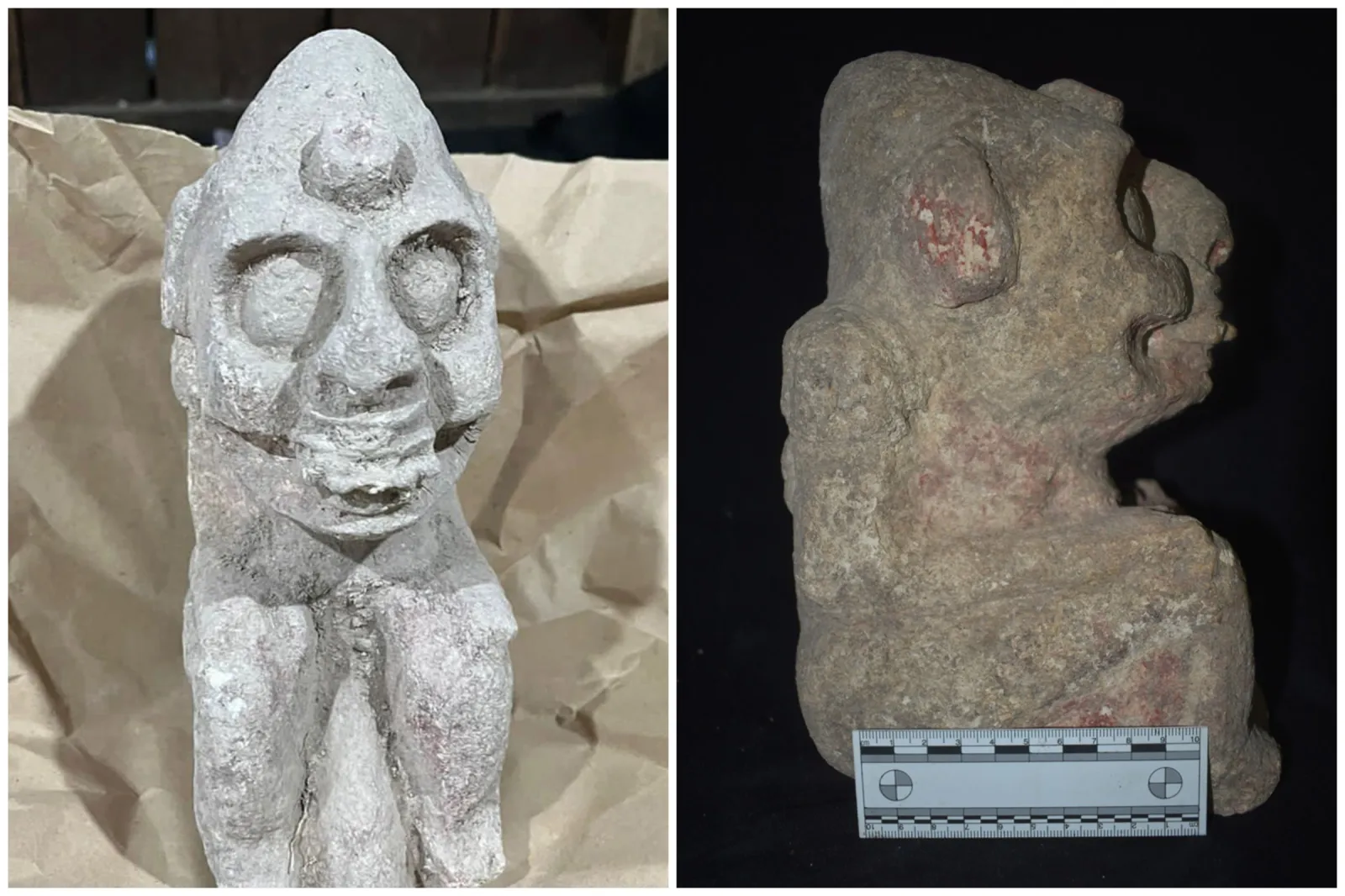
An ancient stone statue of a Maya death deity, dating back more than 1,400 years, has been discovered in southeatsern mexico.
Experts from the National Institute of Anthropology and History (INAH) uncovered the effigy near the town of Conhuas on June 16 during excavations for a new intercity train line.
According to the INAH, the human-like sculpture has been carved out of limestone and stands at roughly 10 inches tall. The emaciated figure is in a seated position and wears a nose ring and a mask on its skull. It also bears signs of skull elongation, a bone-shaping fashion statement sported by upper class Mayans.
Read More
Fury As Ancient Stone Monuments Destroyed to Build DIY Store3 min read

Face of Medieval Teen Girl in Rare Christian Burial Finally Revealed6 min read

Archaeologists Discover Exceptionally Well-Preserved 3,000-Year-Old Sword3 min read

...
"It is a figure that, due to its stark features, appeals to mortuary motifs and would be linked to a deity of death," Diego Prieto Hernández, the General Director of the INAH, said in a press release.
Our understanding of the Maya pantheon is still fairly limited, and at least 166 Maya deities have been named. According to Encyclopedia Britannica, the Maya god of death was called Cizin, also spelled Kisin, which in Maya means "Stinking One."
Cizin is often portrayed wearing a "death collar," consisting of a necklace of disembodied eyes, tied together by their nerve cords. In other depictions, he is shown in the form of a dancing skeleton, holding a smoking cigar-like object.
The stone figure was discovered near the archaeological zone of Balamkú, a pre-Hispanic city in the Campeche jungle. The site consists of three complexes, the largest of which is known as the Temple of the Jaguar, due to the feline engravings along its stone walls.
The recent discovery is just one of thousands of ancient Maya relics that have been discovered during these excavations, according to the INAH.
The Maya civilization first emerged between 7,000 B.C. and 2,000 B.C., according to the National Geographic, and reached its peak between 200 and 900 A.D. By this time, the Maya dominated what is now southeastern Mexico, Guatemala, Belize and the western areas of El Salvador and Honduras.
The Maya believed that divinity could be found in all things, even inanimate objects. Caves were particularly sacred in Maya culture as they were believed to be entrances to the underworld.
According to the Canadian Museum of History, the underworld had nine layers, each governed by its own Lord of the Night.
It is unclear whether the limestone effigy is a depiction of Cizin or one of the other Lords of the Night and research is ongoing to discover more about this find.
View 0 Comments
Submit Correction
View Editorial & AI Guidelines