...

By Jess Thomson
Science Reporter
0
Share
Newsweek is a Trust Project member
See more of our trusted coverage when you search.Prefer Newsweek on Googleto see more of our trusted coverage when you search.
A "totally new phenomenon" has been discovered by astronomers in a strange galaxy from the dawn of time.
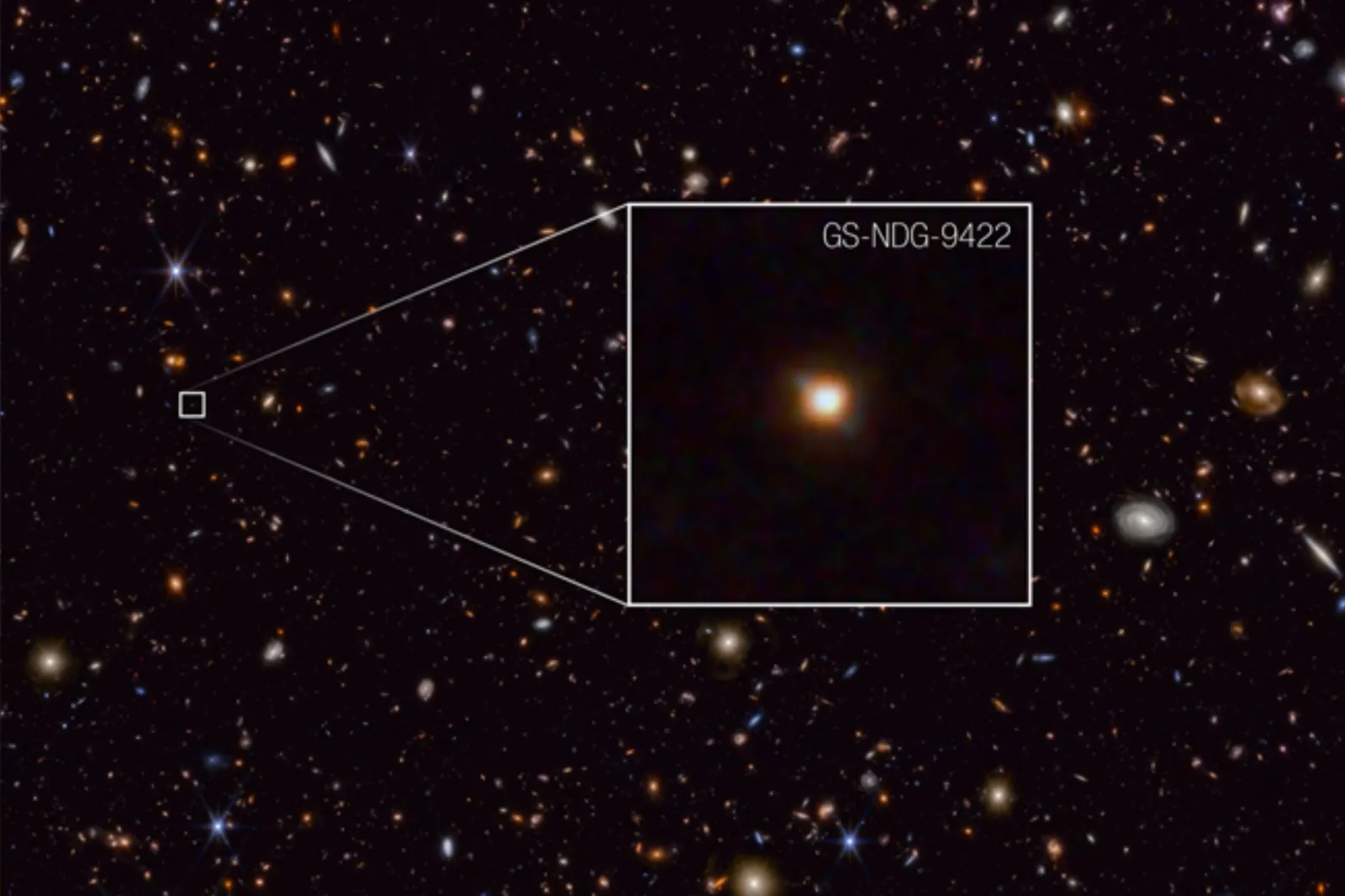
This galaxy, named GS-NDG-9422 (9422), was discovered by the James Webb Space Telescope to have an unusual light signature suggesting that its gas shines brighter than its stars, according to a new paper in the journal Monthly Notices of the Royal Astronomical Society.
This galaxy existed about 1 billion years after the Big Bang—which occurred about 13.8 billion years ago—meaning that it could be a missing link between the formation of the universe's earliest galaxies and the galaxies that exist today.
Read More on Science
...
"My first thought in looking at the galaxy's spectrum was, 'that's weird,' which is exactly what the Webb telescope was designed to reveal: totally new phenomena in the early universe that will help us understand how the cosmic story began," study co-author Alex Cameron, a researcher at the University of Oxford, said in a statement.
The researchers modeled the bizarre light signature from the newly discovered ancient galaxy, and found that it could be explained by the gas clouds in the galaxy being heated to immense temperatures by extremely hot stars, so much so that the gas actually shone more brightly than the stars themselves. Therefore, the images of the galaxy taken by the James Webb Space Telescope are actually lit up by this hot gas, rather than the stars.
"It's common to observe some emission coming from gas, but usually it's only a small fraction of the total light observed from the galaxy. Whenever galaxies have recently formed stars, the hot young stars heat the gas around them, and this gas will then emit some light," Cameron told Newsweek. "But this is the first time a galaxy has been observed with such strong gas emission that it's glowing brighter than the light coming directly from the stars."
Galaxy 9422's stars appear to be burning at 140,000 degrees Fahrenheit, which is much higher than the average temperature of stars in the universe today, which ranges between 70,000 to 90,000 degrees F.
"This gives us tremendous new insights into the properties of stars that were forming in these early phases of the universe," Cameron said.

...
The galaxy is thought to be forming many of these huge, hot stars within clouds of gas, causing the gas to shine incredibly brightly. This may show how some of the first generation of stars formed, which are called Population III stars.
"We know that this galaxy does not have Population III stars, because the Webb data shows too much chemical complexity. However, its stars are different than what we are familiar with—the exotic stars in this galaxy could be a guide for understanding how galaxies transitioned from primordial stars to the types of galaxies we already know," study co-author Harley Katz, a researcher at the University of Oxford and the University of Chicago, said in the statement.
The researchers hope to use the JWST to find more galaxies from the earliest days of the universe to further understand how the first stars and galaxies formed.
"It's a very exciting time, to be able to use the Webb telescope to explore this time in the Universe that was once inaccessible," Cameron said. "We are just at the beginning of new discoveries and understanding."
Do you have a tip on a science story that Newsweek should be covering? Do you have a question about galaxies? Let us know via science@newsweek.com.
References
Cameron, A. J., Katz, H., Witten, C., Saxena, A., Laporte, N., & Bunker, A. J. (2024). Nebular dominated galaxies: insights into the stellar initial mass function at high redshift. Monthly Notices of the Royal Astronomical Society. https://doi.org/10.1093/mnras/stae1547
View 0 Comments
Submit Correction
View Editorial & AI Guidelines