...

By Jenna Sundel
News Reporter
0
Share
Newsweek is a Trust Project member
See more of our trusted coverage when you search.Prefer Newsweek on Googleto see more of our trusted coverage when you search.
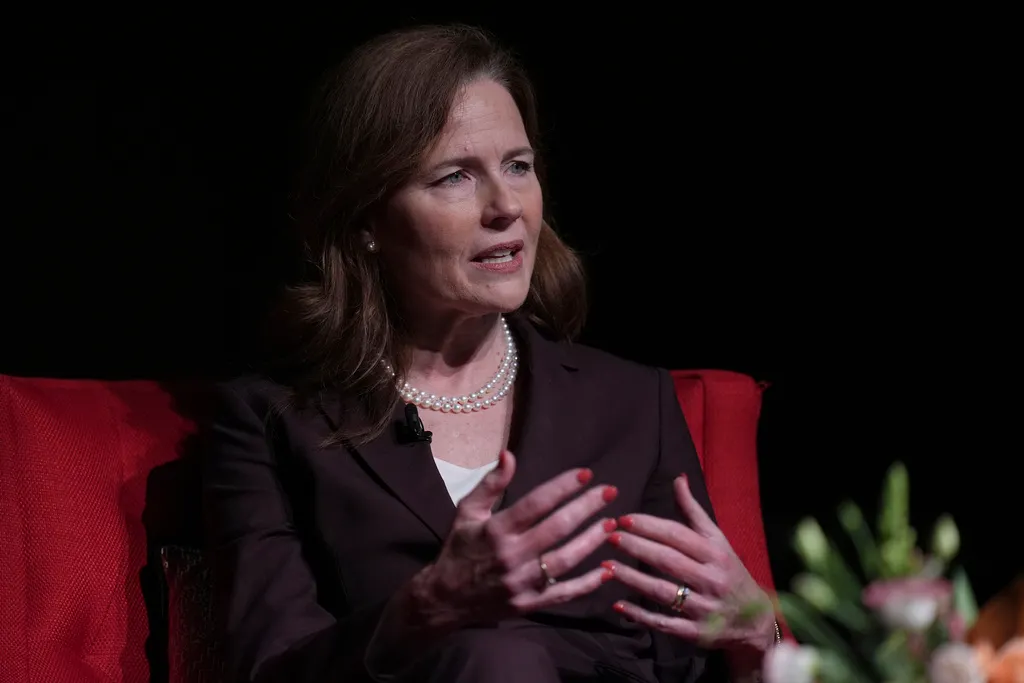
Supreme Court Justice Amy Coney Barrett asked a lawyer representing the Democratic National Committee (DNC) on Tuesday whether overturning limits on how much a political party can spend would benefit the Republican Party.
“Normally, regulated parties are happy to get rid of regulation and, obviously, this ties the DNC’s hands just as much as it ties the RNC’s hands,” Barrett said during oral arguments in NRSC v. FEC. “So, I guess my questions are two. One is if the parties have long been aligned on this, why change the position? And two, if there isn’t an imbalance in who this benefits, why would the DNC be here? Why would your client be here if it didn’t perceive this to be something that would benefit the RNC more than the DNC?”
Marc Elias, who argued on behalf of the DNC, the Democratic Senatorial Campaign Committee and the Democratic Congressional Campaign Committee, said he does not believe the parties have been aligned on this matter.
Read More on U.S.
“Our office holders and our members in voting in Congress and in their public statements and in the platform of the Democratic Party have not been aligned with striking down this limit,” Elias said.
...
Why It Matters
On Tuesday, the Supreme Court heard oral arguments in NRSC v. FEC, a case that could overturn a decades-old decision on how much political parties can spend in races for Congress and the president. The limits on coordinated spending are intended to prevent wealthy donors from skirting contribution caps to candidates by giving money to political parties, which then give it to the candidate.
What To Know
Elias said striking down coordinated party spending limits would impact the DNC’s efforts to build the party and register voters.
“They will not be able to support activity that is long-term in nature because there will be an arms race that right now doesn’t exist," Elias said. “The coordinated party spending limits act as a buffer on how much money you can pump into directly paying the bills of a House or Senate campaign or a presidential campaign, so that you have funds to do these other party-building functions.”
Noel Francisco, an attorney representing the National Republican Senatorial Committee, said the limits are “at war” with recent high court decisions. The Federal Election Commission, which changed its view on the issue after President Donald Trump took office, also argued that the limits should be struck down.
Republicans want to eliminate the limits on coordinated spending, allowing parties to spend more freely on TV ads and organizing efforts for individual candidates.
What People Are Saying
Supreme Court Justice Brett Kavanaugh, during oral arguments on Tuesday: "I am concerned, as you said, that the combination of campaign finance laws and this court's decisions over the years have together reduced the power of political parties as compared to outside groups with negative effects on our constitutional democracy. So I start from that, and I'm trying to figure out how this case fits into that with respect to political parties and the strength of political parties."
Noel Francisco, an attorney representing the National Republican Senatorial Committee, during oral arguments on Tuesday: "Lots of candidates are running unopposed or they have very little chance of winning or they're just generally in safe seats. Parties don't want to spend money on behalf of those candidates. So if I'm trying to submit a bribe to bribe that candidate, it's not likely going to get through to the candidate at the end of the day. And if it does, it's going to be pretty blazingly obvious."
What Happens Next
The Supreme Court has not yet issued a ruling in the case.
Do you have a story that Newsweek should be covering? Do you have any questions about this story? Contact LiveNews@newsweek.com.
View 0 Comments
Submit Correction
View Editorial & AI Guidelines