
Photo-illustration by Newsweek/Getty/America's Leading Doctors ranking methodology

By Lauren Giella
Senior Reporter
0
Share
Newsweek is a Trust Project member
See more of our trusted coverage when you search.Prefer Newsweek on Googleto see more of our trusted coverage when you search.
Choosing the right doctor matters—especially when you or a loved one is facing complex or life-saving surgery. Specialists go beyond the common diagnoses and care from general practitioners to offer advanced expertise to treat specific conditions with focus and precision.
In addition to the specific training and certifications required to advance in their fields, these physicians also share a similar passion and metric for success when providing top-tier care to patients.
For the first time, Newsweek and Statista compiled a ranking of America's Leading Doctors 2025, which highlights more than 2,800 doctors from 15 medical specialties in hospital systems around the country. Previously, the partners published top rankings for vascular and spine surgeons; this is the first comprehensive ranking to be published.
Read More
Gastrointestinal Cancers Are Rising Among US Adults Under 504 min read

Americans Are Using AI To Diagnose Their Health Issues3 min read

How Dr. Heather Farley Led a Wellness Revolution for Health Care Workers6 min read

"High-quality specialist care is crucial for long-term health," Statista told Newsweek in a statement. "With this new resource, Statista and Newsweek continue to expand their portfolio of high-quality health care rankings, committed to empowering patients with trusted, data-driven guidance for some of life's most important health decisions."
Each specialty highlights 175 to 200 doctors, with the top 30 ranked numerically, and the rest listed alphabetically by last name.
The specialties include:
- Cardiothoracic Surgery – Top 200
- Cataract Surgery – Top 200
- Colorectal Surgery – Top 185
- Foot and Ankle Surgery – Top 200
- Glaucoma Surgery – Top 200
- Hand Surgery – Top 200
- Hip Surgery – Top 200
- Knee Surgery – Top 200
- Mohs Surgery – Top 100
- Pain Management – Top 200
- Retina Surgery – Top 200
- Shoulder Surgery – Top 200
- Spine Surgery – Top 200
- Sports Medicine – Top 175
- Vascular Surgery – Top 185
Ranked doctors have up to three affiliated hospitals, which are determined by patient volume and desk research. Doctors with no hospital affiliations listed may work in private practices or at an institute.
Being a top specialist requires not only years of training but deep commitment and the mindset that the job is tough and inconvenient.
Dr. Leonard Girardi, the top cardiothoracic surgeon on the breakout ranking, is a professor and chief of cardiothoracic surgery at NewYork-Presbyterian and Weill Cornell Medicine.
"Today's faculty member has to understand that it is not a job, it is a career, it is a commitment, it is a passion, and you have to be willing to make a lot of sacrifices so that you can be available and deliver the best care to your patients who are under your care," he told Newsweek. "And that may be inconvenient, but 24/7 is the business, at least of cardiothoracic surgery. You can't flip a switch and turn it off."
...
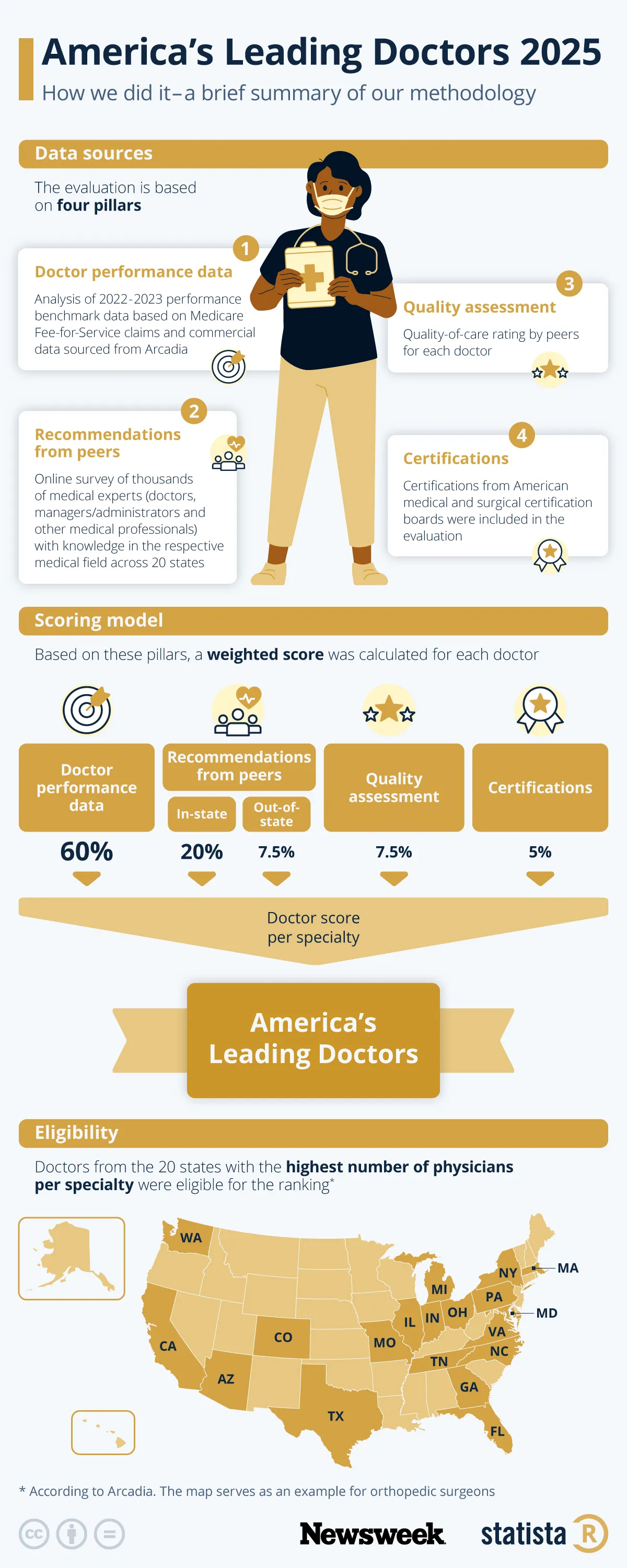
Doctors were evaluated based on four main data sources.
The first was doctor performance data from Medicare Fee-for-Service claims and CareJourney, a health care analytics platform that offers insights to optimize care and costs and was acquired by Arcadia in 2024. Doctors were measured based on 2022 and 2023 "episode of care data," meaning the set of services provided by the doctors to treat a procedure or condition in their specialty, like heart valve surgery for cardiothoracic surgeons or hip replacements for hip surgeons.
Both episode volume and outcomes, including average days of long-term stay, mortality rates, complications, unplanned readmissions and average payment, were factored into the score. Doctors who treated a high volume of patients in 2023 received a separate "High Performance" demarcation in the form of one, two or three ribbons.
Establishing trust with patients is critical, especially when patients are facing serious, life-threatening procedures. Even with the success rate of open heart surgery near 98 percent, Girardi understands that his patients who are referred to him by their primary care physician might be anxious.
"It's really important to be able to take complex situations and put it into layperson terms," he said. "You have to instill confidence in that and in them, so that they feel that OK in a one-hour conversation ... and that's something that I think you need to always keep in the back of your mind because that's a very humbling thing."
The second data source was peer recommendations. Thousands of medical experts participated in an online survey from March to May 2025 to recommend doctors in their specialty either in or out of their respective states. Recommendations were weighed based on the order of preference indicated, the reason for recommendation and the professional experience of the survey participant.
Survey participants had expertise in one or more of the 15 specialties included on the ranking across the 20 states with the highest number of specialists in the country. Those states include Arizona, California, Colorado, Florida, Georgia, Illinois, Indiana, Maryland, Massachusetts, Michigan, Missouri, New Jersey, New York, North Carolina, Ohio, Pennsylvania, Tennessee, Texas, Virginia and Washington. All doctors in these states were eligible for consideration as long as they performed a minimum number of relevant episodes for each specialty. The top states vary slightly between the specialties.
"Having the confidence of your peers and the respect of your peers is certainly something that is incredibly rewarding and valuable," Girardi said. "If you're doing decent work over a long period of time, hopefully that respect and that confidence in your work will follow. And I'm very grateful, and I think that's the foundation to ultimately having the same confidence coming from patients."
On the recommendations, participants were also asked to assess the quality of care for each doctor, including treatment, follow-up care and use of the most up-to-date equipment, as well as the professional expertise of the doctor. Doctors were rated by peers on a scale of one (poor) to 10 (excellent).
These three data points as well as each doctor's certifications for their specialty from American medical and surgical certification boards contributed to each doctor's final score. Doctor performance data made up 60 percent, peer recommendations accounted for 27.5 percent and quality assessment and certifications made up 7.5 percent and 5 percent, respectively.
...
For the doctors on the list, being a leading doctor in their respective specialty requires more than these data points.
As these fields evolve through research and technological advancements, physicians are able to provide better care—meaning using less invasive procedures and offering personalized care to each patient.
Dr. Joseph Ricotta is the national medical director for Vascular Surgery and Endovascular Therapy for Tenet Healthcare and chairman of the Department of Surgery at Delray Medical Center. He ranked No. 2 on the vascular surgery specialty list.
He told Newsweek that his field has advanced with the help of new technology to offer minimally invasive procedures, surgical robots to simplify complex procedures with more stability and accuracy and AI tools to more quickly predict conditions like aortic aneurysms and pulmonary embolisms based on CAT scan results.
These tools allow doctors to provide more comprehensive and tailored treatments to patients, Ricotta said.
"At the end of the day, it's all about quality and patient outcomes," he said. "Providing that individualized approach to each patient and being able to pull from the big tool kit we have as vascular surgeons allows us to provide the best care for patients."
Advances like minimally invasive surgery and other new treatments are improving the quality of care across several specialties. But they are also helping patient outcomes for years after they leave the operating room.
Dr. Martin Weiser is a surgical oncologist specializing in colon cancer, rectal cancer, small bowel cancer, appendiceal cancer and anal cancer at Memorial Sloan Kettering Cancer Center. He is the top-ranked colorectal surgeon on Newsweek's list.
In recent years, there has been an alarming spike in colorectal cancer in young people, prompting experts to lower the recommended screening age to 45. Early diagnosis is critical for the survival of young patients in their 20s and 30s, and doctors are thinking about how to personalize the care to ensure they can maintain healthy lives after treatment.
He told Newsweek that listening to the patient and seeing what they need is the first step in being a great doctor in any specialty.
"There's a standard of care that's in a textbook that experts say is the best way to treat patients, and that's how we treat most patients," he said. "But there's always exceptions and certain specific patient needs that we should consider, and [we] take the time to listen to the patients to see what they need [and] help explain to them the use of alternative treatments."
Focusing on long-term survival means developing treatment beyond radiation to preserve patient fertility and using chemotherapy and radiation to avoid surgery or colostomy bags that can lead to poor bowel function.
"These are even more important when we have younger patients that would potentially live for 40 years after their treatment, because the majority of people with colorectal cancer are cured," he said. "So it's all about maintaining the highest quality of life while we provide a cure whenever possible."
Weiser said he has dedicated his life to studying cancer, from the biology to the treatment, and it is the patient's recovery and return to normal or near-normal that drive him every day. That is why he is dedicated to doing research to advance the field for the broader community to reduce treatment toxicity while maintaining good, quality outcomes and continuing to learn along the way.
"I think certain medicine and surgery is a humbling field because complications and bad outcomes occur all the time, and you have to accept that, learn from it whenever you can and move forward," he said. "In the back of my mind, I carry the memory of a lot of patients that may not have done as well as I had hoped, to try to remember: Is there something we can learn? I think that's what drives our research, and it gets you up every day to do a better and better job."
Below outlines the episodes performed, certifications and states taken into account for doctor scores in each specialty. The 20 states listed are the ones with the highest number of doctors per specialty.
Episodes per specialty: Physicians who treated a high number of patients in 2023 received a separate "High Performance" demarcation in the form of ribbons. Doctors in the 75th percentile received one ribbon, the 85th percentile received two and the 95th percentile received three. These ribbons do not directly impact a doctor's ranking.
Peers' choice: Survey participants were also able to specify a "peers' choice" standout treatment for each recommended doctor. A peers' choice standout treatment was selected only when more than 10 doctors received multiple recommendations for that episode.
Cardiothoracic Surgery
Episodes
- Heart valve surgery (30% weighting toward episode score)
- Coronary artery bypass graft surgery (30% weighting toward episode score)
- Heart device and aorta surgeries (20% weighting toward episode score)
- Surgical removal of lung (20% weighting toward episode score)
Board Certification
- American Board of Surgery – General Surgery
Peer Choice
- Coronary artery bypass graft surgery
States Included
- Arizona, California, Florida, Georgia, Illinois, Indiana, Maryland, Massachusetts, Michigan, Missouri, New Jersey, New York, North Carolina, Ohio, Pennsylvania, Tennessee, Texas, Virginia, Washington, Wisconsin
Cataract Surgery
Episodes
- Cataract (20% weighting toward episode score)
- Secondary membranous cataract surgery (40% weighting toward episode score)
- Cataract surgery with lens implant (40% weighting toward episode score)
Board Certification
- American Board of Ophthalmology
States Included
- Arizona, California, Colorado, Florida, Georgia, Illinois, Maryland, Massachusetts, Michigan, Minnesota, New Jersey, New York, North Carolina, Ohio, Pennsylvania, Tennessee, Texas, Virginia, Washington, Wisconsin
Colorectal Surgery
Episodes
- Acute hemorrhoids (25% weighting toward episode score)
- Blockage of the digestive tract (10% weighting toward episode score)
- Colonoscopy (25% weighting toward episode score)
- Surgical removal of colon (40% weighting toward episode score)
Board Certifications
- American Board of Surgery – General Surgery
- American Board of Colon and Rectal Surgery
Peer Choice
- Surgical removal of colon
States Included
- Arizona, California, Connecticut, Florida, Georgia, Illinois, Indiana, Louisiana, Maryland, Massachusetts, Michigan, Minnesota, Missouri, New Jersey, New York, Ohio, Pennsylvania, Texas, Virginia, Washington
Foot and Ankle Surgery
Episodes
- Broken or dislocated ankle/foot (40% weighting toward episode score)
- Surgery to replace ankle joint (20% weighting toward episode score)
- Fracture/dislocation treatment lower leg/ankle/foot (40% weighting toward episode score)
Board Certifications
- American Board of Orthopaedic Surgery
States Included
- Arizona, California, Colorado, Florida, Georgia, Illinois, Indiana, Maryland, Massachusetts, Michigan, Missouri, New Jersey, New York, North Carolina, Ohio, Pennsylvania, Tennessee, Texas, Virginia, Washington
Glaucoma Surgery
Episodes
- Glaucoma (30% weighting toward episode score)
- Glaucoma surgery (70% weighting toward episode score)
Standout Treatments
- Surgeries that improve fluid drainage
- Surgeries that decease fluid production
- Incision of eye and revision of iris
- General eye pressure relief procedures
Board Certification
- American Board of Ophthalmology
Sates Included
- Arizona, California, Colorado, Florida, Georgia, Illinois, Maryland, Massachusetts, Michigan, Minnesota, New Jersey, New York, North Carolina, Ohio, Pennsylvania, Tennessee, Texas, Virginia, Washington, Wisconsin
Hand Surgery
Episodes
- Joint or tendon inflammation of the finger/wrist/hand (15% weighting toward episode score)
- Joint cyst (15% weighting toward episode score)
- Inflammation or injury of the tendons or ligaments in the arm (15% weighting toward episode score)
- Fracture/dislocation treatment arm/wrist/hand (40% weighting toward episode score)
- Carpal tunnel and related syndromes (15% weighting toward episode score)
Board Certifications
- American Board of Orthopaedic Surgery
- American Board of Orthopaedic Surgery – Subspecialty Hand
States Included
- Arizona, California, Colorado, Florida, Georgia, Illinois, Indiana, Maryland, Massachusetts, Michigan, Missouri, New Jersey, New York, North Carolina, Ohio, Pennsylvania, Tennessee, Texas, Virginia, Washington
Hip Surgery
Episodes
- Repeat hip or knee replacement surgery (30% weighting toward episode score)
- Hip replacement (40% weighting toward episode score)
- Fracture/dislocation treatment pelvis/hip/femur (30% weighting toward episode score)
Board Certifications
- American Board of Orthopaedic Surgery
States Included
- Arizona, California, Colorado, Florida, Georgia, Illinois, Indiana, Maryland, Massachusetts, Michigan, Missouri, New Jersey, New York, North Carolina, Ohio, Pennsylvania, Tennessee, Texas, Virginia, Washington
Knee Surgery
Episodes
- Knee arthroscopy (20% weighting toward episode score)
- Knee joint injury treatment (20% weighting toward episode score)
- Knee replacement (30% weighting toward episode score)
- Knee fracture/dislocation treatment (10% weighting toward episode score)
- Treatment of inflammation/injury of the tendons/ligaments in the leg (20% weighting toward episode score)
Board Certifications
- American Board of Orthopaedic Surgery
States Included
- Arizona, California, Colorado, Florida, Georgia, Illinois, Indiana, Maryland, Massachusetts, Michigan, Missouri, New Jersey, New York, North Carolina, Ohio, Pennsylvania, Tennessee, Texas, Virginia, Washington
Mohs Surgery
Episodes
- Removal of cancerous skin growth (100% weighting toward episode score)
Board Certifications
- American College of Mohs Surgeons (ACMS) Member
- American Board of Dermatology – MDS (Micrographic Dermatologic Surgery)
States Included
- Alabama, Arizona, California, Florida, Georgia, Illinois, Maryland, Massachusetts, Michigan, Missouri, New Jersey, New York, North Carolina, Ohio, Pennsylvania, South Carolina, Tennessee, Texas, Virginia, Wisconsin
Pain Management
Episodes
- Disorders of the thoracic spine (8% weighting toward episode score)
- Injection for back pain (28% weighting toward episode score)
- Lower back pain (28% weighting toward episode score)
- Neck pain and spine problems (28% weighting toward episode score)
- Spinal stenosis post laminectomy (8% weighting toward episode score)
Board Certifications
- American Board of Physical Medicine and Rehabilitation
- American Board of Anesthesiology
- American Board of Pain Medicine
States Included
- Arizona, California, Florida, Georgia, Illinois, Indiana, Kentucky, Maryland, Michigan, Missouri, Nevada, New Jersey, New York, North Carolina, Ohio, Pennsylvania, Tennessee, Texas, Virginia, Wisconsin
Retina Surgery
Episodes
- Age-related macular degeneration (15% weighting toward episode score)
- Blockage of vein or artery in the retina (eye) (15% weighting toward episode score)
- Destruction of retinal or choroid lesions by laser or other (15% weighting toward episode score)
- Retinal detachment (15% weighting toward episode score)
- Surgical retina and vitreous procedures (40% weighting toward episode score)
Board Certifications
- American Board of Ophthalmology
States Included
- Arizona, California, Colorado, Florida, Georgia, Illinois, Maryland, Massachusetts, Michigan, Minnesota, New Jersey, New York, North Carolina, Ohio, Pennsylvania, Tennessee, Texas, Virginia, Washington, Wisconsin
Shoulder Surgery
Episodes
- Shoulder arthroscopy/rotator cuff repair (40% weighting toward episode score)
- Total shoulder replacement (60% weighting toward episode score)
Board Certifications
- American Board of Orthopaedic Surgery
Peer Choice
- Total shoulder replacement
States Included
- Arizona, California, Colorado, Florida, Georgia, Illinois, Indiana, Maryland, Massachusetts, Michigan, Missouri, New Jersey, New York, North Carolina, Ohio, Pennsylvania, Tennessee, Texas, Virginia, Washington
Spine Surgery
Episodes
- Spinal fusion (34% weighting toward episode score)
- Disorders of the thoracic spine (14% weighting toward episode score)
- Spinal deformity or curvature (5% weighting toward episode score)
- Spinal stenosis post-laminectomy (5% weighting toward episode score)
- Back and neck pain treatment without fusion (14% weighting toward episode score)
- Lower back pain (14% weighting toward episode score)
- Neck pain and spine problems (14% weighting toward episode score)
Board Certifications
- American Board of Orthopaedic Surgery
- American Board of Spine Surgery (ABSS)
Peer Choice
- Spinal fusion
States Included
- Alabama, Arizona, California, Florida, Georgia, Illinois, Indiana, Maryland, Massachusetts, Michigan, Missouri, New Jersey, New York, North Carolina, Ohio, Pennsylvania, Tennessee, Texas, Virginia, Washington
Sports Medicine
Episodes
- Pain in Joint (45% weighting toward episode score)
- Arthritis (45% weighting toward episode score)
- Carpal tunnel and related syndromes (10% weighting toward episode score)
Board Certifications
- American Board of Orthopaedic Surgery
- American Board of Orthopaedic Surgery – Sports Medicine Subspecialty Certification
- American Board of Physical Medicine and Rehabilitation (Sports Medicine)
States Included
- Arizona, California, Colorado, Florida, Georgia, Illinois, Indiana, Maryland, Massachusetts, Michigan, Missouri, New Jersey, New York, North Carolina, Ohio, Pennsylvania, Tennessee, Texas, Virginia, Washington
Vascular Surgery
Episodes
- Creation or repair of blood vessel access for dialysis (28% weighting toward episode score)
- Surgery to improve blood flow in carotid arteries (28% weighting toward episode score)
- Surgery to restore blood flow to the leg (28% weighting toward episode score)
- Varicose vein treatments (8% weighting toward episode score)
- Peripheral vascular disease treatment (8% weighting toward episode score)
Board Certifications
- American Board of Surgery – General Surgery
- American Board of Surgery – Vascular Surgery
States Included
- Arizona, California, Florida, Georgia, Illinois, Indiana, Maryland, Massachusetts, Michigan, Missouri, New Jersey, New York, North Carolina, Ohio, Pennsylvania, Tennessee, Texas, Virginia, Washington, Wisconsin
View 0 Comments
Submit Correction
View Editorial & AI Guidelines