10
Loading video...

By Giulia Carbonaro
Senior Reporter
0
Share
Newsweek is a Trust Project member
See more of our trusted coverage when you search.Prefer Newsweek on Googleto see more of our trusted coverage when you search.
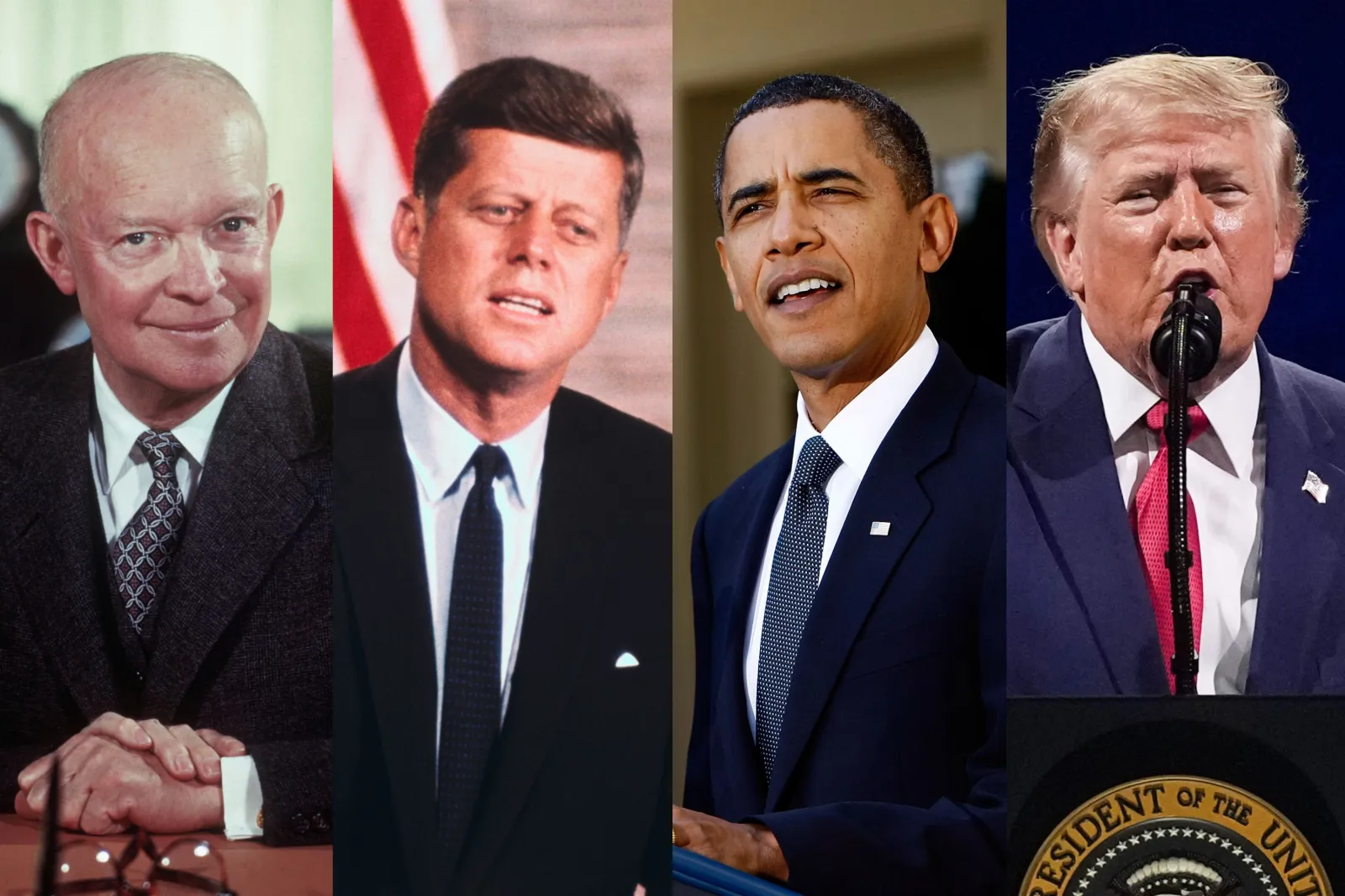
Back in the days when Republican Dwight D. Eisenhower sat in the Oval Office, Americans used to like their presidents—no matter what parties they belonged to.
Now, after decades of increasing political polarization in the United States, presidents can forget about cross-party support, as the “great divide” proves too wide to bridge for leaders on either side of the political spectrum.
In fact, the partisan divide in presidential approval is now wider than at any point in more than seven decades of polling stretching back to Eisenhower’s presidency, according to a new Pew Research Center survey.
Read More on Politics
President Donald Trump’s approval rating was 34 percent as of mid-July, lower than at any point in his first term but comparatively stable since the U.S. launched joint strikes on Iran with Israel in late February, starting the ongoing war in the Middle East, which led to rising inflation in the country. It is even lower than former President Joe Biden’s approval rating of 37 percent during the summer of 2022, when inflation was rampant.
...
Approval ratings dips from a president’s inauguration through the midterms are not uncommon, but what is most noticeable is how little support Trump now has among voters on the other side of the political spectrum. Trump’s approval rating over the course of his second term so far has averaged 84 percent among Republicans and 6 percent among Democrats, a 78 percentage point gap.
It is nearly an all-time record: the only time the gap was wider was during Trump’s first term, at 80 percent. The data analyzed by Pew does not consider independent leaning one way or another.
Newsweek reached out to the White House for comment via email.
From Eisenhower to Trump, How the Country Has Grown More Divided
While Trump breaks the record for the biggest partisan gap in presidential approval, his case is far from unique.
The next-widest partisan gaps in U.S. history prove that Republicans are just as likely as Democrats to dislike presidents from the other party, with Biden reporting a 71 percentage point gap and Democrat Barack Obama a 67 percentage point gap during his two terms in office.
This is not the way it used to be. Eisenhower’s approval rating in the 1950s was 88 percent among Republicans and 49 percent among Democrats. Similarly, Democrat John F. Kennedy in the 1960s could count on the support of 84 percent of Democrats and 49 percent of Republicans.
But historical data shows that the current divide “is part of a political trend that has been gaining strength since the 1970s,” Julian Zelizer, a professor of political history at Princeton University, told Newsweek.
During his time in office, Democrat Lyndon B. Johnson had the support of 70 percent of Democrats but only 40 percent of Republicans. His successor, Republican Richard Nixon, was backed by 75 percent of his party, but only 34 percent of Democrats approved of his handling of the presidency.
The partisan gap shrank modestly for Republican Gerald Ford, whose job was approved of by 67 percent of Republicans and 36 percent of Democrats, but widened again under Democrat Jimmy Carter, with 57 percent of Democrats approving of the president compared to only 30 percent of Republicans.
Republican Ronald Reagan was similarly divisive, receiving the approval of 83 percent of Republicans but only 31 percent of Democrats. Since then, the divide within U.S. politics has gotten even worse.
“The two political parties and the American electorate are far more polarized than they were even during Ronald Reagan’s administration,” William A. Galston, a former policy adviser to Clinton and an expert on domestic policy, political campaigns, and elections, holding the Ezra K. Zilkha Chair in Governance Studies at the Brookings Institution, told Newsweek.
“And, as a result, presidents of the opposing party are identified with principles and programs that the opposition rejects, and not only rejects intellectually, but rejects viscerally and emotionally,” he said.
“Presidents in most of the 21st century have evoked visceral opposition from the other side,” Galston said. “It all kicked off with the contested results of the 2000 election, which really poisoned the well from the outset, and it hasn’t eased up during this entire period.”
The data shows signs of this acceleration. While Republican George H. W. Bush’s gap was 44 percentage points during his term in office in the 1990s, the partisan gap had grown to 58 percentage points during George W. Bush’s presidency in the 2000s. Democrat Bill Clinton’s was 53 percent. Under Obama, Biden, and Trump, it continued plunging lower and lower.
Related Story
Donald Trump’s Approval Rating Shifts Among Christians
Is Trump the Reason Behind the Nation’s Growing Political Divide?
Trump might have turbocharged the political rift in the country, but the current divide has not originated with him. According to a recent study by the University of Cambridge, political and social divisions within the U.S. population have increased by 64 percent since 1988, with almost all this coming after 2008.
This was a big year for the country: 2008 was when the housing bubble burst, the financial crisis started, Obama took office, and Apple launched its App Store. According to this study, it was Americans on the left who moved further left on many issues (they were 31.5 percent more socially liberal in 2024 compared to 1988), while the right remained relatively stable (only 2.8 percent more conservative).
While not pointing the finger at either side, Zelizer agrees that U.S. voters have changed dramatically since the time of Eisenhower.
“The electorate was much more movable in 1952 and 1956. Presidential candidates were able to swing states, many more, than is possible today. Even within states, outside the south, there was much more partisan diversity than today,” he said.
“Partisan division is stronger, but that division has increasingly manifested itself in what political scientists call ‘affective polarization,' where people emotionally dislike each other at an emotional and not just political level,” Zelizer said.
Galston speaks of the events throughout the past quarter of a century which “have added fuel to the fire of polarization,” as he describes it. “Starting with the long wars in the Middle East after 9/11, then, of course, the financial crisis and its aftermath, the handling of the COVID pandemic, which you might have thought would bring the country together against a common foe, but divided us further,” he said.
“And Donald Trump is arguably the most divisive president in modern American history, because he divides in order to conquer; that’s his modus operandi. It’s not working very well right now, but it has worked in the past,” he added.
“So you put it all together, and there has been nothing in the past 25 years to quench the fire and a lot of fuel added to it.”
But Galston believes that, though he “didn’t invent partisan polarization,” Trump has used it “very deliberately as a political instrument” to solidify his own base, he said.
“He believes that policies of conciliation and compromise demobilize his base and his modus operandi is to keep his base aroused and loyal to him at all costs. And he never wavers for that,” he said.
“As a result, he very rarely takes steps that have any potential whatsoever bringing the two parties together, because he thinks that would undermine his strategy,” Galston added. “And there’s no question about the fact that it has helped him to maintain an iron grip on his own political party.”
Will the Future Remain Polarized?
The historic trend would suggest that the partisan gap might remain as wide as it has been over the past twenty years. But according to Galston, the country’s partisan division would be “an important issue” in the forthcoming Democratic and Republican presidential primary.
“There may be conciliatory candidates,” he said, though adding that under current circumstances, he does not think they would get very far.
“But I think that some Democrats will argue that governing with very narrow majorities doesn’t work very well, and that if you want to build a sustainable majority you have to get the support of at least a portion of the other side and the only way you can do that is with a program that focuses less on polarization and more on conciliation,” Galston said.
“Other Democrats, I’m quite sure, will take the opposite view,” he said. “My own view, for what it’s worth, is that a conciliatory candidate is long overdue, but I’m not sure that what I just said is a majority view.”
The risk, for the entire country, is to struggle to remain the “pro-democratic force” it has long been in the world, Galston said.
“A divided country is a weaker country. It’s weaker at home, it’s weaker abroad, and I think we’ve already seen the results of that,” he said.
Contact Newsweek editors on this story: Daniel Orton and Sam Wilson.
View 0 Comments
Submit Correction
View Editorial & AI Guidelines