10
Loading video...

By Amanda Greenwood
Associate News Editor
0
Share
Newsweek is a Trust Project member
See more of our trusted coverage when you search.Prefer Newsweek on Googleto see more of our trusted coverage when you search.
XFG, a COVID-19 variant nicknamed "American COVID" or "Stratus," is circulating as health authorities report an increase in coronavirus activity, just as we head into the colder months.
XFG remains the most common current COVID-19 variant in the United Kingdom, according to the UK Health Security Agency (UKHSA). The agency said on October 8 that positive COVID-19 test results increased to around 7 percent during September, while hospital admission rates increased by 50 percent.
UKHSA said that similar increases have been seen and reported across Europe and the United States. However, Dr. Alex Allen, consultant epidemiologist at UKHSA, told Newsweek that overall levels remain low. "While COVID-19 activity has shown some recent increases, cases remain at low levels in the UK," he said.
Read More on News
What Is the XFG Variant?
XFG is a COVID-19 variant that developed from a combination of two earlier variants, LF. 7 and LP. 8.1.2. The earliest known sample was collected on January 27, 2025, according to the World Health Organization (WHO). The organization began monitoring XFG in June 2025, after it started spreading more widely around the world.
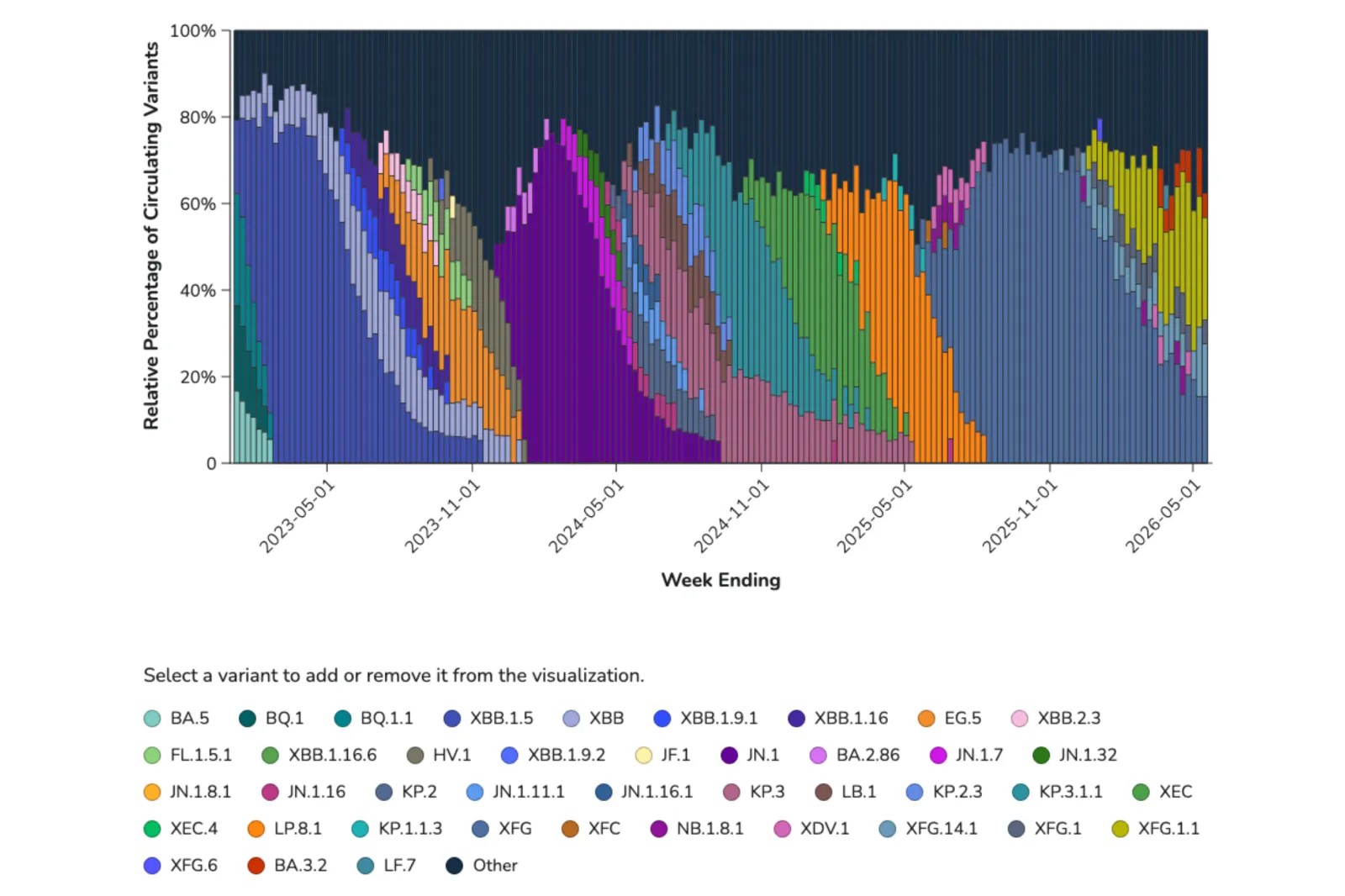
The strain has also circulated extensively in the United States. Data previously published by the Centers for Disease Control and Prevention (CDC) identified the related XFG. 1.1 lineage as the predominant variant in U.S. wastewater surveillance.
...
What Are the Symptoms of ‘American COVID’?
There isn’t any official evidence that XFG triggers a completely different set of symptoms from other recent COVID-19 variants. However, a common symptom, alongside the familiar symptoms, which include a sore throat, cough, and a fever, seems to be a hoarse or croaky voice. Dr. Kaywaan Khan, Harley Street physician and founder of Hannah London Clinic, told Cosmopolitan UK last year: "One of the most noticeable symptoms of the Stratus variant is hoarseness, which includes a scratchy or raspy voice.'
The key distinction is that doctors can’t tell whether someone has the XFG variant from their symptoms alone. Instead, the CDC says that scientists are using genetic sequencing, which looks at the genetic makeup of the virus, to distinguish it from other COVID variants.
Is It Worse Than Other COVID Variants?
In its initial assessment, WHO rated the global public-health risk from XFG as low. The organization said there was no evidence it caused more severe illness or deaths than other circulating variants. It added that approved COVID-19 vaccines were expected to remain effective against XFG.

...
UKHSA reached a similar conclusion. Despite the recent increase in hospitalizations, it said hospital admissions have been rising in line with the overall increase in COVID circulation rather than disproportionately. This suggests that the increase reflects more infections rather than a variant causing more serious disease.
Allen told Newsweek: "It's completely normal for viruses to change over time. The strains currently going around, including those known as XFG, are closely related to strains that have been with us for over a year, so this isn't something new."
He added: "We're also not seeing any evidence that these are making people more ill or spreading faster than before, and this year's autumn vaccine has been specifically designed to protect against them."
The agency said colder and wetter weather, which leads people to spend more time together indoors, could be contributing to increased transmission. It added that roughly a year has passed since the last significant COVID wave. This means immunity from previous infections or vaccinations might have weakened for some people.
Allen also urged people who are eligible for an autumn COVID-19 vaccination to take it up. "If you are eligible for a COVID-19 vaccine, it is because you are at greater risk of severe illness and being hospitalized. Don’t risk it; get the vaccine and give yourself the best protection," he said.
Why Is It Being Called American COVID?
Despite the nickname, "American COVID" doesn’t mean XFG necessarily originated in the United States.
UKHSA explicitly addressed the term this month, saying XFG has been referred to as "American COVID" in some media coverage. However, it added that the variant "is not new" and has circulated in Britain and other countries for around a year.
The agency says the American nickname reflects where the strain was first sequenced and detected, rather than necessarily where it originated.
XFG has also spread much further than the United States. WHO reported in June 2025 that XFG had been detected in 38 countries. At the time, the variant was increasing in the Americas, Europe, Western Pacific and Southeast Asia.
Newsweek has reached out to WHO for comment and awaits their response.
Newsweek’s reporters and editors used Martyn, our AI assistant, to produce this story. Learn more about Martyn here.
Contact Newsweek editors on this story: Ben Kelly and James Debens
Update, 10/15/26 4:09 a.m. ET: this article has been updated with expert comment.
View 0 Comments
Submit Correction
View Editorial & AI Guidelines