...

By Jordan King
Reporter
0
Share
Newsweek is a Trust Project member
See more of our trusted coverage when you search.Prefer Newsweek on Googleto see more of our trusted coverage when you search.
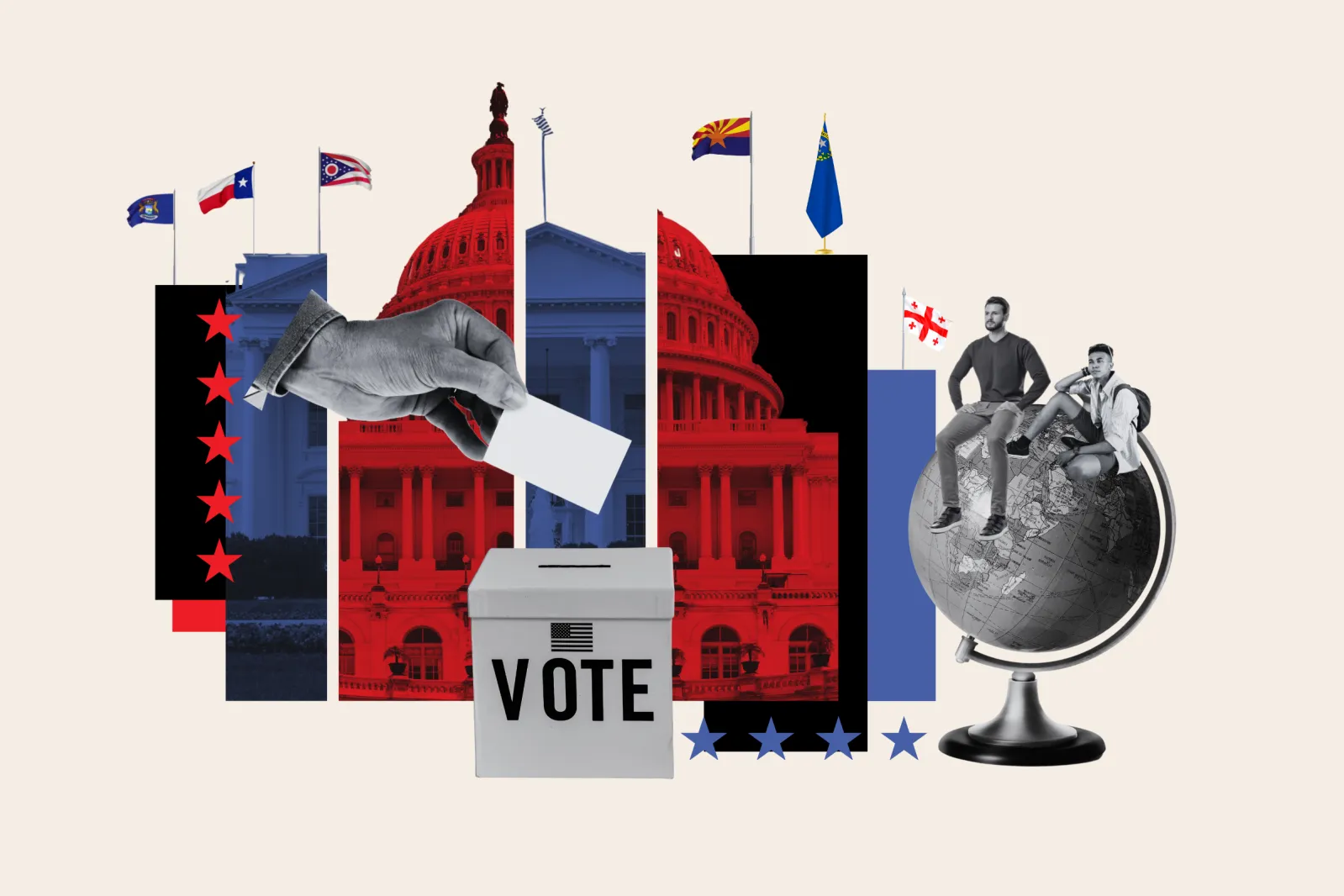
Americans who live abroad could help determine whether former President Donald Trump or Vice President Kamala Harris win key states, data shows.
The presidential election in November looks set to be an extremely tight contest, making the states of Pennsylvania, Michigan, Wisconsin, Arizona, Nevada, North Carolina and Georgia even more crucial than usual.
Both candidates have gone to great lengths to campaign in these states, with Trump spending drastically more on ads in Pennsylvania ($132.1 million) than nationally ($31.2 million) between March 5 and September 7, according to campaign monitoring firm AdImpact Politics.
Read More on Politics
...
But the states could be swung by Americans who are not even in the country, according to Newsweek analysis of data from the Electoral Assistance Commission's 2020 Election Administration and Voting Surveys.
For example, Joe Biden won Georgia in the 2020 presidential election by only 11,779 votes, a substantially smaller number than the 18,475 overseas votes counted for the state.
Likewise, in Arizona, Biden won the state by only 10,457 votes, while 18,435 overseas votes were counted.
And in Wisconsin, the president won by 20,682 votes, while 13,530 overseas votes were counted.
In contrast, Trump won North Carolina by 74,483 votes, with 26,386 overseas ballots counted.
Republicans Overseas, a group that represents the interests of Americans overseas who support the Republican Party, said that another example of how "overseas Americans can impact elections" was in 2000, when George W. Bush won Florida by a narrow margin.
Despite Democratic Vice President Al Gore receiving 202 more Florida votes than Bush on Election Day, Bush ended up with 537 more Florida votes than Gore after overseas absentee ballots were counted and won the presidency.
There was some controversy over the legality of how those votes were counted, after a six-month New York Times investigation said it found that there were "questionable votes" cast.
Gore's campaign requested a recount of votes, but the U.S. Supreme Court eventually halted the proceedings because there was not enough time to carry out a new recount and meet the certification deadline.
The Uniformed and Overseas Citizens Absentee Voting Act (UOCAVA) was implemented in 1986 and requires states to allow certain citizens to register and vote absentee in federal elections.
Dr. Stephen J. Farnsworth, a professor of political science and international affairs at the University of Mary Washington in Virginia, said the data shows how much "every vote counts."
"When presidential elections come down to several thousand votes in a handful of key swing states, every vote really does count," he told Newsweek. "While Americans abroad are not a huge voting bloc, these narrow-margin elections of recent years mean that they could be a decisive voting group in a few closely contested states."
Farnsworth added that Trump has an "isolationist perspective" that would not appeal to voters abroad.
"Trump's foreign policy vision may play well in some parts of the American Midwest, it will not go over well with a lot of Americans who are living, working and studying internationally," he said.
"With Trump as the Republican candidate, Democratic activists are likely to see much more pro-Democratic voting among Americans abroad than in past elections."
Newsweek has contacted Trump's team for comment via email.
UOCAVA ballots also include votes cast by soldiers stationed abroad, and the military has historically leaned toward the Republican Party. About six in 10 military veterans said they voted for Trump in 2020, according to AP VoteCast.
Democrats Abroad is the official organization of the Democratic Party for citizens living outside of the U.S., which unlike its Republican counterpart, functions as a state party within the Democratic National Committee.
"There's this misconception Americans abroad are all millionaires...when in fact we want to make sure our phone bill is paid," Sharon Manitta, a spokeswoman for Democrats Abroad, told Newsweek.
"People live around the world for different reasons—you have people who married somebody, long-term work, you also get people on short-term business contracts—maybe three to five years and then of course there's all the permutations of various students, who may be here for a term or three to four years."
She added: "When we say every vote counts, it really counts this time."
Kym Kettler, a spokesperson for Republicans Overseas, a group that represents the interests of Americans overseas who support the Republican Party, said: "Overseas Americans can absolutely impact election results, usually in hotly contested, close races."
She told Newsweek: "In 2000, votes from overseas Republicans gave George W. Bush the win in Florida and, ultimately, the American presidency.
Republicans Overseas urges Americans abroad to exercise their right to vote and to return their voted ballots as soon as possible, especially if they are registered in one of the nearly two dozen states and territories that require ballot return via mail.
"Ultimately, we believe overseas Americans—like stateside Americans—vote for pocketbook issues that impact their daily lives," Kettler said.
View 0 Comments
Submit Correction
View Editorial & AI Guidelines