10
Loading video...

By Hannah Parry
Associate News Editor
0
Share
Newsweek is a Trust Project member
See more of our trusted coverage when you search.Prefer Newsweek on Googleto see more of our trusted coverage when you search.
A new expedition searching for Amelia Earhart’s missing plane has ruled out a leading theory about possible wreckage on a remote Pacific island, dealing a setback to efforts to solve the aviation pioneer’s disappearance nearly 90 years ago.
The Taraia Object expedition found no conclusive evidence that a suspicious anomaly identified in satellite imagery in 2020, was part of Earhart’s Lockheed Electra 10-E, Purdue University and the Archaeological Legacy Institute told Newsweek Sunday.
Researchers concluded the feature on Nikumaroro, a remote atoll in the Pacific nation of Kiribati, was most likely a collection of large trees deposited along a sandy peninsula. By the time the team reached the site, much of the debris had broken apart or washed away, leaving a single Y-shaped fragment.
Read More on News
“Amelia Earhart’s spirit of courage and curiosity drove every step of the search,” said Rick Pettigrew, ALI’s executive director, in a statement to Newsweek. “We accomplished our goal to determine what the Taraia Object was, and we’re deeply grateful to the private donors who shared our vision and made this journey possible. Our team remains in great spirits and proud of what was accomplished.”
The expedition did uncover other artifacts, including a steel tube approximately 30 inches long in the lagoon, which researchers said would require further study.
Earhart and her navigator, Fred Noonan, disappeared on July 2, 1937, while attempting to fly around the world. The expedition’s findings do not resolve the mystery of their fate.
Despite the Taraia Object setback, researchers continue to investigate the broader theory that the pair landed on Nikumaroro and became stranded there.

...
Timeline of Amelia Earhart’s Disappearance and the Search for Her Plane
Earhart was already an internationally recognized aviator when she embarked on her attempt to circumnavigate the globe in 1937. Her disappearance, alongside Noonan, prompted a major search that ultimately failed to locate either the aircraft or its occupants.
May 1937: Earhart Begins Her Round-the-World Flight
Earhart began her journey in Oakland, California, in late May 1937, traveling with navigator Fred Noonan along a route that took her across the United States and through South America, Africa, Asia and Australia.
By late June, the pair had reached Lae, Papua New Guinea. Their next destination was Howland Island, a tiny Pacific island where they planned to refuel before continuing their journey.
July 2, 1937: Earhart and Noonan Disappear
Earhart and Noonan departed Lae for Howland Island, a challenging flight of approximately 2,550 miles across open ocean.
The U.S. Coast Guard cutter Itasca was stationed near Howland to assist with communications and navigation. However, Earhart experienced difficulties establishing reliable radio contact with the ship and locating the island.
In her final known transmissions received by the Itasca, Earhart reported that the aircraft was following a navigational line of position described as 157–337 degrees, running approximately north and south. The transmission did not establish the plane’s precise location.
The aircraft never arrived at Howland Island.
July 1937: A Massive Search Fails to Find the Aircraft
The U.S. Navy and Coast Guard launched an extensive air-and-sea search for Earhart, Noonan and their plane. Ships and aircraft searched a vast area of the central Pacific, but the effort produced no confirmed trace of the missing aviators.
The conventional explanation is that the aircraft ran out of fuel and crashed into the ocean after failing to locate Howland Island.
1938–1940: New Clues Emerge Around Nikumaroro
Nikumaroro, then known as Gardner Island, became a focus of interest because of the possibility that Earhart and Noonan had continued south and reached the atoll.
Aerial photographs taken in 1938 later became part of the historical record examined by researchers investigating the island. In 1940, human skeletal remains and artifacts were discovered there. The bones were examined by a physician in Fiji, who concluded they probably belonged to a man, but the remains were subsequently lost.
The discovery has remained central to debate over whether Earhart and Noonan could have survived a landing and lived as castaways.
2020: The Taraia Object Is Identified in Satellite Imagery
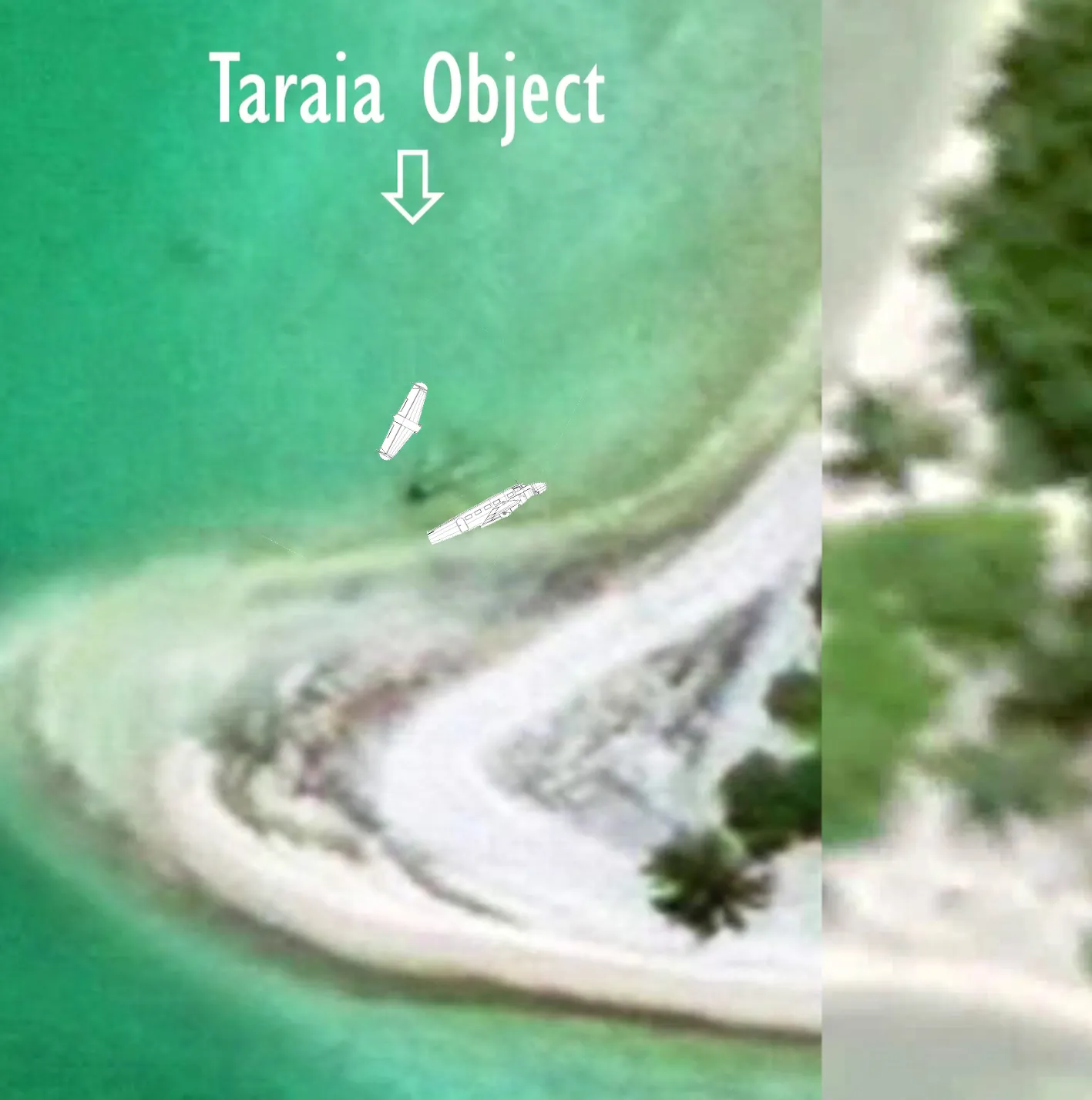
Researcher Michael Ashmore noticed an unusual elongated shape in satellite imagery of Nikumaroro’s lagoon in 2020. The object appeared to have characteristics that some researchers believed could be consistent with parts of Earhart’s Lockheed Electra 10-E.
Its elongated shape particularly attracted attention because it appeared potentially consistent with the fuselage and tail of an aircraft. Researchers also noted a reflective surface that seemed to suggest the presence of metal.
...
Further examination of older imagery showed that the shape had also appeared in photographs taken years earlier.
The possibility that the object was connected to Earhart’s plane prompted a new expedition, organized by ALI with support from Purdue University and the Purdue Research Foundation.
October 2026: Expedition Rules Out the Latest Hypothesis
The team arrived at Nikumaroro in October after a five-day sea voyage from Tarawa. Researchers cleared a path through dense vegetation, established fieldwork areas and began investigating the lagoon.
Severe weather and rough seas complicated the operation, delaying access to shore and extending the expedition. However, the team persevered and used maritime archaeological techniques, including a magnetometer and sonar technology, to investigate the lagoon. Researchers also conducted terrestrial archaeology work along the Taraia Peninsula.
The investigation ultimately found that the anomaly was likely formed by large trees deposited along the peninsula’s sandspit.
The reflective surface that had contributed to speculation about metallic aircraft wreckage was instead attributed to a carbonate veneer. Other items discovered by the team also had a shiny, hardened coating formed from coral sand.
The expedition did, however, recover other artifacts that will continue to be studied.
Steve Schultz, Purdue’s general counsel and a member of the expedition, said the team had approached the mission as an investigation rather than an effort to guarantee a particular discovery.
“Perhaps no words better capture this expedition than Amelia Earhart’s own: ‘Adventure is worthwhile in itself,’” he said. “We set out to test a hypothesis, not to guarantee a particular result, and we followed the evidence to the end."
“While the Taraia Object did not prove to be what we hoped, the journey produced new discoveries, added to the world’s knowledge of Nikumaroro, and wrote another extraordinary chapter in a story of discovery and exploration.”
Purdue University also has a historical connection to Earhart. She worked there from 1935 to 1937 as a women’s career counselor and adviser in the aeronautics department. The Purdue Research Foundation helped fund her Lockheed Electra through the Amelia Earhart Fund for Aeronautical Research.
Earhart intended to return the aircraft to Purdue after completing her flight, making the search particularly significant to the university.
The result rules out the expedition’s specific hypothesis about the Taraia Object, but it does not establish what happened to Earhart or Noonan.
What to Know About Nikumaroro Island
Nikumaroro is a remote coral atoll in the Phoenix Islands group of Kiribati, in the central Pacific Ocean. Formerly known as Gardner Island, it is surrounded by a coral reef and contains a lagoon at its center.
The island lies approximately 400 miles southeast of Howland Island, Earhart and Noonan’s intended destination on the final leg of their attempted circumnavigation.
Its remoteness and difficult access have made archaeological investigations challenging. Researchers must navigate the surrounding reef and contend with changing tides, rough seas and unpredictable weather.
During the October expedition, the team traveled ashore from the support vessel Marin Mainiku. Members used hand chainsaws and machetes to clear an overgrown trail through the island’s vegetation before establishing staging areas for their work.
The team also encountered coconut crabs, sometimes called robber crabs, which are among the world’s largest land-dwelling arthropods. Their size and nocturnal activity were among the reasons the expedition members returned to the vessel to sleep each night.
Nikumaroro has attracted researchers for decades because of the possibility that Earhart and Noonan landed there and survived temporarily as castaways. Supporters of the theory point to several pieces of circumstantial evidence, including the human remains discovered in 1940, historical radio reports and artifacts found on the island such as a woman’s shoe, a compact case, a freckle cream jar and a medicine vial. Their possible connection to Earhart has not been conclusively established.
Researchers have also examined historical photographs for signs of aircraft wreckage. Prior to the Taraia Object, another photographic anomaly was recorded on the island’s reef in 1937. Named the Bevington Object, some investigators believe resembles part of an aircraft landing gear.
None of these clues has conclusively established that Earhart or her aircraft reached Nikumaroro.
What Happened to Amelia Earhart? Leading Theories Explained
The failure to identify the Taraia Object as aircraft wreckage leaves the broader mystery unresolved. Several explanations for Earhart’s disappearance have persisted over the decades, although none has been definitively established.
The Crash-and-Sink Theory
The conventional explanation is that Earhart and Noonan failed to locate Howland Island, ran out of fuel and crashed into the Pacific Ocean.
Earhart’s final radio transmissions indicated difficulties with navigation and communications, while the aircraft never reached its intended destination.
The U.S. Navy and Coast Guard searched a vast area of the ocean after the disappearance, but no confirmed wreckage was found. The theory remains widely accepted as the most likely explanation, although the precise location of the aircraft has not been established.
The Nikumaroro Castaway Hypothesis
The castaway hypothesis holds that Earhart and Noonan may have continued searching for land after failing to locate Howland Island and eventually reached Nikumaroro.
Under this theory, they landed on the island’s reef and survived for some time before dying as castaways.
Supporters point to radio bearings recorded around the time of the disappearance that they argue converge on Nikumaroro, as well as the human remains and artifacts discovered there in subsequent years.
Some researchers have also cited historical reports of distress calls that may have been transmitted after the aircraft disappeared. One account involves Betty Klenck, a teenager who said she heard what she believed was Earhart on a shortwave radio shortly after the disappearance.
The interpretation of those reports remains disputed, and none conclusively proves that Earhart reached the island.
Capture by Japanese Forces
Another theory suggests that Earhart and Noonan flew into territory controlled by Japan and were captured.
Versions of this theory differ over why the aviators might have been in the area and what happened to them afterward. Some accounts suggest that Earhart was conducting a covert intelligence mission, although no evidence has established that claim.
The theory has attracted attention for decades but has not been supported by definitive evidence.
Earhart Survived and Assumed a New Identity
One of the most out there theories suggests that Earhart survived her disappearance in 1937 and went on to live under an assumed identity. The theory has resurfaced over the decades, but no credible evidence has ever emerged to support it.
The Search for Answers Continues
Although the Taraia Object expedition did not find the aircraft, researchers say the mission produced new archaeological discoveries and improved understanding of Nikumaroro’s lagoon and coastline.
The steel tube and other artifacts recovered during the expedition will continue to be studied, potentially providing further information about how objects move through the lagoon and accumulate along the Taraia Peninsula. The team also reiterated its support for the broader castaway hypothesis, which has been investigated by The International Group for Historic Aircraft Recovery since the 1980s.
For now, however, no discovery from the expedition has conclusively linked Earhart or Noonan to Nikumaroro. Nearly nine decades after their disappearance, the fate of the aviators and the location of their Lockheed Electra remain unknown.
Purdue University has pledged to continue the search.
“Amelia Earhart never gave up — she kept pushing boundaries and flying into the unknown,” Schultz said. “That same fire fuels our search. She kept flying, and we will keep searching.”
View 0 Comments
Submit Correction
View Editorial & AI Guidelines