...

By Newsweek Editors
0
Share
Newsweek is a Trust Project member
See more of our trusted coverage when you search.Prefer Newsweek on Googleto see more of our trusted coverage when you search.
This article is in response to one of our valued members, Diane, who made the following observation:
"Decades ago, the national debate topic for colleges and universities was should there be a guaranteed annual income. With the rise of AI, this topic will be seriously discussed, if not implemented, in 2026."
It's a great point. As ever, the reality is complex. Remember, if you're not a member yet and want to be part of this conversation and receive other benefits, sign up here.
Read More on News
In 1967 and 1968, college debaters across America stood to affirm or oppose an official debate proposition that felt radical: "That the federal government should establish a specific guaranteed annual cash income for all citizens." Half a century later—after a pandemic, a generative-AI boom, and a tech-driven stock surge—the thought experiment is back on the agenda. President Donald Trump now says the U.S. will do "whatever it takes" to lead in AI—setting a swaggering baseline for any UBI talk.
The surprise? The most relevant UBI case study isn’t Silicon Valley; it’s Alaska, whose oil-fund dividend has quietly tested a narrow version of the idea for years. And here’s the comparison that animates today’s debate: U.S. corporations executed and teed up more than $1 trillion of stock buybacks over the past year—roughly one-third of what Andrew Yang’s $12,000-per-adult UBI would cost—just as AI spending by cloud giants hit an all-time quarterly record of $142 billion. If there’s "free money" in the system, it’s already flowing—just not to households. How to get it there, even if it's possible, is fraught with risks.
Common Knowledge
Some see AI as a shock requiring a new floor under everyone. "AI will affect almost 40 percent of jobs around the world," IMF chief Kristalina Georgieva has warned, arguing for policies to ensure the benefits don’t deepen inequality. Pro-UBI economists Abhijit Banerjee and Esther Duflo say a guaranteed income won’t stop people from wanting to work, pointing to evidence that cash doesn’t automatically kill labor supply.
Others are skeptical. Economist Ryan Bourne at Cato puts it bluntly: "The main reason governments reject UBI out-of-hand is that it is prohibitively expensive." Heritage analysts urged policymakers "to help low-income children and families by giving them a hand up instead of a handout" and The Wall Street Journal’s editorial board recently dismissed a high-profile modern trial as "a guaranteed annual income flop." Even some left-leaning technologists now talk less about UBI and more about targeted supports or an "AI dividend" tied to compute or profits.
In 1967–68, amid the national college debate topic, versions of the idea reached the Oval Office in the Nixon era, then ebbed.
Uncommon Knowledge
A basic income isn’t just a check; it’s a system that collides with other systems—housing, energy, health care—and with prices. That’s why some plausible-sounding UBI narratives can become traps.
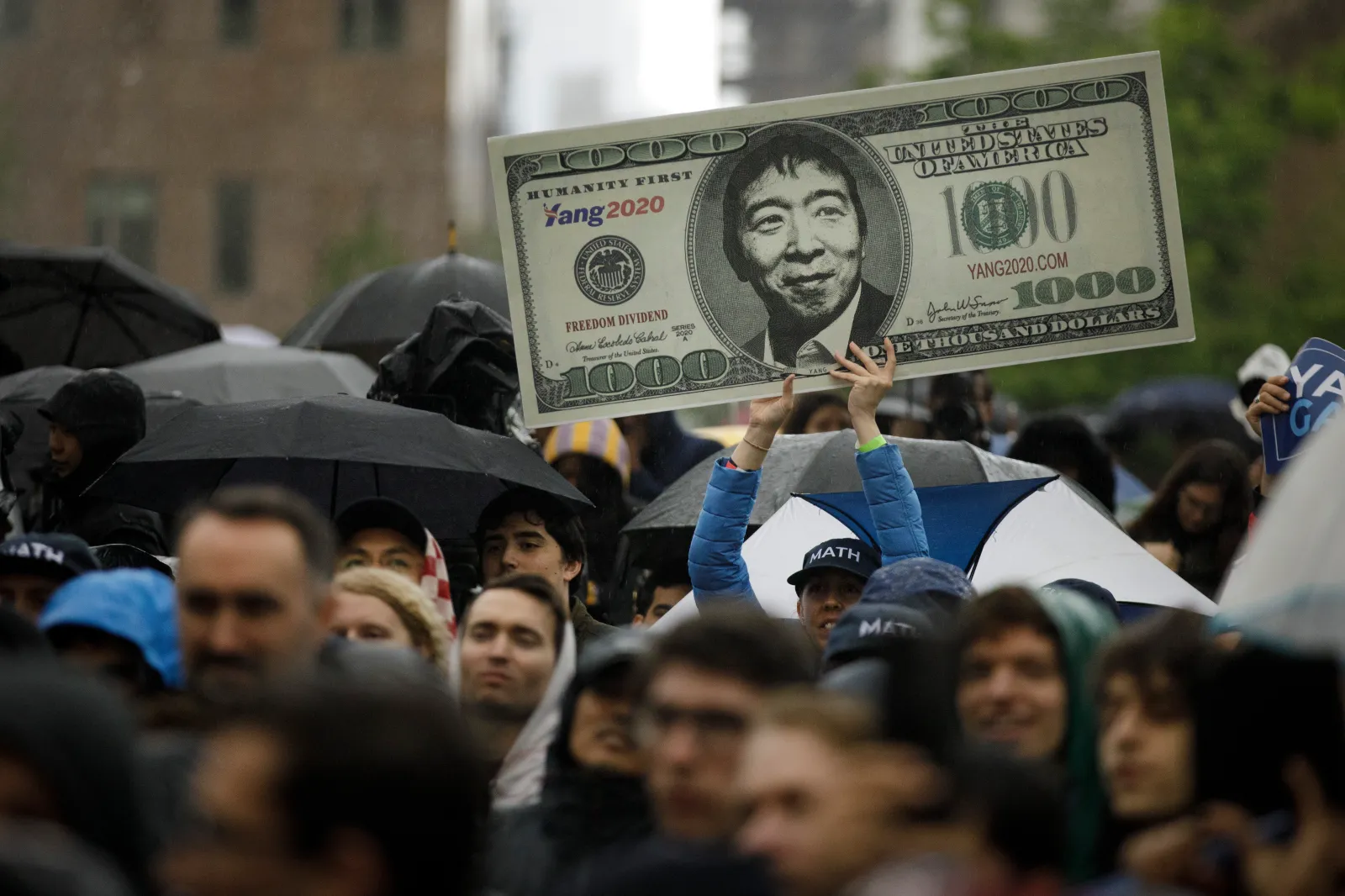
The first is affordability. Yang’s flagship proposal—$1,000 a month for every adult—was costed by the Tax Foundation at around $2.8 trillion to $3.0 trillion a year (in 2019 dollars). That’s not an impossible sum for a $30-trillion economy, but it’s not small. For a sense of scale, S&P Dow Jones Indices reports $1.02 trillion in S&P 500 buybacks over the 12 months through September 2025—about a third of the annualized tab for a national UBI at Yang-size. Put differently: even redirecting a record year of buybacks wouldn’t come close to funding a full UBI.
That leads to other risks. If you hand out cash into markets where supply is tight, you risk funding landlords and utilities more than families. Economists have repeatedly documented how broader housing subsidies can show up as higher rents, especially where new supply is hard to build. In France, a nationwide increase in voucher ceilings raised rents with little improvement in unit quality. In the U.S., the Boston Fed calculates that "shelter costs" now carry outsized weight in inflation. In cities, the asymmetry can be glaring: typical rents run about $3,500 in San Francisco versus $1,500 in Indianapolis. A flat $1,000 a month doesn’t buy the same dignity everywhere; without supply-side reforms, part of it can get capitalized into prices.
The expansion of AI is real and fast—the IMF’s baseline says around 40 percent of jobs will be affected globally, with around 60 percent in advanced economies—but that does not automatically mean joblessness. OECD tracking finds employment growth was slower in highly automatable roles, but all member countries still saw overall job gains in the past decade. The risk isn’t a lights-out labor market so much as mismatch: displaced workers struggling to find new roles. A permanent UBI may be a blunt tool for this part of the problem.
So, what do we know already? Alaska’s Permanent Fund Dividend is not UBI, but it’s the closest U.S. "natural experiment" we have. The dividend—which has paid out around $1,600 annually—has not cratered employment; a leading study finds no overall effect on full-time work, though consumer-facing sectors expanded. That’s encouraging. It’s also a reminder that Alaska’s check is financed by a sovereign-wealth fund fed by oil revenues, which is very different from a nationwide program funding itself by new taxes. Finland’s two-year basic-income trial (2017–18) improved well-being but produced little change in employment, validating cash’s psychological benefit but not the claim that UBI is a jobs policy. And Germany’s recent crowdfunded UBI study found higher life satisfaction with no drop in hours worked, yet the sample was small and not universal.
What changed in 2025 was the capex tide. In the last quarter of 2025, hyperscalers’ capital spending hit $142 billion, an unprecedented surge driven by AI infrastructure. That’s far more new money than any legislature moved into basic income. If there is to be an "AI dividend," the potential route is corporate investment and shareholder distributions, not government checks. Policymakers who want to convert AI productivity into household security must grapple with where value accrues: capital-intensive platforms first, wages later and unevenly.
So what’s the trap? It’s believing that because AI disruption is novel, policy must be only novel. The left’s strongest case—for security and bargaining power in a more volatile labor market—is real. The right’s strongest warning—about program cost and the risk of shoveling cash into constrained markets—is also real. The productive middle ground for 2026 and beyond looks less like a moon-shot UBI and more like a targeted, timed "AI dividend" that scales with measured exposure to automation, paired with accelerants in housing, power, and care. If Congress wants to copy Alaska, copy the funding mechanism—build assets that spin off income—before copying the checks.
The question isn’t whether cash helps. It’s whether we engineer the economy around that cash so it doesn’t help everyone but the people it’s meant to help.
If you’re enjoying Uncommon Knowledge, please share. If you have suggestions for future editions or feedback, email subscriber.feedback@newsweek.com. We want to hear your voice.
View 0 Comments
Submit Correction
View Editorial & AI Guidelines