
...

By Taryn Pedler
0
Share
Newsweek is a Trust Project member
See more of our trusted coverage when you search.Prefer Newsweek on Googleto see more of our trusted coverage when you search.
Michigan Senate candidate Abdul El-Sayed has faced repeated questions about the Muslim Brotherhood during his political career, with scrutiny intensifying in October as he campaigns for the U.S. Senate.
The Democratic candidate has denied having ties to the Islamist organization and rejected suggestions that his Muslim faith raises questions about his political loyalties.
The controversy has gained renewed attention following comments from President Donald Trump and the emergence of social media posts attributed to El-Sayed's half-sister, Eman Abdelhadi, about their family's alleged connections to the group.
Read More on News
The Muslim Brotherhood is an Islamist movement founded in Egypt in 1928. Its status varies internationally, with some governments designating the organization or particular branches as terrorist groups, while others have not.
Here is what El-Sayed has said about the Muslim Brotherhood and related allegations over the years.
May 2018: 'Muslims Definitely Hate You'
El-Sayed first faced questions about his alleged connections to the Muslim Brotherhood during a Michigan gubernatorial forum in May 2018, when he was running for governor.
His Republican rival, Patrick Colbeck, questioned El-Sayed's religious affiliations and raised concerns about the implementation of Sharia law in Michigan.
Colbeck also alleged that El-Sayed had connections to the Muslim Brotherhood through his involvement with the Muslim Students Association at the University of Michigan.
When the moderator asked whether the implementation of Sharia law in Michigan was a genuine concern, El-Sayed rejected the suggestion that he would attempt to undermine the U.S. Constitution.
"I solemnly swear to uphold the Constitution of the United States and the constitution of this state—that's the oath that if any one of us is elected, we will swear," El-Sayed said.
He added that he took the oath particularly seriously because it guaranteed his right to practice his religion. "Sharia law is not in question in this state," he said.
Addressing Colbeck's criticism, El-Sayed also accused his opponent of exploiting anti-Muslim prejudice.
"You may not hate Muslims. But I'll tell you, Muslims definitely hate you," he said.
The exchange resurfaced in September 2026, as El-Sayed's campaign for the Senate brought renewed attention to his previous comments and associations.

...
October 2021: Defending a Friend Imprisoned in Egypt
In October 2021, El-Sayed published an article on his now-defunct Substack page, The Incision, defending his friend Mohamed Soltan, an American citizen who had been imprisoned in Egypt.
The article, titled "The hypocrisy of police rejecting vaccine requirements," criticized the use of government power and compared policing in the United States with authoritarian practices abroad.
El-Sayed described Soltan as his friend and referred to his imprisonment as an example of the dangers of arbitrary government power.
However, El-Sayed did not mention the Muslim Brotherhood in the article itself.
The post later attracted scrutiny because Soltan's father, Salah Soltan, had been identified as a senior figure in the Muslim Brotherhood.
Mohamed Soltan faced terrorism-related charges in Egypt, including allegations relating to membership of the banned organization, and was sentenced to life imprisonment before being released and returning to the United States in 2015.
El-Sayed's Substack publication was subsequently made private as scrutiny of his past writings intensified during his Senate campaign.
October 5, 2026: 'Terrorism Is the Act of Political Violence'
During an interview with Fox News host Martha MacCallum on October 5, El-Sayed was asked whether he would support terrorist designations for Muslim Brotherhood organizations in Egypt, Lebanon and Jordan if elected to the Senate.
MacCallum questioned him about the groups' alleged involvement in political violence and asked specifically whether he supported the existing designations.
El-Sayed said his approach would be based on whether an organization engaged in political violence.
"I think terrorism is the act of political violence," he said. "So I will support a terror designation for any organization that is engaged in or committed to political violence."
When MacCallum pressed him on the Muslim Brotherhood, El-Sayed said he wanted evidence of the organization's involvement in such activity. "Show me that they're engaged," he said.
MacCallum then cited allegations concerning the Egyptian and Jordanian branches of the organization.
El-Sayed reiterated that he would support designating organizations that engaged in or called for political violence as terrorist groups before later challenging the argument that military intervention was the best way to address terrorism.
He argued that the United States had spent trillions of dollars on wars without necessarily making itself safer.
October 11, 2026: 'No Family Connection'
El-Sayed addressed the controversy more directly during an appearance on NBC's Meet the Press on October 11.
Host Kristen Welker asked him about allegations concerning his family's connections to the Muslim Brotherhood and sought clarification about whether he or his relatives had ties to the organization.
El-Sayed denied that either he or his family had any connection.
His response became a focus of further scrutiny after social media posts attributed to his half-sister, Eman Abdelhadi, resurfaced.
In posts dating from 2012 and 2013, Abdelhadi had referred to her family's alleged connections to the Muslim Brotherhood, including her mother's activism in Egypt during the early 1970s.
The posts prompted questions about whether El-Sayed had been aware of the alleged family connections.
El-Sayed's denial on Meet the Press was then challenged by political opponents, who argued that the posts warranted further explanation.
October 14, 2026: 'We Have No Ties'
El-Sayed was questioned again about the allegations during an interview with NBC Nightly News anchor Tom Llamas on October 14.
Llamas raised the social media posts attributed to Abdelhadi, including one in which she described her mother's activism in the Muslim Brotherhood while studying in Egypt in the early 1970s.
The interviewer asked El-Sayed to explain the apparent discrepancy between his denial and his half-sister's statements.
El-Sayed rejected the suggestion that the posts demonstrated a connection between him and the organization. He reiterated his denial, saying: "We have no ties."
When pressed about his mother, El-Sayed said he had never discussed the alleged connections with her. "I have never had these conversations with my mother," he said.
He also challenged the evidential basis of the questions, arguing that the interviewer was relying on social media posts rather than direct evidence of his own involvement.
"You're using hearsay evidence from a tweet," El-Sayed said.
He questioned why his political record was being overshadowed by allegations about events in Egypt decades before his birth in 1984. The activities described in the posts allegedly took place in the early 1970s.
...
October 16, 2026: 'I Don't Want To Make This About Faith'
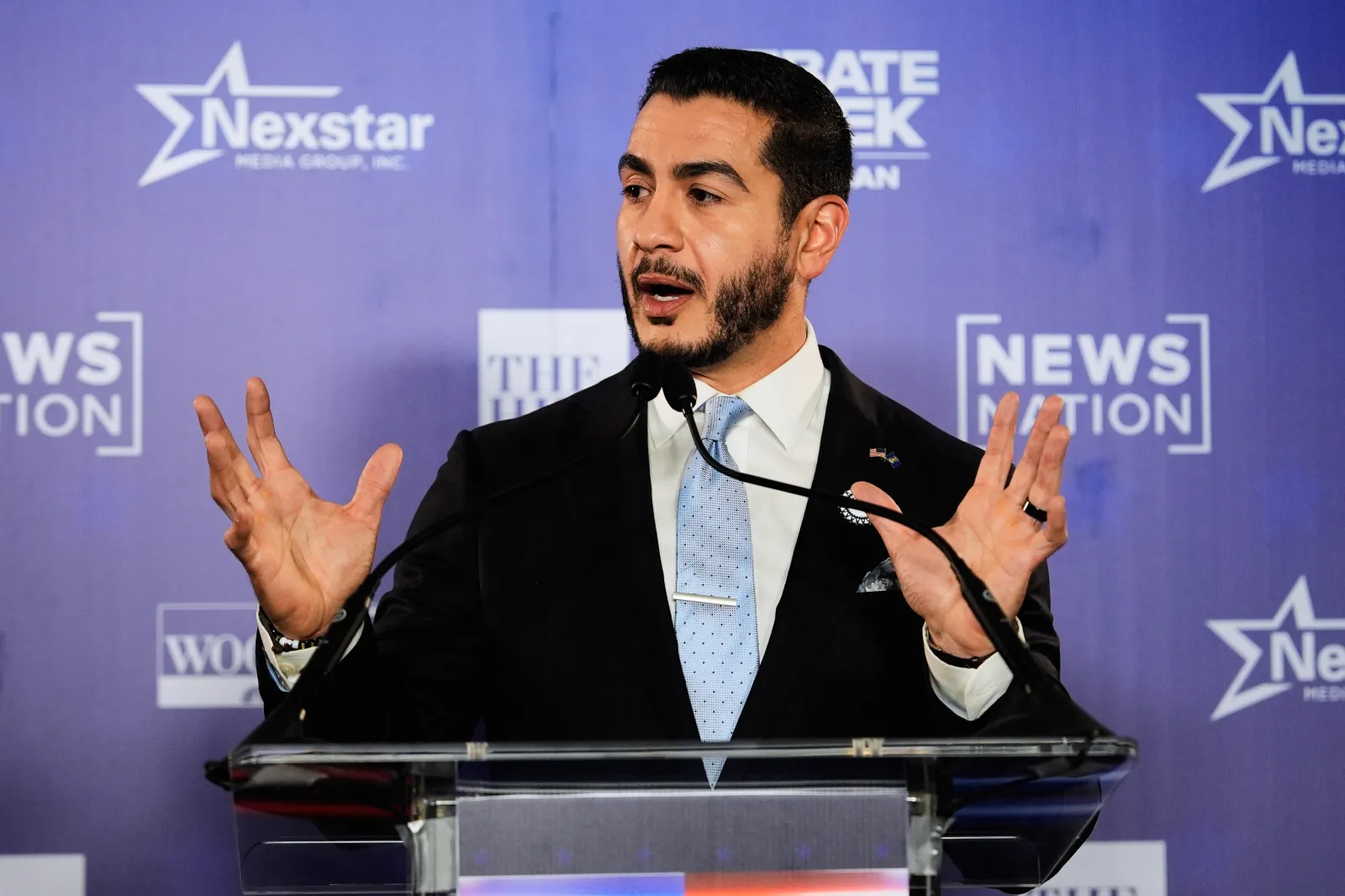
El-Sayed faced further questions about the Muslim Brotherhood during an October 16 interview with NewsNation.
The interview came amid growing political scrutiny of the allegations and repeated calls from Republicans for him to address the issue.
El-Sayed objected to the focus on his religious identity, arguing that questions about the organization risked turning the campaign into a debate about his faith rather than his policies.
The interview was reported under the headline "El-Sayed on Muslim Brotherhood attacks: 'I don't want to make this about faith.'"
His response reflected a broader argument he had made throughout the controversy—that being Muslim should not be treated as evidence of allegiance to an Islamist political organization.
October 17, 2026: Disavows the Muslim Brotherhood
The controversy intensified during a campaign event in Caro, Michigan, on October 17, when a voter directly asked El-Sayed whether he would disavow the Muslim Brotherhood.
El-Sayed responded affirmatively before challenging the premise of the question. "Yeah, absolutely," he said.
He then asked the man why he had raised the issue and whether he assumed that El-Sayed would refuse to disavow the group because he was Muslim.
The candidate questioned why he was being singled out for such a declaration, asking whether the man had asked everyone in his life to disavow the organization.
When the voter said he had not previously heard El-Sayed disavow the Muslim Brotherhood, the candidate turned the argument back on him. El-Sayed argued that the question implied he might have divided loyalties because of his religious identity.
He also invoked the U.S. Constitution, arguing that its protections for religious freedom meant that a person's faith should not be treated as evidence of allegiance to any foreign organization.
El-Sayed then compared the scrutiny to questions faced by John F. Kennedy during his presidential campaign in 1960, when the Catholic candidate was asked about his relationship with the Pope.
He argued that, just as Kennedy was running to be president rather than a Catholic president, he was running to represent Michigan rather than to represent Muslims.
The exchange attracted widespread attention online, with supporters praising his response as a rejection of religious prejudice and critics arguing that he had not adequately addressed the underlying allegations.
October 18, 2026: Comparing the Allegations to Questions About JFK's Catholic Faith
El-Sayed returned to the controversy during an October 18 appearance on MS NOW, where he discussed the questions about his family's alleged connections to the Muslim Brotherhood.
Speaking to Ali Velshi, he compared the scrutiny to the religious prejudice faced by Kennedy during his 1960 presidential campaign.
El-Sayed argued that Kennedy had been asked whether his Catholic faith would influence his presidential decisions, just as he was now being questioned about whether his Muslim faith affected his political loyalties.
He invoked Kennedy's response to those concerns, arguing that the former president had made clear that he was running to lead the country rather than to represent a particular religious group.
El-Sayed applied the same distinction to his own campaign, saying he was seeking a Senate seat as an American political candidate who happened to be Muslim.
The comparison reinforced his argument that the controversy was rooted in assumptions about his religion rather than evidence of his own involvement with the Muslim Brotherhood.
El-Sayed's Family Ties to the Muslim Brotherhood
His Mother: Alleged Muslim Brotherhood Activism in Egypt
El-Sayed's biological mother, Fatten Elkomy, is at the center of the controversy.
On June 24, 2012, El-Sayed's half-sister Eman Abdelhadi reportedly posted on social media about their mother's political activities in Egypt.
In one post, Abdelhadi wrote: "Had an amazing talk with my mom about her activism in the Muslim Brotherhood during the early 70s while she was in college #respect."
In another, she referred to her family as having long-standing connections to the organization.
El-Sayed has repeatedly denied any personal or family ties to the organization, dismissing the claims as "hearsay." Abdelhadi's posts do not establish any connection between El-Sayed and the organization.
Other Alleged Connections Involving His Extended Family
Critics have also raised questions about El-Sayed's wider family and political associations, including his father-in-law, Tayeb Jukaku, and his connections to American Muslim organizations. These allegations, however, have not been officially confirmed.
Contact Newsweek editors for this story: Robert Greenall and Ben Kelly
View 0 Comments
Submit Correction
View Editorial & AI Guidelines