...

By Giulia Carbonaro
Senior Reporter
0
Share
Newsweek is a Trust Project member
See more of our trusted coverage when you search.Prefer Newsweek on Googleto see more of our trusted coverage when you search.
Michigan Senator Mallory McMorrow dropped out of the state's Democratic U.S. Senate primary on Sunday, leaving voters to choose between Representative Haley Stevens, a centrist backed by Minority Leader Chuck Schumer, and Abdul El-Sayed, a progressive backed by Bernie Sanders and Alexandria Ocasio-Cortez.
El-Sayed, a former public health official, has been leading polls since May, and he is confident he can win the Senate race to succeed two-term Democratic Senator Gary Peters—who is retiring, vacating a seat in a state that President Donald Trump won narrowly in 2024.
It is of crucial importance for Democrats to win this seat if they want to flip control of the Senate and win the majority in the upper chamber in November. But the party will have to sort out its internal struggles first—and McMorrow's exit from the race may have made it a little bit simpler.
Read More on News
...
The Michigan Senate primary in early August is now shaping up to be a straight fight between the Democratic Party's progressive and establishment wings—the sort of struggle that has come under the spotlight in recent weeks after the stunning primary victories of three progressive candidates in New York backed by Mayor Zohran Mamdani.
But the party fears El-Sayed may be a weaker candidate than Stevens—or even McMorrow, had she stayed in the race—against Republican Representative Mike Rogers.
Why Did McMorrow End Her Senate Bid?
After struggling to gather enough support in the crowded and splintered Democratic primary race, McMorrow announced on Sunday that she was suspending her 15-month campaign.
Support for McMorrow had plunged in recent weeks as El-Sayed emerged as the clear front-runner, and there had long been rumors that she would drop out of the race.
"I'm doing it with a deep, deep sense of gratitude. For our thousands of volunteers, for everyone who donated what you could—building a campaign with zero corporate PAC dollars. For my staff, who built this team up from nothing. I thank you," she wrote on X.
"I want to be very clear about what this announcement is not. I may be suspending this campaign, but I am not leaving the fight," McMorrow added, listing her political achievements—such as helping to repeal Michigan's abortion ban and raising wages.
"I haven't been shy about calling for new leadership and a better Democratic Party. I mean it. The energy is there. People are crying out for change. And we owe it to them to listen. Then we need to build it up, together, from the ground up," she said.
"So here's what we do next. Every day through November 3rd. We win this Senate seat and send Mike Rogers back to Florida for good," McMorrow continued.
She concluded by saying that the winner of the August 4 primary would have her "full support."
McMorrow left the race because "she was gaining no traction whatsoever. Our numbers consistently showed that any momentum she had early, in March or April, had dissipated," pollster Richard Czuba, the founder of Glengariff Group, told Newsweek.
"She had no lane to run in. She tried to run in the left lane, and it just wasn't working. So she tried to shift to straddling both lanes, and that was even worse for her," he added. "This was always going to be a race between the two sides of the Democratic Party in Michigan."
El-Sayed responded to McMorrow's announcement, praising her for the work she did during her campaign and saying she "showed what it looks like to fight back against a politics that rigs the system against too many of us."
He accused "party insiders" of spending "$30 million to drown you and me out," adding that these same people were now "spending even more to attack me."
"It's everything we are standing up against," El-Sayed continued.

...
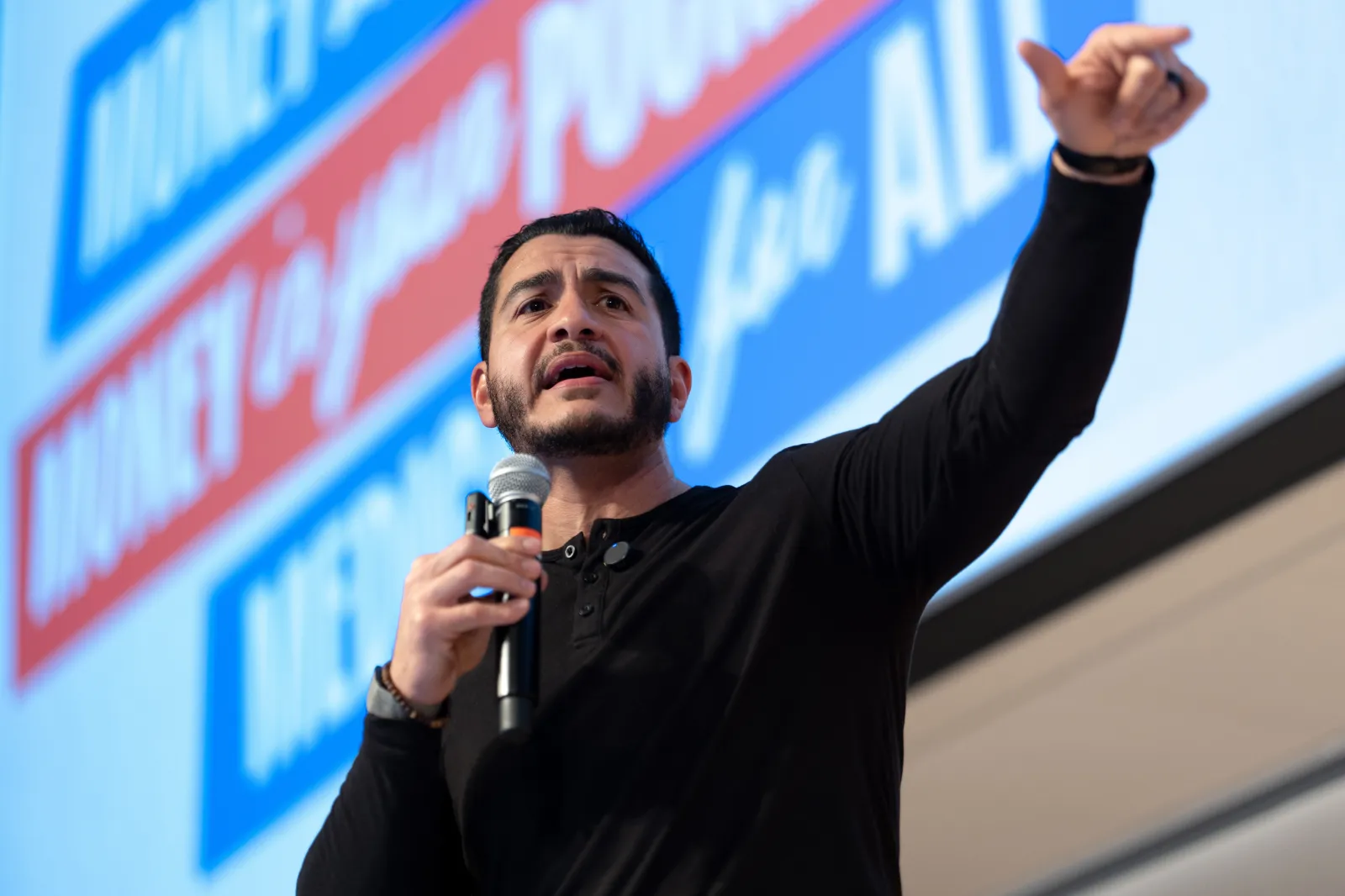
"I welcome your supporters to our movement to stand up against money in politics, to put money back in pockets, and pass Medicare for All. We cannot allow the establishment to decide our nominee for us," he wrote.
In a statement published on X, Stevens praised McMorrow as "an important voice, both in this race and in the State Senate, for policies that benefit Michigan's children and families." She added, "I look forward to working with her in the future to build a stronger Michigan for everyone."
Stevens then appealed to Democratic voters, describing herself as "the strongest Democrat to defeat Mike Rogers this November."
Michigan Senate Majority Leader Winnie Brinks said in a statement shared with Newsweek: "I'd like to thank Mallory McMorrow for running a positive campaign that skillfully combined an optimism for a better politics and with a track record of solid accomplishments on the topics that matter most to the American people.
"I look forward to continuing our work to ensure Democrats are successful this year, not just in the U.S. Senate, but in our statewide offices and, of course, the state legislature."
She added that she had "every confidence" that McMorrow would "continue to accomplish big things in service to our state, no matter the path she chooses."
What Are El-Sayed's Chances of Victory?
It is not yet clear who will benefit most from the end of McMorrow's bid, as both El-Sayed and Stevens were ahead of her in the polls.
Pollster Bernie Porn told Newsweek that if McMorrow had stayed in the primary race, she would have taken more votes away from Stevens than El-Sayed, based on polling.
"Also, as I understand it, many Stevens supporters were urging McMorrow to drop out to give Stevens a chance at winning the Democratic primary over El-Sayed, who they thought would be less likely to win the general election against Rogers," he said.
"There was a time when El-Sayed was either losing to Rogers in early polling or having a narrower lead over Rogers than Stevens or McMorrow. However, more recent polls are showing that El-Sayed has a lead over Rogers that is about the same as a lead by Stevens over Rogers, so that argument may no longer apply," Porn added.
"It may well be that without McMorrow in the race, Stevens has a significantly improved chance of catching El-Sayed, making it a closer primary race, and maybe winning," he said. "Again, I assume that is based on polling, probably looking at the second choice of votes for candidates. There have already been a few endorsements and support for Stevens after McMorrow dropped out."
After McMorrow's announcement on Sunday, Michigan Attorney General Dana Nessel endorsed Stevens in the primary race, writing on Facebook: "With today's announcement by Senator McMorrow, the choice is clear. Representative Haley Stevens is a seasoned fighter for Michigan who knows how to work in a difficult environment to get essential policies across the finish line. She has the proven ability to work with members in D.C. and in our local communities to create laws that enhance the lives of everyday Michiganders."

...
A Quantus Insights poll conducted on June 29-30 showed El-Sayed with 41 percent support among Democratic primary voters, compared to Stevens' 36 percent and McMorrow's 8 percent. An additional 16 percent were still undecided about who they would support.
The poll was conducted among 947 likely voters, with a margin of error of plus or minus 3.3 percentage points.
Another recent poll from Tulchin Research gave the progressive candidate 46 percent of the vote compared to Stevens' 27 percent and McMorrow's 17 percent, while 9 percent were undecided. The poll surveyed 500 likely Democratic voters from June 24 to 28 and had a margin of error of plus or minus 4.38 percentage points.
While it would take time for new polls to show the impact of McMorrow's exit from the race, betting platforms are already reflecting a shift in users' expectations for the primary.
On Polymarket, El-Sayed's perceived chances of victory fell from 87 percent to 78 percent between July 4 and July 6, while Stevens' perceived chances of victory went up from 13.3 percent to 20.1 percent. El-Sayed, however, still had a robust lead over the other candidates.
On Kalshi, El-Sayed's chances stand at 83 percent, as of writing, though they fell slightly from 87.8 percent on July 4. Stevens' chances, on the other hand, are much lower, at 19.2 percent—though they rose significantly from 11 percent on July 4.

...
El-Sayed, a supporter of Medicare for all who is pushing the party to the left on several issues, would be the first Muslim U.S. senator if elected. Many within the Democratic Party are afraid that he would be too progressive a candidate to win against Rogers in a state that went to Trump in 2024, even if narrowly.
The more moderate and centrist wing of the party is pushing for Stevens, who has collected about $32 million across five groups in support of her candidacy, as reported by Politico. Among the groups supporting her is the country's most powerful pro-Israel group, the American Israel Public Affairs Committee, as Stevens has historically been a strong supporter of Israel. El-Sayed, on the other hand, has harshly criticized Israel over its conduct in Gaza.
"A couple of weeks ago I would have thought that Stevens would have a better chance of beating Rogers than El-Sayed, but more recent polling makes that more uncertain," Porn said.
"Also, many Republicans have said they thought El-Sayed would be the weaker candidate against Rogers, which is why some GOP groups have run ads against El-Sayed, thinking that would help him in the Democratic primary, which it has, but it may have improved his performance in a general election against Rogers as well."
Czuba believes Stevens still has the best chance of beating Rogers in November.
"I know there's a lot of polls flying around saying that's not true," he said. "But here's the bottom line of Michigan: 20 percent of the Michigan electorate is independent. They make all the decisions in Michigan. They decide the races. And if you cannot appeal to that independent vote, you don't win."
Contact Newsweek editors on this story: John Fitzpatrick and Shakeema Edwards.
Update 7/8/26, 4:47 a.m. ET: This article has been updated with additional information and comments from Bernie Porn, Richard Czuba and Winnie Brinks.
View 0 Comments
Submit Correction
View Editorial & AI Guidelines