10
Loading video...

By Sam Stevenson
Associate News Editor
0
Share
Newsweek is a Trust Project member
See more of our trusted coverage when you search.Prefer Newsweek on Googleto see more of our trusted coverage when you search.
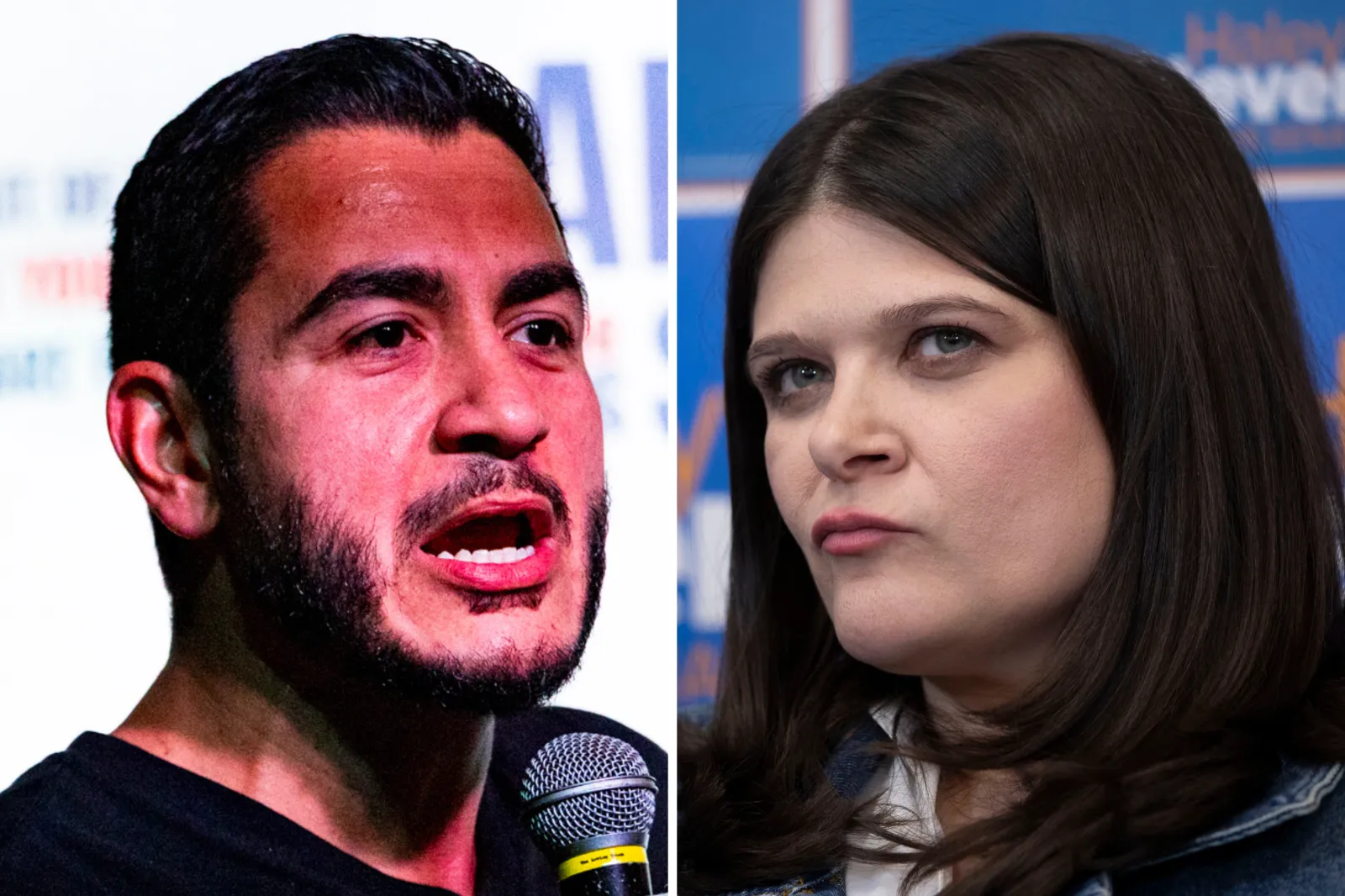
Former public health official Abdul El-Sayed appears to have strengthened his position in the final stretch of Michigan's Democratic Senate primary, after a high-profile debate that highlighted the stark differences between him and four-term Representative Haley Stevens.
The candidates clashed on Monday in their final debate before Michigan's August 4 Democratic Senate primary, sparring over American Israel Public Affairs Committee (AIPAC) spending, Israel, immigration and the future of the Democratic Party.
With voting already underway and just days remaining until the primary, new prediction market movements and polling data suggest momentum may be shifting toward the more progressive El-Sayed.
Read More on Politics
A new Emerson College Polling/WLNS/WOODTV survey found him leading Stevens by 15 points, 54 percent to 39 percent.
Next Tuesday's primary will see Michigan Democrats choose a nominee to face Republican Mike Rogers in one of the party's most important Senate battleground races of 2026.
Newsweek has contacted the campaigns of Stevens and El-Sayed for comment via email.
Why It Matters
The contest to replace retiring Democratic Senator Gary Peters has become one of the most expensive and ideologically charged Democratic primaries in the country.
The race is now more than a battle between two candidates, having evolved into a broader fight over issues such as the U.S.'s support for Israel, campaign finance transparency and the ideological direction of the Democratic Party.
...
What Prediction Markets Say
While polls offer snapshots of voter sentiment, prediction markets attempt to estimate the probability of an outcome by allowing participants to trade contracts based on election results.
Prediction markets can incorporate large amounts of information quickly, including polling, fundraising, endorsements and campaign developments. But they can also be influenced by trader sentiment, liquidity limitations and speculative behavior rather than actual voting intentions.
Both major political prediction markets have recently moved in El-Sayed's favor.
On Kalshi, El-Sayed's implied chance of winning the Democratic primary rose on Tuesday to 71 percent, up from 64 percent on July 26. By Thursday morning, it stood at 84 percent. Stevens' probability fell to 18 percent from 36 percent over the same period.
Polymarket showed a similar shift. El-Sayed's chances increased to 72 percent on Tuesday, rising from 65 percent on July 26. By Thursday morning, they had moved to 91 percent while Stevens' fell to 9 percent from 36 percent over the same time period.
Debate Highlights Deep Divisions in the Race
Monday's debate showcased the contrasting styles and political philosophies of the two candidates.
El-Sayed repeatedly attacked Stevens over support from groups linked to AIPAC, arguing that large-scale outside spending could influence her conduct in the Senate.
Stevens pushed back by portraying herself as a pragmatic lawmaker focused on delivering results for Michigan.
She also questioned whether El-Sayed was more interested in national prominence than the day-to-day work of serving in the Senate, describing him as a "celebrity candidate."
The candidates also sparred over immigration, with El-Sayed saying he would abolish Immigration and Customs Enforcement, while Stevens emphasized efforts to reform the agency.
Differences over Israel, campaign finance and Democratic Party priorities were recurring themes throughout the debate.
Recent Polls Paint a Mixed Picture
Polling in the race has produced conflicting results over recent weeks, but the newest independent survey suggests El-Sayed has opened a significant lead in the campaign's final days.
The Emerson College Polling/WLNS/WOODTV survey, conducted July 26-27 among 700 likely Democratic primary voters, found El-Sayed leading Stevens by 15 points, 54 percent to 39 percent, with 6 percent undecided. The poll had a credibility interval of plus or minus 3.7 percentage points.
When undecided voters who expressed a preference were included, El-Sayed's advantage expanded to 57 percent to 41 percent.
The findings broadly align with other recent surveys that have shown El-Sayed ahead, though they contrast with an earlier Detroit News/WDIV-TV poll that found Stevens holding a lead earlier in July.
Another survey came from Tulchin Research, which conducted a poll of 500 likely Democratic primary voters between July 13 and 15, with a margin of error of plus or minus 4.38 percentage points.
The survey gave El-Sayed a 16-point lead, with 56 percent support compared with 40 percent for Stevens and 4 percent undecided.
Another recent poll, conducted by Data for Progress between July 10 and 14 for American Priorities, surveyed 614 likely Democratic primary voters and had a margin of error of plus or minus 4 percentage points.
That poll found El-Sayed ahead by 13 points, 54 percent to 41 percent, with 5 percent undecided.
Data for Progress also reported a significant gap in candidate favorability ratings. El-Sayed posted a 69 percent favorable and 17 percent unfavorable rating among respondents, while Stevens registered 55 percent favorable and 33 percent unfavorable.
Not all surveys have shown El-Sayed leading. A Detroit News/WDIV-TV poll conducted by Glengariff Group between July 8 and 11 surveyed 500 likely Democratic primary voters and had a margin of error of plus or minus 4.4 percentage points. That poll put Stevens ahead of El-Sayed with 48 percent to his 41 percent.
Glengariff pollster Richard Czuba described the race as "wide open," noting that a large bloc of undecided and less-committed voters remained available to both campaigns.
Competing Electoral Coalitions
The polling suggests each candidate is relying on a different coalition of voters.
According to the Detroit News survey, Stevens performed particularly well among Black voters, older voters and those without college degrees. She also showed strength among absentee voters who had already cast ballots.
El-Sayed's support was concentrated among younger voters, white voters, college-educated Democrats and self-described democratic socialists. The survey also indicated he was running strongly among voters planning to cast ballots on Election Day.
How successfully each campaign turns out supporters could be decisive.
What Happens Next
Taken together, the recent movement in prediction markets and the latest Emerson survey suggest El-Sayed enters the final stretch of the race as the favorite.
The Emerson poll is particularly notable because it is one of the largest recent surveys of the primary electorate and was conducted after weeks of heavy advertising and immediately before the campaign's closing arguments to voters.
Still, Michigan's Democratic primary has produced conflicting data throughout the campaign, and substantial early voting means many ballots may already have been cast before the final debate.
With just days remaining before Democrats choose their nominee, one of the country's most closely watched Senate primaries appears to be entering its final phase with El-Sayed holding an advantage—but not yet the certainty of victory.
Contact Newsweek editors on this story: John Fitzpatrick and Shakeema Edwards.
View 0 Comments
Submit Correction
View Editorial & AI Guidelines