
By Aristos Georgiou
Science and Health Reporter
0
Share
Newsweek is a Trust Project member
See more of our trusted coverage when you search.Prefer Newsweek on Googleto see more of our trusted coverage when you search.
Paleontologists have announced the discovery of "North America's oldest dinosaur." The find challenges the consensus view on the origins of these extinct reptiles.
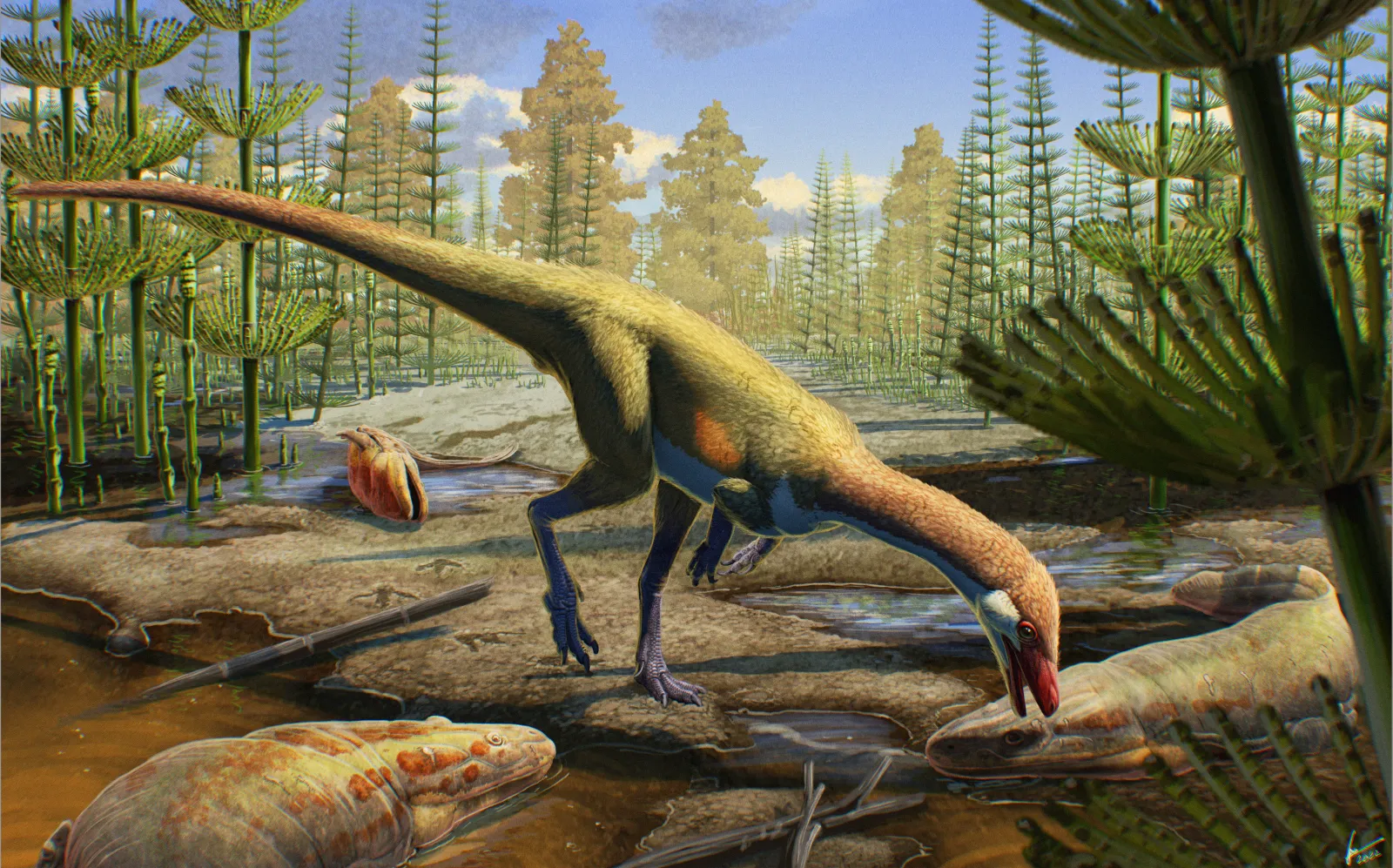
In a study published in the Zoological Journal of the Linnean Society, researchers described a previously unknown, chicken-sized dinosaur species named Ahvaytum bahndooiveche.
The description of the new species was based on the discovery of fossils unearthed between 2013 and 2016 by University of Wisconsin–Madison Geology Museum (UWMGM) field crews at a site in what is now Wyoming. The site lies within the Popo Agie geological formation.
Read More on Science
Researchers have dated the rocks the fossils were found in—using high-precision techniques—to around 230 million years ago, which means the species is one of the oldest known dinosaurs globally and the earliest recorded from North America. The find also suggests that dinosaurs roamed the northern hemisphere several million years earlier than previously thought.
...
"The interesting aspect of this animal is the time and place of its occurrence," study co-lead author and UWMGM researcher Aaron Kufner told Newsweek.
"Some other researchers have suggested that some dinosaur-bearing deposits from the U.K. are older than originally thought and possibly contemporaneous with the site we have presented. However, the age control on these sites is less precise than what we have now for the Popo Agie Formation."
The question of how and when dinosaurs first emerged before spreading across the planet more than 200 million years ago has long been debated among paleontologists—a discussion hampered by a fragmented fossil record.
The mainstream view contends that the reptiles emerged first on the southern portion of the prehistoric supercontinent Pangea called Gondwana, before spreading to the northern part, known as Laurasia, sometime later.
The oldest known dinosaurs from Gondwana date to roughly 233-230 million years ago, according to Kufner. Around this time, the landmass was primarily located in the southern hemisphere.
Prior to the latest study, the available evidence suggested that the oldest known dinosaurs from Laurasia—primarily situated in the northern hemisphere—did not appear until 6–10 million years later.
But this is where Ahvaytum may rewrite the origin story because it originates from the North American landmass, which once formed part of Laurasia. At roughly 230 million years old, it is comparable to the oldest known dinosaurs from Gondwana.
The part of Wyoming where the new species emerged was located in low latitudes near the prehistoric equator around 230 million years ago.
"We have, with these fossils, the oldest equatorial dinosaur in the world—it's also North America's oldest dinosaur," study co-lead author and UWMGM researcher Dave Lovelace said in a statement.
The team does not have a complete specimen of the new species, but they had sufficient evidence to determine that it likely belonged to the sauropodomorph group. This group formed the ancestral stock of the long-necked sauropod dinosaurs.
But while it may represent a very early relative of the sauropods, Ahvaytum was significantly smaller than most of these dinosaurs, which include some of the largest species ever to roam the Earth.
"It was basically the size of a chicken but with a really long tail," Lovelace said. "We think of dinosaurs as these giant behemoths, but they didn't start out that way."
The latest discovery suggests that there is a "sampling bias" in the window of time when dinosaurs first appeared, according to Kufner.
"In other words, there are more rocks of this age exposed in the southern hemisphere than in the northern hemisphere. Or perhaps, our constraints on the timing of deposition of dinosaur-bearing rocks in the northern hemisphere need to be reassessed," the researcher said.
"For instance, the age of the Popo Agie Formation where Ahvaytum was discovered was not known until we were able to determine it over the last few years—so these rocks were never considered as a possible 'testing ground' for early dinosaur paleobiogeography."
In any case, the data presented in the study helps to fill a knowledge gap in the early record of dinosaur evolution.
"We're kind of filling in some of this story, and we're showing that the ideas that we've held for so long—ideas that were supported by the fragmented evidence that we had—weren't quite right," Lovelace said. "We now have this piece of evidence that shows dinosaurs were here in the northern hemisphere much earlier than we thought."
Do you have an animal or nature story to share with Newsweek? Do you have a question about paleontology? Let us know via science@newsweek.com.
View 0 Comments
Submit Correction
View Editorial & AI Guidelines