...

By Anna Skinner
Associate News Editor
0
Share
Newsweek is a Trust Project member
See more of our trusted coverage when you search.Prefer Newsweek on Googleto see more of our trusted coverage when you search.
The term "100-year flood" implies that the event is a rare occurrence; however, dozens of such storms have inundated the United States over the past year alone, prompting concern that they are occurring more frequently as the Earth's climate continues to warm.
Why It Matters
Flooding is the second-deadliest weather hazard in the U.S., next to extreme heat. Devastating flood events have made headlines numerous times this year, including a 1,000-year atmospheric river event that hit the Midwest and South in April and the deadly floods that inundated Central Texas over the July 4th weekend.
Read More on U.S.
The frequency of such flooding rainstorms, which often go hand-in-hand with death and destruction, is alarming. What's even more concerning is that AccuWeather meteorologist Alex DaSilva told Newsweek that these events are happening more frequently.
What To Know
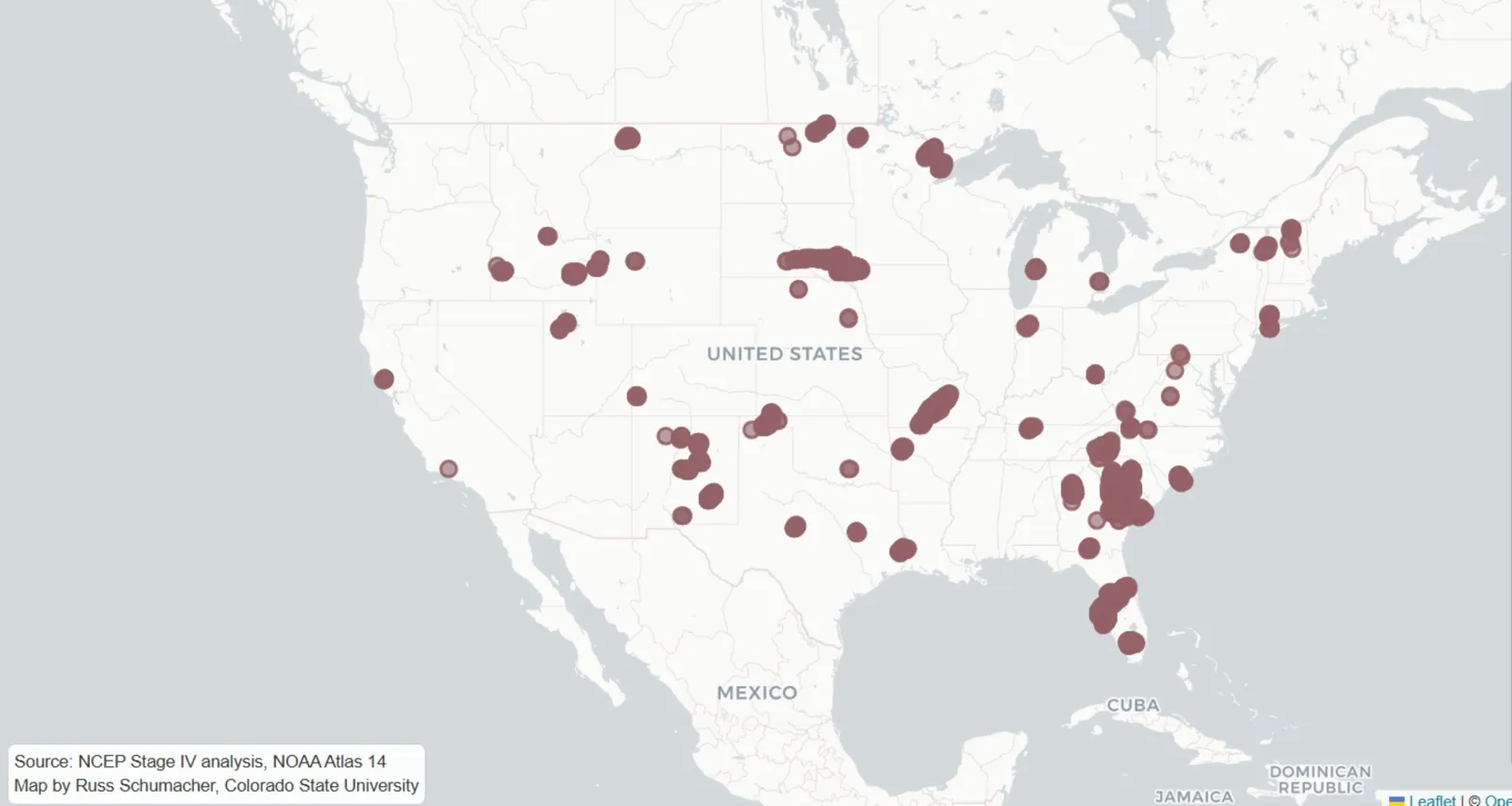
In 2024, dozens of 100-year rainstorms struck the U.S. Each point is marked on the map below, created by Colorado State University. The points marking each event are widespread, with only a few states escaping unscathed.
Last year wasn't a one-time occurrence, either. This year is also "shaping up to be one of the most flood-impacted summers on record in the United States," AccuWeather reported.
...
What Is a 100-Year Flood?
The United States Geological Service (USGS) describes the term "100-year flood" as an attempt "to simplify the definition of a flood that statistically has a 1-percent chance of occurring in any given year."
Where Did 100-Year Rainstorms Hit in 2024?
On the CSU map, countless points pepper the Eastern Seaboard around North Carolina and South Carolina after Hurricane Helene struck in September. Others show the devastating impact of the summer monsoon season in New Mexico, which caused deserts to flood and cars to become stranded as water washed over a highway. Vermont faced catastrophic floods in late July.
Central Texas, known as Flash Flood Alley, experienced several 100-year rainstorms last year, as did Florida, with a scattershot of points dated as occurring during the Atlantic hurricane season.
There was also an onslaught of precipitation that hit South Dakota in June 2024, as well as a similar storm that measured as a 100-year event at several locations in Missouri in November, among others.
Only a few states emerged unscathed, including Iowa, Wisconsin, Oregon, Washington, and Massachusetts, but most of the U.S. experienced some form of severe flooding precipitation last year.
Why Are 100-Year Floods Occurring More Frequently?
The map's creator, Russ Schumacher, a professor of atmospheric sciences at CSU and a CSU climatologist, told Newsweek that improved technology, such as radar, provides better access to data, which can make it seem as if the flood events are happening more frequently. However, he also stressed the impact of climate change.
"The physics of climate change tells us that we should see these extreme events more frequently," he said.
As the atmosphere grows warmer through global warming, its ability to hold moisture increases, DaSilva told Newsweek.
"This is why in the wintertime, we typically don't see too much flash flooding in the wintertime," DaSilva said. "It's too cold, and there's snow, of course, but it's hard to get the moisture content you need for heavy rain events in the wintertime because it's cooler out. In the summertime obviously the temperature is above freezing, but the atmosphere can hold more water content. There's more moisture to squeeze out."
Which States Have Increased Flood Risk?
As the atmosphere's ability to hold moisture increases, DaSilva told Newsweek that states in the Ohio and Tennessee valleys are becoming wetter, while areas like California are becoming drier.
What People Are Saying
AccuWeather meteorologist Alex DaSilva told Newsweek: "When the atmosphere is getting warmer as a whole...essentially what it's doing is making summer warmer and the shoulder seasons warmer as well. What's happening is those seasons, especially in the summertime, the [atmosphere's] ability to hold more moisture is going up as well."
DaSilva added: "It doesn't guarantee we will see more rain over a certain area, but...when it rains, it's going to rain heavier."
The USGS in a webpage about 100-year flood events: "In other words, over the course of 1 million years, these events would be expected to occur 10,000 times. But, just because it rained 10 inches in one day last year doesn't mean it can't rain 10 inches in one day again this year."
What Happens Next
As the probability of heavy rain events increases, people are advised to have a flood plan in place before such an event occurs in their area. People should also never drive on a flooded roadway, as most flood-related deaths occur in vehicles.
View 0 Comments
Submit Correction
View Editorial & AI Guidelines