
10
Loading video...

By Matt Mowers
0
Share
Newsweek is a Trust Project member
See more of our trusted coverage when you search.Prefer Newsweek on Googleto see more of our trusted coverage when you search.
President Donald Trump has done what Washington said couldn't be done. He forced the European Union (EU) to the negotiating table and began dismantling the unfair tariffs and trade restrictions that have disadvantaged American workers and businesses for decades. That's a genuine victory. But while EU diplomats shake hands in Brussels, European regulators are quietly doing everything in their power to make sure American companies can't compete on a level playing field in Europe.
If the EU does not step up as a fair and reciprocal partner, European business leaders will start to feel it in their bottom lines.
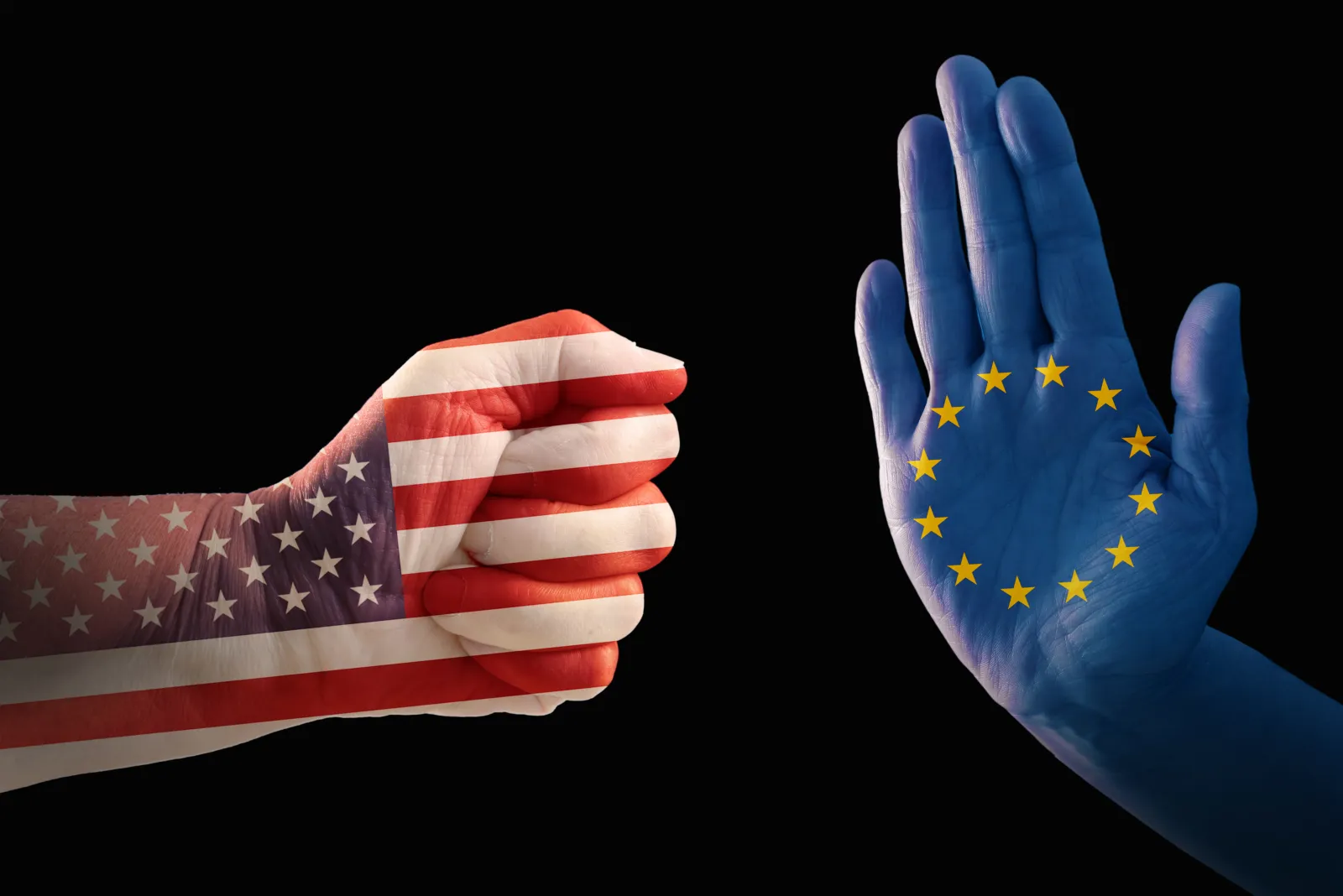
The EU's Digital Markets Act was sold as a procompetition measure. In practice, it has become a regulatory weapon aimed almost exclusively at American technology companies—imposing compliance burdens, operational restrictions, and enforcement exposure that their Chinese and European competitors simply do not face.
Read More on Opinion
The American firms powering Europe's cloud infrastructure, digital payments, and online commerce are already subject to strict European regulatory regimes. Adding another layer of regulations and oversight isn't protecting competition. It's freeloading on American innovation while engineering a system that ensures American companies bear costs that no other competitor does.
...
That contradiction might be easier to ignore if European companies weren't simultaneously building their most important growth stories on American soil, with American consumers, and under the protection of American regulatory goodwill. But they are. And nowhere is that exposure more glaring than in the health care and pharmaceutical sector.
Consider Novo Nordisk. The Danish pharmaceutical giant has become one of the most valuable companies in Europe, largely on the back of two drugs: Ozempic and Wegovy. Those drugs are, for all practical purposes, American products. The United States accounts for around 60 percent of Novo Nordisk's global obesity drug sales, and Americans pay five to fifteen times more for their GLP-1 products than their European counterparts. The company's extraordinary valuation is built on U.S. pricing, U.S. volume, and U.S. market access. Its shareholders should be asking a direct question of their leadership: why is the European Commission picking a fight with the country that made us rich?
The same question applies across the sector. GSK, Roche, and Sanofi have each made explicit, multibillion-dollar commitments to U.S. manufacturing and research infrastructure because they understand the unmatched advantages of operating in the American market—its scale, its innovation ecosystem, its regulatory pathways, and its unrivaled capacity to reward bold investment. GSK has pledged $30 billion in U.S. drug manufacturing and R&D over five years. Roche committed $50 billion to U.S. expansion. These are strategic bets on the world's most dynamic business environment.
These companies understand something that European regulators apparently do not: the American market is not guaranteed. The goodwill that makes U.S. regulatory approvals accessible, that keeps trade lanes open, and that allows European multinationals to operate as quasi-domestic players in the world's largest economy—that goodwill is a function of the broader trans-Atlantic relationship. And the EU is burning through it.
President Trump is winning at the trade table. But a deal is only as good as its enforcement. European institutions believe they can sign trade agreements with the United States while simultaneously running a shadow trade war through regulatory enforcement—targeting American technology companies with compliance regimes designed not to protect consumers, but to protect European markets from American competition. It is naive to assume that signal goes unnoticed in Washington, or that its consequences stay contained to the tech sector. Trade policy is not modular. When one set of American industries is treated as fair game, every industry pays attention.
European pharmaceutical executives have real standing, credibility, and financial stakes in this fight. They have built their companies' futures on the assumption that the U.S. market will remain open and that the trans-Atlantic relationship will remain functional. That assumption is now at risk.
Last week, U.S. lawmakers sent a letter to President Trump urging him to take necessary action to defend American interests and demand a fair and reciprocal relationship with the EU. That includes using all available tools, including Section 301 tariffs, to ensure the EU does not succeed in pushing an anti-American regime.
The EU should not confuse American restraint with American indifference. Using regulation as a backdoor trade barrier has a cost—and when the United States decides to collect, European companies will be the ones paying it.
President Trump has made clear the era of one-sided trade is over. The EU would be wise to make sure its regulators got the memo.
Matt Mower is founding board member of the EU-US Forum and former State Department official.
The views expressed in this article are the writer's own.
View 0 Comments
Submit Correction
View Editorial & AI Guidelines